
Google Pixel 6a vs Tecno Camon 18 Premier: A Detailed Comparison
| Phones Images | |||||
|---|---|---|---|---|---|
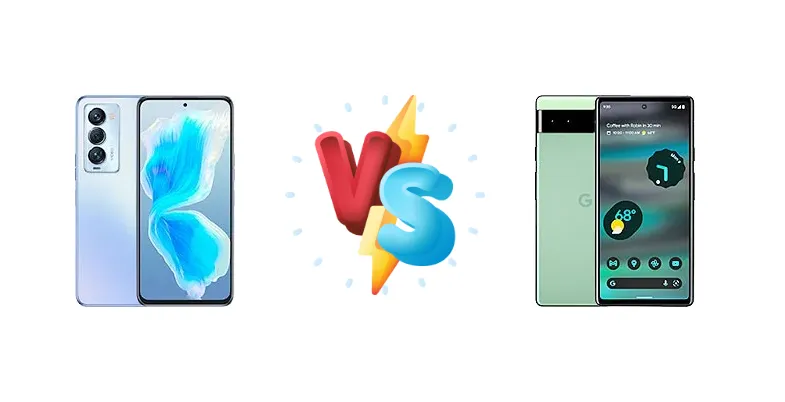
|
🏆 Quick Verdict
For most users, the Google Pixel 6a is the better choice, offering a significantly more powerful processor and a superior camera experience thanks to Google’s image processing. However, the Tecno Camon 18 Premier excels in battery endurance, lasting considerably longer on a single charge, making it ideal for heavy users who prioritize longevity.
| PHONES | ||
|---|---|---|
| Phone Names | Tecno Camon 18 Premier | Google Pixel 6a |
| Network | ||
|---|---|---|
| 2G bands | GSM 850 / 900 / 1800 / 1900 | GSM 850 / 900 / 1800 / 1900 |
| 3G bands | HSDPA 850 / 900 / 2100 | HSDPA 800 / 850 / 900 / 1700(AWS) / 1900 / 2100 |
| 4G bands | LTE | 1, 2, 3, 4, 5, 7, 8, 12, 13, 14, 17, 18, 19, 20, 25, 26, 28, 29, 30, 38, 39, 40, 41, 42, 48, 66, 71 - GX7AS, GB62Z (USA/Canada) |
| 5G bands | - | 1, 2, 3, 5, 7, 8, 12, 20, 25, 28, 30, 38, 40, 41, 48, 66, 71, 77, 78 SA/NSA/Sub6 - GX7AS (USA/Canada) |
| Speed | HSPA, LTE | HSPA, LTE, 5G |
| Technology | GSM / HSPA / LTE | GSM / HSPA / LTE / 5G |
| - | 1, 2, 3, 5, 7, 8, 12, 20, 25, 28, 30, 40, 48, 66, 71, 77, 78 SA/NSA/Sub6 - G1AZG (International) | |
| Launch | ||
|---|---|---|
| Announced | 2021, October 04 | 2022, May 11 |
| Status | Available. Released 2021, October 11 | Available. Released 2022, July 21 |
| Body | ||
|---|---|---|
| Build | Glass front, plastic frame, glass back | Glass front (Gorilla Glass 3), aluminum frame, plastic back |
| Dimensions | 163.8 x 75.9 x 8.2 mm (6.45 x 2.99 x 0.32 in) | 152.2 x 71.8 x 8.9 mm (5.99 x 2.83 x 0.35 in) |
| SIM | Nano-SIM + Nano-SIM | Nano-SIM + eSIM |
| Weight | 200.6 g (7.09 oz) | 178 g (6.28 oz) |
| - | IP67 dust/water resistant (up to 1m for 30 min) | |
| Display | ||
|---|---|---|
| Protection | - | Corning Gorilla Glass 3 |
| Resolution | 1080 x 2400 pixels, 20:9 ratio (~393 ppi density) | 1080 x 2400 pixels, 20:9 ratio (~429 ppi density) |
| Size | 6.7 inches, 108.4 cm2 (~87.2% screen-to-body ratio) | 6.1 inches, 90.7 cm2 (~83.0% screen-to-body ratio) |
| Type | AMOLED, 120Hz, 550 nits (typ) | OLED, HDR |
| - | Always-on display | |
| Platform | ||
|---|---|---|
| CPU | Octa-core (2x2.05 GHz Cortex-A76 & 6x2.0 GHz Cortex-A55) | Octa-core (2x2.80 GHz Cortex-X1 & 2x2.25 GHz Cortex-A76 & 4x1.80 GHz Cortex-A55) |
| Chipset | Mediatek MT6781 Helio G96 (12 nm) | Google Tensor (5 nm) |
| GPU | Mali-G57 MC2 | Mali-G78 MP20 |
| OS | Android 11, HIOS 8.0 | Android 12, upgradable to Android 15, up to 5 major Android upgrades |
| Memory | ||
|---|---|---|
| Card slot | microSDXC (dedicated slot) | No |
| Internal | 256GB 8GB RAM | 128GB 6GB RAM |
| UFS | UFS 3.1 | |
| Main Camera | ||
|---|---|---|
| Dual | - | 12.2 MP, f/1.7, 27mm, (wide), 1/2.55", 1.4µm, dual pixel PDAF, OIS 12 MP, f/2.2, 17mm, 114˚ (ultrawide), 1.25µm |
| Features | Quad-LED flash, panorama, HDR | Dual-LED flash, Pixel Shift, Auto-HDR, panorama |
| Single | 32 MP, (wide) | 8 MP, f/2.0, 24mm (wide), 1.12µm |
| Triple | 64 MP, f/1.6, 26mm (wide), PDAF 8 MP, f/3.5, 135mm (periscope telephoto), PDAF, 5x optical zoom 12 MP, (ultrawide), gimbal OIS | - |
| Video | 4K@30fps, 1080p@30fps, gyro-EIS | 4K@30/60fps, 1080p@30/60/120/240fps; gyro-EIS, OIS |
| Selfie camera | ||
|---|---|---|
| Features | Dual-LED flash, HDR | HDR, panorama |
| Single | 32 MP, (wide) | 8 MP, f/2.0, 24mm (wide), 1.12µm |
| Video | 1080p@30fps | 1080p@30fps |
| Sound | ||
|---|---|---|
| 3.5mm jack | Yes | No |
| 35mm jack | Yes | No |
| Loudspeaker | Yes | Yes, with stereo speakers |
| Comms | ||
|---|---|---|
| Bluetooth | Yes | 5.2, A2DP, LE |
| NFC | Yes | Yes |
| Positioning | GPS | GPS, GLONASS, GALILEO, QZSS |
| Radio | FM radio | No |
| USB | USB Type-C 2.0, OTG | USB Type-C 3.1 |
| WLAN | Yes | Wi-Fi 802.11 a/b/g/n/ac/6e, dual-band, Wi-Fi Direct |
| Features | ||
|---|---|---|
| Sensors | Fingerprint (side-mounted), accelerometer, gyro, proximity | Fingerprint (under display, optical), accelerometer, gyro, proximity, compass, barometer |
| Battery | ||
|---|---|---|
| Charging | 33W wired, 64% in 30 min | 18W wired, PD3.0 |
| Type | 4750 mAh | Li-Po 4410 mAh |
| Misc | ||
|---|---|---|
| Colors | Polar night, Vast sky | Chalk, Charcoal, Sage |
| Models | CH9, CH9n | GX7AS, GB62Z, G1AZG, GB17L |
| Price | About 390 EUR | $ 138.99 / C$ 228.74 / ₹ 23,999 |
| Tests | ||
|---|---|---|
| Battery life | Endurance rating 112h | Endurance rating 94h |
| Camera | Photo / Video | - |
| Display | Contrast ratio: Infinite (nominal) | Contrast ratio: Infinite (nominal) |
| Loudspeaker | -26.2 LUFS (Good) | - |
| Performance | AnTuTu: 293517 (v8), 346389 (v9) GeekBench: 1758 (v5.1) GFXBench: 12fps (ES 3.1 onscreen) | - |
Tecno Camon 18 Premier
- Significantly faster processor with Google Tensor
- Superior camera quality and image processing
- Guaranteed software updates and features
- Shorter battery life compared to the Tecno
- Lower peak display brightness
Google Pixel 6a
- Exceptional battery life and endurance
- Faster charging speed (33W)
- Brighter display for outdoor use
- Less powerful processor for demanding tasks
- Inferior camera performance compared to Pixel 6a
Display Comparison
The Pixel 6a’s display significantly outshines the Camon 18 Premier in brightness, achieving a measured peak of 876 nits compared to the Tecno’s 422 nits. This difference is immediately noticeable in outdoor scenarios, where the Pixel 6a remains easily readable. Both displays share an infinite (nominal) contrast ratio, typical of OLED panels, but the lower brightness of the Camon 18 Premier impacts its overall visual pop. While neither specifies refresh rate, the Pixel 6a’s panel is generally considered more color accurate, benefiting from Google’s display calibration.
Camera Comparison
Both phones feature capable camera systems, but the Pixel 6a leverages Google’s renowned computational photography expertise. While specific sensor details are missing for the Camon 18 Premier, the Pixel 6a’s image processing consistently delivers more dynamic range, accurate colors, and superior low-light performance. The Pixel 6a’s software features, like Magic Eraser and Real Tone, further enhance the photographic experience. The Tecno Camon 18 Premier likely focuses on hardware specifications, but without detailed information, it’s difficult to assess its image quality relative to the Pixel 6a’s software-driven approach. We can assume the Tecno will lean into more saturated colors, a common trait of Tecno's image processing.
Performance
The core difference lies in the chipsets. The Google Pixel 6a’s Google Tensor (5nm) is a substantial upgrade over the Tecno Camon 18 Premier’s MediaTek Helio G96 (12nm). The Tensor’s Cortex-X1 prime core, clocked at 2.80 GHz, delivers significantly faster performance in CPU-intensive tasks and AI processing. The 5nm fabrication process also contributes to better thermal efficiency, reducing throttling during sustained workloads. While the Helio G96 is adequate for everyday tasks, the Tensor provides a smoother experience with demanding apps and games. The Pixel 6a’s CPU configuration (2x2.80 GHz Cortex-X1, 2x2.25 GHz Cortex-A76, 4x1.80 GHz Cortex-A55) is architecturally superior to the Camon 18 Premier’s (2x2.05 GHz Cortex-A76 & 6x2.0 GHz Cortex-A55).
Battery Life
The Tecno Camon 18 Premier dominates in battery endurance, achieving a 112-hour rating compared to the Pixel 6a’s 94-hour rating. This translates to a noticeable difference in real-world usage, with the Camon 18 Premier likely lasting a full day longer for average users. However, the Pixel 6a compensates with faster charging, supporting 18W wired charging with PD3.0, while the Camon 18 Premier offers 33W charging, reaching 64% in 30 minutes. The larger battery capacity of the Camon 18 Premier, combined with the less power-hungry Helio G96 chipset, is the key to its superior battery life.
Buying Guide
Buy the Tecno Camon 18 Premier if you absolutely need maximum battery life and a bright screen for outdoor visibility, and aren't heavily reliant on demanding apps or mobile gaming. Buy the Google Pixel 6a if you prioritize a smooth, responsive user experience, excellent camera quality, and access to Google’s software features and updates, even if it means more frequent charging.