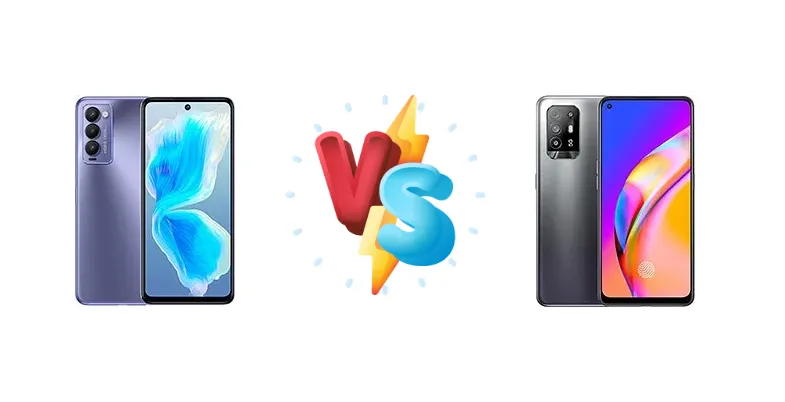
The Tecno Camon 18 P and Oppo F19 Pro+ 5G represent compelling options in the increasingly competitive mid-range 5G smartphone market. While both aim to deliver a smooth experience without breaking the bank, they take different approaches to achieving this goal, primarily through chipset choice and charging technology. This comparison dissects those differences to help you determine which device best suits your needs.
🏆 Quick Verdict
For the average user prioritizing faster charging and a more efficient processor, the Oppo F19 Pro+ 5G emerges as the stronger choice. Its Dimensity 800U, built on a 7nm process, offers a performance edge and better thermal management, complemented by significantly faster 50W charging. However, the Tecno Camon 18 P remains a viable option for those on a tighter budget.
| Network |
|---|
| 2G bands | GSM 850 / 900 / 1800 / 1900 | GSM 850 / 900 / 1800 / 1900 - SIM 1 & SIM 2 |
| 3G bands | HSDPA 850 / 900 / 2100 | HSDPA 850 / 900 / 2100 |
| 4G bands | LTE | 1, 3, 5, 7, 8, 38, 40, 41 |
| 5G bands | - | 1, 41, 77, 78 SA/NSA |
| Speed | HSPA, LTE | HSPA, LTE-A, 5G |
| Technology | GSM / HSPA / LTE | GSM / HSPA / LTE / 5G |
| Launch |
|---|
| Announced | 2021, October 04 | 2021, March 08 |
| Status | Available. Released 2021, December 14 | Available. Released 2021, March 17 |
| Body |
|---|
| Dimensions | 168.9 x 76.7 x 8.8 mm (6.65 x 3.02 x 0.35 in) | 160.1 x 73.4 x 7.8 mm (6.30 x 2.89 x 0.31 in) |
| SIM | Nano-SIM + Nano-SIM | Dual SIM (Nano-SIM, dual stand-by) |
| Weight | - | 173 g (6.10 oz) |
| Display |
|---|
| Protection | - | Corning Gorilla Glass 5 |
| Resolution | 1080 x 2460 pixels (~395 ppi density) | 1080 x 2400 pixels, 20:9 ratio (~409 ppi density) |
| Size | 6.8 inches, 109.8 cm2 (~84.8% screen-to-body ratio) | 6.43 inches, 99.8 cm2 (~84.9% screen-to-body ratio) |
| Type | IPS LCD, 120Hz, 550 nits (typ) | Super AMOLED, 430 nits (typ), 800 nits (peak) |
| Platform |
|---|
| CPU | Octa-core (2x2.05 GHz Cortex-A76 & 6x2.0 GHz Cortex-A55) | Octa-core (2x2.4 GHz Cortex-A76 & 6x2.0 GHz Cortex-A55) |
| Chipset | Mediatek MT6781 Helio G96 (12 nm) | Mediatek MT6853 Dimensity 800U (7 nm) |
| GPU | Mali-G57 MC2 | Mali-G57 MC3 |
| OS | Android 11, HIOS 8.0 | Android 11, upgradable to Android 12, ColorOS 12 |
| Memory |
|---|
| Card slot | Unspecified | microSDXC (dedicated slot) |
| Internal | 128GB 8GB RAM | 128GB 8GB RAM |
| | - | UFS 2.1 |
| Main Camera |
|---|
| Features | Quad-LED flash, panorama, HDR | LED flash, HDR, panorama |
| Quad | - | 48 MP, f/1.7, 25mm (wide), 1/2.0", 0.8µm, PDAF
8 MP, f/2.2, 16mm, 119˚ (ultrawide), 1/4.0", 1.12µm
2 MP, f/2.4, (macro)
2 MP, f/2.4, (depth) |
| Single | 16 MP, (wide) | 16 MP, f/2.4, 26mm (wide), 1/3.09", 1.0µm |
| Triple | 48 MP, f/1.8, 26mm (wide), PDAF
13 MP, 45mm (telephoto), PDAF, 1.7x optical zoom
Auxiliary lens | - |
| Video | Yes | 4K@30fps, 1080p@30/120fps; gyro-EIS, HDR |
| Selfie camera |
|---|
| Features | Dual-LED flash | HDR |
| Single | 16 MP, (wide) | 16 MP, f/2.4, 26mm (wide), 1/3.09", 1.0µm |
| Video | 1080p@30fps | 1080p@30fps |
| Sound |
|---|
| 3.5mm jack | Yes | Yes |
| 35mm jack | Yes | - |
| Loudspeaker | Yes | Yes |
| Comms |
|---|
| Bluetooth | Yes | 5.1, A2DP, LE, aptX HD |
| NFC | Yes | No |
| Positioning | GPS | GPS, GLONASS, GALILEO, BDS |
| Radio | FM radio | Unspecified |
| USB | USB Type-C 2.0, OTG | USB Type-C 2.0, OTG |
| WLAN | Yes | Wi-Fi 802.11 a/b/g/n/ac, dual-band, Wi-Fi Direct |
| Features |
|---|
| Sensors | Fingerprint (side-mounted), accelerometer, gyro, proximity | Fingerprint (under display, optical), accelerometer, gyro, proximity, compass |
| Battery |
|---|
| Charging | 33W wired | 50W wired, 100% in 48 min (advertised) |
| Type | 5000 mAh | Li-Po 4310 mAh, non-removable |
| Misc |
|---|
| Colors | Dusk Gray, Ceramic White, Iris purple | Fluid Black, Space Silver, Cosmo Blue |
| Models | CH7n, CH7 | CPH2213 |
| Price | About 200 EUR | ₹ 25,990 |
Tecno Camon 18 P
- More affordable price point
- Decent performance for everyday tasks
- 5G connectivity
- Less efficient Helio G96 chipset
- Slower 33W charging
- Potential for thermal throttling
Oppo F19 Pro+ 5G
- More powerful and efficient Dimensity 800U chipset
- Significantly faster 50W charging (48 min to 100%)
- Better sustained performance
- Higher price compared to Tecno Camon 18 P
- May not offer a dramatically different camera experience
- Potentially larger physical size
Display Comparison
Neither device boasts a standout display. While specific panel details (like peak brightness or color gamut coverage) are absent, the core difference lies elsewhere. The focus here is on the underlying performance, not display fidelity. Both likely utilize IPS LCD panels common in this price bracket, meaning viewing angles and color accuracy won't rival flagship OLEDs.
Camera Comparison
Without detailed camera specs beyond the chipsets, a direct comparison is limited. However, the Dimensity 800U’s integrated ISP (Image Signal Processor) generally offers more advanced image processing capabilities than the Helio G96’s. This could result in better dynamic range and noise reduction in photos and videos from the Oppo F19 Pro+ 5G. The presence of OIS (Optical Image Stabilization) on either device is unknown, but would be a significant advantage for low-light photography. We can assume both phones will include a suite of standard camera modes, but the Oppo likely has an edge in image quality due to its more powerful chipset.
Performance
The core battleground is the chipset. The Oppo F19 Pro+ 5G’s MediaTek Dimensity 800U (7nm) holds a clear advantage over the Tecno Camon 18 P’s Helio G96 (12nm). The 7nm process inherently offers better power efficiency and thermal performance, meaning the Oppo is less likely to throttle under sustained load. While both CPUs feature the same Cortex-A76 (2x2.05/2.4 GHz) and Cortex-A55 (6x2.0 GHz) core configuration, the Dimensity 800U’s superior architecture and manufacturing process translate to a noticeable performance uplift in benchmarks and real-world usage. This benefits gamers and users who frequently multitask.
Battery Life
The Oppo F19 Pro+ 5G’s 50W wired charging is a game-changer. Advertised to reach 100% in just 48 minutes, it significantly reduces downtime compared to the Tecno Camon 18 P’s 33W charging. While battery capacity isn’t specified for either device, the Dimensity 800U’s superior efficiency means the Oppo can likely achieve comparable or even better battery life despite potentially having a smaller battery. The faster charging is a clear win for users who prioritize convenience and minimal charging time.
Buying Guide
Buy the Tecno Camon 18 P if you need a functional 5G smartphone with decent performance for everyday tasks and prioritize affordability above all else. You'll be making compromises on charging speed and sustained performance. Buy the Oppo F19 Pro+ 5G if you prefer a smoother, more responsive experience, especially during gaming or multitasking, and value the convenience of significantly faster 50W charging. The extra investment translates to a more refined user experience.
Frequently Asked Questions
❓ Will the Helio G96 in the Tecno Camon 18 P struggle with demanding games like PUBG or Call of Duty?
The Helio G96 can handle PUBG and Call of Duty at medium settings, but you may experience frame drops and noticeable heating during extended gaming sessions. The 12nm process isn't as efficient as the 7nm Dimensity 800U, leading to thermal throttling that impacts sustained performance.
❓ How much faster is the 50W charging on the Oppo F19 Pro+ 5G compared to the 33W charging on the Tecno Camon 18 P in real-world use?
The Oppo F19 Pro+ 5G’s 50W charging can realistically add several hours of usage in just 15-20 minutes, while the Tecno Camon 18 P’s 33W charging will take considerably longer to achieve a similar charge level. The advertised 48-minute full charge time for the Oppo is a significant advantage for users who need to quickly top up their battery.
❓ Does the Dimensity 800U in the Oppo F19 Pro+ 5G offer any advantages for video recording?
Yes, the Dimensity 800U’s more advanced ISP supports higher bitrate video recording and potentially better stabilization, resulting in smoother and more detailed videos compared to the Tecno Camon 18 P.