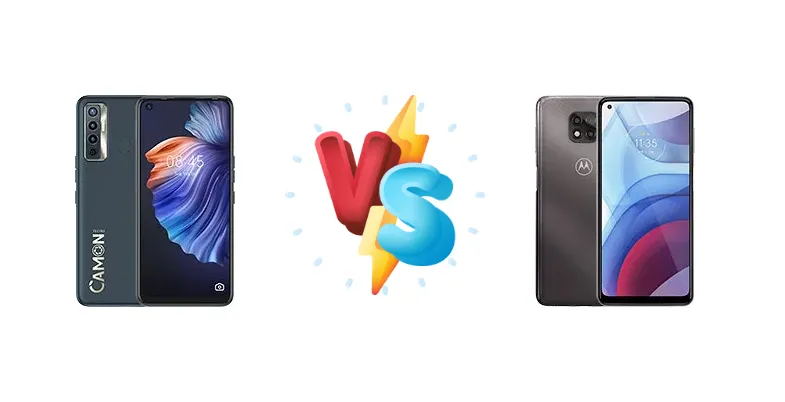
The Tecno Camon 17 and Motorola Moto G Power (2021) represent compelling options in the crowded sub-$200 smartphone market. While both aim to deliver essential features at an accessible price, they take different approaches to achieving this. The Camon 17 prioritizes processing power with its Mediatek Helio G85, while the Moto G Power focuses on maximizing battery life with a more efficient Snapdragon 662. This comparison dissects these key differences to determine which device best suits your needs.
🏆 Quick Verdict
For users prioritizing gaming and occasional multitasking, the Tecno Camon 17 offers a slight edge in performance thanks to its Helio G85 chipset. However, the Motorola Moto G Power (2021) is the better choice for those who value long-lasting battery life and consistent, reliable performance for everyday tasks.
| Network |
|---|
| 2G bands | GSM 850 / 900 / 1800 / 1900 | GSM 850 / 900 / 1800 / 1900 |
| 3G bands | HSDPA 900 / 2100 | HSDPA 850 / 900 / 1700(AWS) / 1900 / 2100 |
| 4G bands | LTE | 1, 2, 3, 4, 5, 7, 8, 12, 13, 14, 17, 25, 26, 29, 30, 38, 41, 66, 71 |
| Speed | HSPA, LTE | HSPA, LTE |
| Technology | GSM / HSPA / LTE | GSM / CDMA / HSPA / EVDO / LTE |
| | - | CDMA2000 1xEV-DO |
| Launch |
|---|
| Announced | 2021, May 08 | 2021, January 08 |
| Status | Available. Released 2021, May 22 | Available. Released 2021, January 14 |
| Body |
|---|
| Build | - | Glass front, plastic back, plastic frame |
| Dimensions | 164.5 x 76.5 x 9 mm (6.48 x 3.01 x 0.35 in) | 165.3 x 75.9 x 9.5 mm (6.51 x 2.99 x 0.37 in) |
| SIM | Nano-SIM + Nano-SIM | Nano-SIM |
| Weight | - | 206.5 g (7.30 oz) |
| | - | Water-repellent coating |
| Display |
|---|
| Resolution | 720 x 1600 pixels, 20:9 ratio (~266 ppi density) | 720 x 1600 pixels, 20:9 ratio (~266 ppi density) |
| Size | 6.6 inches, 105.2 cm2 (~83.6% screen-to-body ratio) | 6.6 inches, 105.2 cm2 (~83.8% screen-to-body ratio) |
| Type | IPS LCD, 90Hz, 450 nits (HBM) | IPS LCD |
| Platform |
|---|
| CPU | Octa-core (2x2.0 GHz Cortex-A75 & 6x1.8 GHz Cortex-A55) | Octa-core (4x2.0 GHz Kryo 260 Gold & 4x1.8 GHz Kryo 260 Silver) |
| Chipset | Mediatek MT6769Z Helio G85 (12 nm) | Qualcomm SM6115 Snapdragon 662 (11 nm) |
| GPU | Mali-G52 MC2 | Adreno 610 |
| OS | Android 11, HIOS 7.6 | Android 10 |
| Memory |
|---|
| Card slot | Unspecified | microSDXC (dedicated slot) |
| Internal | 128GB 4GB RAM, 128GB 6GB RAM | 32GB 3GB RAM, 64GB 4GB RAM |
| | - | eMMC 5.1 |
| Main Camera |
|---|
| Features | Quad-LED flash, panorama, HDR | LED flash, HDR, panorama |
| Single | 16 MP | - |
| Triple | 48 MP, (wide), PDAF
Auxiliary lenses | 48 MP, f/1.7, (wide), 1/2.0", 0.8µm, PDAF
2 MP (macro)
Auxiliary lens |
| Video | 1080p@30fps | 1080p@30/60fps, gyro-EIS |
| Selfie camera |
|---|
| Features | Dual-LED flash | HDR |
| Single | 16 MP | 8 MP, f/2.0, 1.12µm |
| Video | 1080p@30fps | 1080p@30fps, gyro-EIS |
| Sound |
|---|
| 3.5mm jack | Yes | Yes |
| 35mm jack | Yes | Yes |
| Loudspeaker | Yes | Yes |
| Comms |
|---|
| Bluetooth | Yes | 5.0, A2DP, LE |
| NFC | No | No |
| Positioning | GPS | GPS, GLONASS, GALILEO |
| Radio | FM radio | FM radio |
| USB | Yes | USB Type-C 2.0 |
| WLAN | Yes | Wi-Fi 802.11 a/b/g/n/ac, dual-band, Wi-Fi Direct |
| Features |
|---|
| Sensors | Fingerprint (rear-mounted), accelerometer, proximity | Fingerprint (side-mounted), accelerometer, gyro, proximity, compass, barometer |
| Battery |
|---|
| Charging | 18W wired | 15W wired |
| Type | 5000 mAh | Li-Po 5000 mAh |
| Misc |
|---|
| Colors | Frost Sliver, Deep Sea, Tranquil Green | Flash Gray, Polar Silver |
| Models | CG6, CG6j | - |
| Price | About 160 EUR | About 60 EUR |
Tecno Camon 17
- Potentially better gaming performance due to Helio G85’s CPU architecture.
- Slightly faster 18W charging.
- May offer more RAM options (depending on configuration).
- Likely shorter battery life due to the less efficient Helio G85.
- Potential for more thermal throttling under sustained load.
Motorola Moto G Power (2021)
- Superior battery life thanks to the Snapdragon 662’s efficiency.
- More consistent performance for everyday tasks.
- Reliable image processing from the Snapdragon ISP.
- Less powerful CPU for demanding games and applications.
- Slower 15W charging.
Display Comparison
Neither device boasts a standout display. Both likely utilize LCD panels, common in this price bracket. The core difference lies under the hood: the Tecno Camon 17’s Helio G85 may require more power to drive the display, potentially impacting battery life. While specific brightness data is unavailable, the Moto G Power’s Snapdragon 662’s 11nm process could contribute to slightly better power efficiency in display operation. Bezels are expected to be similar on both, and color accuracy will likely be standard for the segment.
Camera Comparison
Without detailed camera specs beyond the chipsets, a direct comparison is difficult. Both phones likely feature a primary camera and multiple secondary sensors (often 2MP macro/depth lenses of limited utility). The image signal processor (ISP) within the Snapdragon 662 is generally known for its reliable image processing, prioritizing accurate colors and good dynamic range. The Helio G85’s ISP is capable, but may lean towards more saturated colors to appeal to a wider audience. The absence of OIS on either device suggests reliance on software stabilization, which can introduce artifacts in low-light conditions.
Performance
The chipset is the defining factor here. The Tecno Camon 17’s Mediatek Helio G85 (12nm) features a more aggressive CPU core configuration – two Cortex-A75 cores clocked at 2.0 GHz alongside six Cortex-A55 cores. This contrasts with the Motorola Moto G Power (2021)’s Qualcomm Snapdragon 662 (11nm) which uses four Kryo 260 Gold cores at 2.0 GHz and four Kryo 260 Silver cores. The 11nm process of the Snapdragon 662 offers a theoretical efficiency advantage, meaning less heat generation and potentially more sustained performance. However, the G85’s core architecture is geared towards bursts of higher performance, making it better suited for gaming. The lack of LPDDR5x RAM information suggests both likely use LPDDR4x, limiting memory bandwidth.
Battery Life
The Motorola Moto G Power (2021) is the clear winner in battery endurance. While the exact mAh capacity isn't provided, Motorola’s ‘Power’ branding historically signifies large batteries. Coupled with the Snapdragon 662’s 11nm efficiency, users can expect multi-day battery life with moderate usage. The Tecno Camon 17’s 18W charging is slightly faster than the Moto G Power’s 15W, but the difference is unlikely to be substantial. The G85’s higher power draw will offset some of the charging speed advantage, meaning a full charge will take a comparable amount of time.
Buying Guide
Buy the Tecno Camon 17 if you frequently play mobile games, edit photos/videos, or need a phone that can handle more demanding applications. Its Helio G85 chipset provides a noticeable performance boost. Buy the Motorola Moto G Power (2021) if your primary concern is battery life and you primarily use your phone for calls, texts, social media, and light web browsing. The Snapdragon 662 offers excellent efficiency, translating to days of use on a single charge.
Frequently Asked Questions
❓ Will the Tecno Camon 17 struggle with graphically intensive games like PUBG Mobile?
While the Helio G85 can handle PUBG Mobile, you may need to lower the graphics settings to achieve a smooth frame rate. The chipset is capable, but it's not a dedicated gaming processor and may exhibit some frame drops during intense battles. Thermal throttling could also become a factor during extended gaming sessions.
❓ How long can I realistically expect the Motorola Moto G Power (2021) to last on a single charge with typical use?
With typical use – including calls, texts, social media, and some web browsing – the Moto G Power (2021) can easily last a full day, and often two days, on a single charge. The Snapdragon 662’s efficiency and the likely large battery capacity contribute to this exceptional battery life.
❓ Are the 2MP macro/depth cameras on either phone worth using?
Generally, 2MP macro and depth cameras on phones in this price range offer limited utility. The image quality from the macro lens is often subpar, and the depth sensor’s impact on portrait mode is minimal. You’re better off relying on the main camera and software processing for portrait shots.