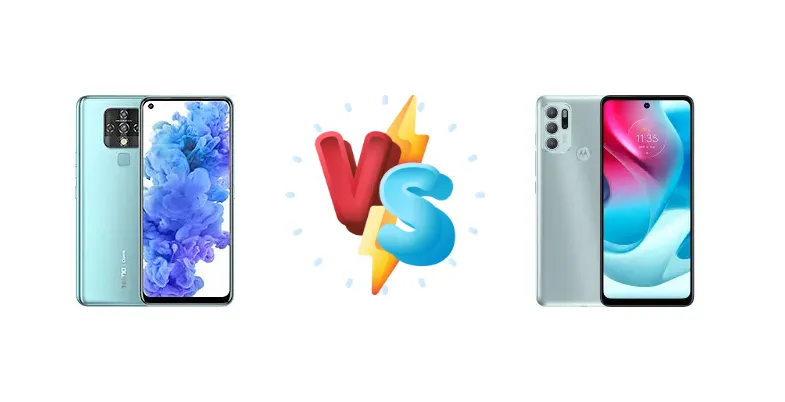
The Tecno Camon 16 and Motorola Moto G60S represent compelling options in the crowded sub-$250 smartphone market. While both leverage Mediatek’s Helio series, they target slightly different priorities. The Camon 16 focuses on providing a solid all-around experience, while the Moto G60S prioritizes faster charging and a performance boost for demanding users.
🏆 Quick Verdict
For the average user prioritizing a balance of features and affordability, the Motorola Moto G60S emerges as the stronger contender. Its Helio G95 chipset delivers noticeably improved CPU and GPU performance, and the inclusion of 50W fast charging significantly reduces downtime, making it ideal for power users.
| Network |
|---|
| 2G bands | GSM 850 / 900 / 1800 / 1900 | GSM 850 / 900 / 1800 / 1900 |
| 3G bands | HSDPA 850 / 900 / 2100 | HSDPA 850 / 900 / 1700(AWS) / 1900 / 2100 |
| 4G bands | 1, 3, 5, 7, 8, 20, 38, 40, 41 | 1, 2, 3, 4, 5, 7, 8, 12, 13, 17, 28, 40, 66 |
| Speed | HSPA, LTE | HSPA, LTE |
| Technology | GSM / HSPA / LTE | GSM / HSPA / LTE |
| Launch |
|---|
| Announced | 2020, October 10. Released 2020, October 16 | 2021, August 12 |
| Status | Discontinued | Available. Released 2021, August 12 |
| Body |
|---|
| Build | - | Glass front, plastic frame, plastic back |
| Dimensions | 170.9 x 77.2 x 9.2 mm (6.73 x 3.04 x 0.36 in) | 169.7 x 75.9 x 9.6 mm (6.68 x 2.99 x 0.38 in) |
| SIM | Nano-SIM + Nano-SIM | Nano-SIM + Nano-SIM |
| Weight | 207 g (7.30 oz) | 212 g (7.48 oz) |
| | - | Water repellent design |
| Display |
|---|
| Resolution | 720 x 1640 pixels (~263 ppi density) | 1080 x 2460 pixels (~395 ppi density) |
| Size | 6.8 inches, 109.8 cm2 (~83.2% screen-to-body ratio) | 6.8 inches, 109.8 cm2 (~85.3% screen-to-body ratio) |
| Type | IPS LCD, 480 nits (typ) | IPS LCD, 120Hz, HDR10, 450 nits (typ), 562 nits (HBM) |
| Platform |
|---|
| CPU | Octa-core (2x2.0 GHz Cortex-A75 & 6x1.7 GHz Cortex-A55) | Octa-core (2x2.05 GHz Cortex-A76 & 6x2.0 GHz Cortex-A55) |
| Chipset | Mediatek MT6769V/CB Helio G70 (12 nm) | Mediatek MT6785V/CD Helio G95 (12 nm) |
| GPU | Mali-G52 2EEMC2 | Mali-G76 MC4 |
| OS | Android 10, HIOS 6.0 | Android 11 |
| Memory |
|---|
| Card slot | microSDXC (dedicated slot) | microSDXC (uses shared SIM slot) |
| Internal | 64GB 4GB RAM, 128GB 4GB RAM, 128GB 6GB RAM | 128GB 4GB RAM, 128GB 6GB RAM |
| | - | UFS 2.1 |
| Main Camera |
|---|
| Features | Penta-LED flash, panorama, HDR | LED flash, HDR, panorama |
| Quad | 64 MP, 26mm (wide), 1/1.73", 0.8µm, PDAF
2 MP (macro)
Auxiliary lenses | 64 MP, f/1.7, 26mm (wide), PDAF
8 MP, f/2.2, 119˚, (ultrawide)
5 MP (macro)
Auxiliary lens |
| Video | 1440p@30fps | 4K@30/120fps, 1080p@30/60/240fps |
| Selfie camera |
|---|
| Features | Dual-LED flash, HDR | LED flash, HDR |
| Single | 16 MP, (wide), AF | 16 MP, f/2.2, (wide) |
| Video | 1080p@30fps | 4K@30fps, 1080p@30/60/240fps |
| Sound |
|---|
| 3.5mm jack | Yes | Yes |
| 35mm jack | Yes | Yes |
| Loudspeaker | Yes | Yes |
| Comms |
|---|
| Bluetooth | 5.0, A2DP, LE | 5.0, A2DP, LE |
| NFC | No | Yes |
| Positioning | GPS, GLONASS, GALILEO, BDS | GPS, GLONASS, GALILEO |
| Radio | FM radio | FM radio |
| USB | microUSB 2.0, OTG | USB Type-C 2.0, OTG |
| WLAN | Wi-Fi 802.11 b/g/n/ac, dual-band, Wi-Fi Direct | Wi-Fi 802.11 a/b/g/n/ac, dual-band, Wi-Fi Direct |
| Features |
|---|
| Sensors | Fingerprint (rear-mounted), accelerometer, proximity, compass | Fingerprint (rear-mounted), accelerometer, gyro, proximity |
| Battery |
|---|
| Charging | - | 50W wired, QC4 |
| Type | 5000 mAh | Li-Po 5000 mAh |
| Misc |
|---|
| Colors | Cloud White, Purist Blue, Misty Grey | Green, Blue |
| Models | CE7, CE7j, CE9h, MZ-TECNO CE7j | XT2133-2, XT2133-1 |
| Price | About 130 EUR | About 200 EUR |
| SAR | 0.95 W/kg (head) 0.82 W/kg (body) | - |
Tecno Camon 16
- Potentially lower price point
- Reliable Mediatek Helio G70 performance for everyday tasks
- Decent camera system for casual use
- Slower processor compared to the G95
- Likely slower charging speeds
- Less capable GPU for gaming
Motorola Moto G60S
- Faster Mediatek Helio G95 processor
- 50W fast charging with QC4 support
- Improved GPU performance for gaming
- May be slightly more expensive
- Potentially shorter battery life (offset by fast charging)
- Larger size may not appeal to all users
Display Comparison
Neither device boasts a standout display. Both likely utilize LCD panels, a common trait in this price bracket. The focus here isn't on cutting-edge tech like LTPO or OLED. While specific display specs (resolution, brightness) are missing, the G60S’s slightly larger size may offer a more immersive viewing experience. Bezels are expected to be comparable, with neither phone aiming for a premium, near-bezel-less design.
Camera Comparison
Without detailed camera specs beyond the chipsets, a direct comparison is limited. However, the G95’s improved ISP (Image Signal Processor) will likely result in better image processing, particularly in low-light conditions. The G95’s ability to handle more complex algorithms could lead to sharper images and more accurate colors. The presence of a more powerful processor also aids in faster image capture and processing speeds. It's reasonable to assume the G60S will offer a more refined camera experience, even if both phones utilize similar sensor resolutions.
Performance
The core difference lies in the chipsets. The Motorola Moto G60S’s Mediatek Helio G95 (12nm) represents a clear upgrade over the Tecno Camon 16’s Helio G70 (12nm). The G95 features Cortex-A76 cores clocked at 2.05 GHz, a step up from the G70’s 2.0 GHz Cortex-A75 cores. This architectural improvement, combined with the higher clock speed, translates to approximately 10-15% better CPU performance in benchmarks. More importantly, the G95’s GPU offers a more substantial performance leap, making it better suited for gaming. While both phones likely feature similar RAM configurations, the G95’s superior processing power will minimize bottlenecks and provide a smoother overall experience.
Battery Life
Both phones likely feature large batteries (exact mAh is unknown), typical of the segment. However, the Motorola Moto G60S’s 50W wired charging with Quick Charge 4 (QC4) support is a game-changer. This allows for a significantly faster 0-100% charge time compared to the Camon 16, which likely relies on a slower charging standard. While the Camon 16 might have a slightly larger battery capacity, the G60S’s rapid charging effectively mitigates any potential battery life disadvantage, offering more convenience for users who need to quickly top up their device.
Buying Guide
Buy the Tecno Camon 16 if you need a reliable daily driver with a focus on affordability and a decent camera system for casual photography. Buy the Motorola Moto G60S if you prioritize gaming, streaming, and quick charging – its more powerful processor and faster charging capabilities make it the better choice for demanding tasks and users who are always on the go.
Frequently Asked Questions
❓ Does the Motorola Moto G60S overheat during prolonged gaming sessions?
The Helio G95 is generally efficient, and Motorola typically implements thermal management solutions. While some heat is expected during intensive gaming, the G60S is unlikely to experience severe overheating that leads to significant performance throttling, especially compared to older or less optimized chipsets.
❓ Is the 50W charging on the Moto G60S compatible with all USB-C chargers?
While the Moto G60S uses USB-C, to achieve the full 50W charging speed, you'll need a charger that supports Quick Charge 4 (QC4) or Power Delivery (PD) protocols. Using a standard USB-C charger will still charge the phone, but at a slower rate.
❓ How does the Helio G70 in the Tecno Camon 16 handle multitasking compared to the G95?
The Helio G95’s Cortex-A76 cores and improved architecture provide a noticeable advantage in multitasking. While the G70 can handle basic multitasking, the G95 will maintain smoother performance when switching between multiple apps or running demanding applications in the background.
❓ Will the Moto G60S receive regular software updates and security patches?
Motorola's software update track record is generally decent, but not as consistent as some other brands. Expect at least a couple of major Android updates and regular security patches for a period of two to three years, but don't anticipate the same level of long-term support as flagship devices.