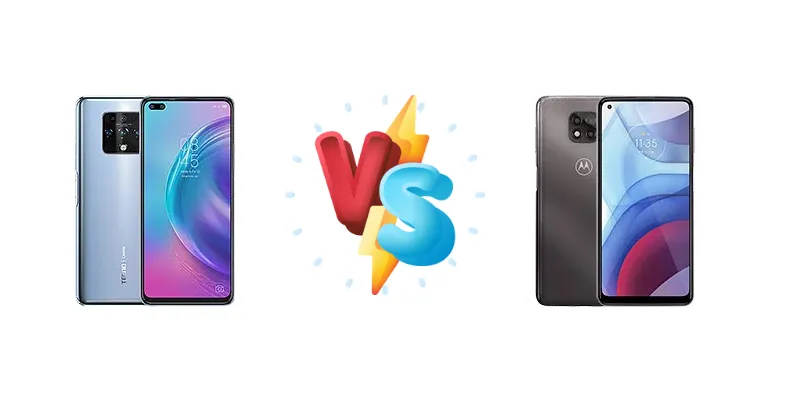
The Tecno Camon 16 Premier and Motorola Moto G Power (2021) represent distinct priorities in the budget smartphone space. The Camon 16 Premier aggressively targets mobile gamers with a powerful chipset and fast charging, while the Moto G Power (2021) doubles down on battery life, aiming for multi-day usage. This comparison dissects these trade-offs to determine which device best suits your needs.
🏆 Quick Verdict
For users prioritizing gaming and quick top-ups, the Tecno Camon 16 Premier is the clear winner. Its Helio G90T chipset delivers significantly more processing power. However, if battery life is paramount and gaming is a secondary concern, the Motorola Moto G Power (2021) offers unmatched endurance.
| Network |
|---|
| 2G bands | GSM 850 / 900 / 1800 / 1900 | GSM 850 / 900 / 1800 / 1900 |
| 3G bands | HSDPA 850 / 900 / 1700(AWS) / 1900 / 2100 | HSDPA 850 / 900 / 1700(AWS) / 1900 / 2100 |
| 4G bands | 1, 3, 5, 7, 8, 20, 38, 40, 41 | 1, 2, 3, 4, 5, 7, 8, 12, 13, 14, 17, 25, 26, 29, 30, 38, 41, 66, 71 |
| Speed | HSPA, LTE | HSPA, LTE |
| Technology | GSM / HSPA / LTE | GSM / CDMA / HSPA / EVDO / LTE |
| | HSDPA 850 / 900 / 2100 - India | CDMA2000 1xEV-DO |
| Launch |
|---|
| Announced | 2020, September 04. Released 2020, September 04 | 2021, January 08 |
| Status | Discontinued | Available. Released 2021, January 14 |
| Body |
|---|
| Build | Glass front, plastic frame, plastic back | Glass front, plastic back, plastic frame |
| Dimensions | 170.6 x 77.2 x 9.1 mm (6.72 x 3.04 x 0.36 in) | 165.3 x 75.9 x 9.5 mm (6.51 x 2.99 x 0.37 in) |
| SIM | Nano-SIM + Nano-SIM | Nano-SIM |
| Weight | 210 g (7.41 oz) | 206.5 g (7.30 oz) |
| | - | Water-repellent coating |
| Display |
|---|
| Resolution | 1080 x 2460 pixels (~392 ppi density) | 720 x 1600 pixels, 20:9 ratio (~266 ppi density) |
| Size | 6.85 inches, 111.4 cm2 (~84.6% screen-to-body ratio) | 6.6 inches, 105.2 cm2 (~83.8% screen-to-body ratio) |
| Type | IPS LCD, 90Hz, HDR10+, 480 nits (typ) | IPS LCD |
| Platform |
|---|
| CPU | Octa-core (2x2.05 GHz Cortex-A76 & 6x2.0 GHz Cortex-A55) | Octa-core (4x2.0 GHz Kryo 260 Gold & 4x1.8 GHz Kryo 260 Silver) |
| Chipset | Mediatek MT6785 Helio G90T (12 nm) | Qualcomm SM6115 Snapdragon 662 (11 nm) |
| GPU | Mali-G76 MC4 | Adreno 610 |
| OS | Android 10, HIOS 6.0 | Android 10 |
| Memory |
|---|
| Card slot | microSDXC (dedicated slot) | microSDXC (dedicated slot) |
| Internal | 128GB 8GB RAM | 32GB 3GB RAM, 64GB 4GB RAM |
| | UFS 2.1 | eMMC 5.1 |
| Main Camera |
|---|
| Features | Penta-LED flash, panorama, HDR | LED flash, HDR, panorama |
| Quad | 64 MP, f/1.9, 26mm (wide), 1/1.73", 0.8µm, PDAF
8 MP, f/2.3, 119˚ (ultrawide), 1/4.0", 1.12µm
2 MP, f/2.4, (dedicated video camera)
Auxiliary lens | - |
| Triple | - | 48 MP, f/1.7, (wide), 1/2.0", 0.8µm, PDAF
2 MP (macro)
Auxiliary lens |
| Video | 4K@30fps, 1080p@30fps, 720p@960fps, gyro-EIS | 1080p@30/60fps, gyro-EIS |
| Selfie camera |
|---|
| Dual | 48 MP, f/2.2, 23mm (wide), 1/2.0", 0.8µm
8 MP, f/2.2, 105˚ (ultrawide), 1/4.0", 1.12µm | - |
| Features | Dual-LED flash, HDR | HDR |
| Single | - | 8 MP, f/2.0, 1.12µm |
| Video | 1080p@30fps | 1080p@30fps, gyro-EIS |
| Sound |
|---|
| 3.5mm jack | Yes | Yes |
| 35mm jack | Yes | Yes |
| Loudspeaker | Yes | Yes |
| Comms |
|---|
| Bluetooth | 5.0, A2DP, LE | 5.0, A2DP, LE |
| NFC | No | No |
| Positioning | GPS | GPS, GLONASS, GALILEO |
| Radio | FM radio | FM radio |
| USB | USB Type-C 2.0, OTG | USB Type-C 2.0 |
| WLAN | Wi-Fi 802.11 a/b/g/n/ac, dual-band, Wi-Fi Direct | Wi-Fi 802.11 a/b/g/n/ac, dual-band, Wi-Fi Direct |
| Features |
|---|
| Sensors | Fingerprint (side-mounted), accelerometer, gyro, proximity, compass | Fingerprint (side-mounted), accelerometer, gyro, proximity, compass, barometer |
| Battery |
|---|
| Charging | 33W wired, 70% in 30 min (International)
18W wired (India) | 15W wired |
| Type | 4500 mAh | Li-Po 5000 mAh |
| Misc |
|---|
| Colors | Glacial Silver | Flash Gray, Polar Silver |
| Models | CE9, CD6j | - |
| Price | About 230 EUR | About 60 EUR |
| SAR | 1.25 W/kg (head) 0.88 W/kg (body) | - |
| Tests |
|---|
| Battery life | Endurance rating 118h | - |
| Camera |
Photo / Video | - |
| Display |
Contrast ratio: 1896:1 (nominal) | - |
| Loudspeaker |
-28.1 LUFS (Average) | - |
| Performance |
AnTuTu: 283847 (v8)
GeekBench: 6692 (v4.4), 1672 (v5.1)
GFXBench: 15fps (ES 3.1 onscreen) | - |
Tecno Camon 16 Premier
- Faster processor for gaming and demanding apps
- 33W fast charging (in select regions)
- Higher contrast ratio for a more vibrant display
- Less efficient chipset leading to potentially shorter battery life
- Charging speed varies by region (18W in India)
Motorola Moto G Power (2021)
- Exceptional battery life for multi-day usage
- More efficient processor for longer runtimes
- Generally more affordable
- Significantly less powerful processor for gaming
- Slower 15W charging
Display Comparison
The Tecno Camon 16 Premier boasts a contrast ratio of 1896:1, suggesting decent black levels, and a measured peak brightness of 400 nits. While adequate for indoor use, this is a standard brightness level. The Moto G Power (2021)'s display specifications are not provided, but Motorola typically focuses on maximizing screen size and efficiency rather than peak brightness or contrast in this segment. The Camon 16 Premier's contrast ratio offers a more visually dynamic experience, but the Moto G Power likely prioritizes power efficiency in its display panel.
Camera Comparison
Both phones feature 'Photo / Video' capabilities, but detailed camera specifications are limited. Without sensor size or aperture information, a direct comparison is difficult. However, the Camon 16 Premier's focus on overall features suggests a more robust camera system aimed at social media sharing and casual photography. The Moto G Power (2021) likely prioritizes a reliable, functional camera for everyday snapshots. The absence of details on either phone suggests neither is positioned as a camera-centric device.
Performance
The core difference lies in the chipsets. The Tecno Camon 16 Premier utilizes the Mediatek Helio G90T (12nm), featuring an octa-core CPU with two high-performance Cortex-A76 cores clocked at 2.05 GHz, paired with six Cortex-A55 cores. This configuration is geared towards gaming. Conversely, the Motorola Moto G Power (2021) employs the Qualcomm Snapdragon 662 (11nm) with its Kryo 260 Gold and Silver cores. While the Snapdragon 662 is a capable chip, its architecture prioritizes efficiency over raw power. The 11nm process node on the Snapdragon 662 is more efficient than the 12nm node on the Helio G90T, but the G90T's core configuration provides a substantial performance advantage in graphically intensive tasks.
Battery Life
The Tecno Camon 16 Premier achieves an endurance rating of 118 hours, a respectable figure. Its 33W wired charging (international markets) is a significant advantage, promising a 70% charge in just 30 minutes. However, India receives a slower 18W charging solution. The Moto G Power (2021) lacks specific endurance ratings, but its namesake suggests a focus on longevity. While it only supports 15W charging, the Snapdragon 662's efficiency and potentially a larger battery capacity (not specified) likely contribute to significantly longer runtimes between charges. The Camon 16 Premier offers faster refueling, while the Moto G Power prioritizes extended usage.
Buying Guide
Buy the Tecno Camon 16 Premier if you need a phone capable of handling demanding games and appreciate the convenience of 33W fast charging. You'll sacrifice some battery longevity for this performance boost. Buy the Motorola Moto G Power (2021) if you prioritize a phone that can reliably last through two or even three days on a single charge, and your usage primarily consists of everyday tasks like browsing, calling, and light social media.
Frequently Asked Questions
❓ Will the Tecno Camon 16 Premier's Helio G90T overheat during extended gaming sessions?
The Helio G90T is known to generate more heat than some competing chipsets. While the Camon 16 Premier's thermal management isn't detailed, prolonged gaming at maximum settings could lead to throttling, reducing performance to manage temperatures. Using a game booster app and avoiding extended sessions in hot environments can help mitigate this.
❓ How long can the Motorola Moto G Power (2021) realistically last on a single charge with moderate use?
With moderate use – including browsing, social media, calls, and occasional video streaming – the Moto G Power (2021) can realistically last two to three days on a single charge. Its Snapdragon 662 chipset and likely larger battery capacity contribute to its exceptional endurance. Heavy gaming or prolonged video playback will reduce this runtime.
❓ Is the 18W charging on the Tecno Camon 16 Premier (India) significantly slower than the 33W version?
Yes, the 18W charging in the Indian market is noticeably slower than the 33W version available in other regions. While still providing a charge, it will take considerably longer to reach 100%, potentially doubling the charging time. This is a key consideration for Indian buyers.