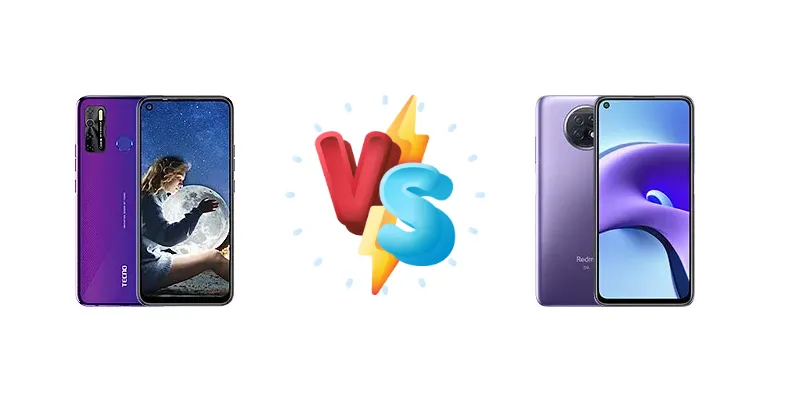
The smartphone market is flooded with options, particularly in the budget and mid-range segments. We're pitting the Xiaomi Redmi Note 9T, a device boasting 5G connectivity and a modern chipset, against the Tecno Camon 15, a more affordable option focused on essential features. This comparison will dissect their key differences to help you determine which phone best suits your needs.
🏆 Quick Verdict
For most users, the Xiaomi Redmi Note 9T is the clear winner. Its Mediatek Dimensity 800U chipset provides a substantial performance leap over the Tecno Camon 15’s Helio P22, making it better suited for gaming, multitasking, and future-proofing. However, the Camon 15 remains a viable option for those on a very tight budget prioritizing basic functionality.
| Network |
|---|
| 2G bands | GSM 850 / 900 / 1800 / 1900 | GSM 850 / 900 / 1800 / 1900 |
| 3G bands | HSDPA 850 / 900 / 2100 | HSDPA 850 / 900 / 1700(AWS) / 1900 / 2100 |
| 4G bands | 1, 3, 5, 8, 38, 40, 41 | 1, 2, 3, 4, 5, 7, 8, 12, 17, 18, 19, 20, 26, 28, 32, 38, 40, 41, 42 |
| 5G bands | - | 1, 3, 5, 7, 8, 20, 28, 38, 41, 77, 78, 79 SA/NSA/Sub6 |
| Speed | HSPA 42.2/5.76 Mbps, LTE Cat4 150/50 Mbps | HSPA, LTE, 5G |
| Technology | GSM / HSPA / LTE | GSM / HSPA / LTE / 5G |
| Launch |
|---|
| Announced | 2020, February 21. Released 2020, February 25 | 2021, January 08 |
| Status | Discontinued | Available. Released 2021, January 18 |
| Body |
|---|
| Build | Glass front, plastic back, plastic frame | Glass front (Gorilla Glass 5), plastic back, plastic frame |
| Dimensions | 164.1 x 76.4 x 8.8 mm (6.46 x 3.01 x 0.35 in) | 161.2 x 77.3 x 9.1 mm (6.35 x 3.04 x 0.36 in) |
| SIM | Nano-SIM + Nano-SIM | Nano-SIM + Nano-SIM |
| Weight | 196 g (6.91 oz) | 199 g (7.02 oz) |
| | - | Water-repellent coating |
| Display |
|---|
| Protection | - | Corning Gorilla Glass 5 |
| Resolution | 720 x 1600 pixels, 20:9 ratio (~266 ppi density) | 1080 x 2340 pixels, 19.5:9 ratio (~395 ppi density) |
| Size | 6.6 inches, 105.2 cm2 (~83.9% screen-to-body ratio) | 6.53 inches, 104.7 cm2 (~84.0% screen-to-body ratio) |
| Type | IPS LCD | IPS LCD, 450 nits (typ) |
| Platform |
|---|
| CPU | Octa-core 2.0 GHz Cortex-A53 | Octa-core (2x2.4 GHz Cortex-A76 & 6x2.0 GHz Cortex-A55) |
| Chipset | Mediatek MT6762 Helio P22 (12 nm) | Mediatek Dimensity 800U (7 nm) |
| GPU | PowerVR GE8320 | Mali-G57 MC3 |
| OS | Android 10, HIOS 6.0 | Android 10, MIUI 12 |
| Memory |
|---|
| Card slot | microSDXC (dedicated slot) | microSDXC (dedicated slot) |
| Internal | 64GB 4GB RAM | 64GB 4GB RAM, 128GB 4GB RAM, 128GB 6GB RAM |
| | eMMC 5.1 | UFS 2.1 - 64GB
UFS 2.2 - 128GB |
| Main Camera |
|---|
| Features | Quad-LED flash, panorama, HDR | LED flash, HDR, panorama |
| Quad | 48 MP, PDAF
2 MP
2 MP
Auxiliary lens | - |
| Triple | - | 48 MP, f/1.8, 26mm (wide), 1/2.0", 0.8µm, PDAF
2 MP (macro)
Auxiliary lens |
| Video | 1080p@30fps | 4K@30fps, 1080p@30/60fps |
| Selfie camera |
|---|
| Features | Dual-LED flash, HDR | - |
| Single | 16 MP | 13 MP, f/2.3, 29mm (standard), 1/3.1", 1.12µm |
| Video | 1080p@30fps | 1080p@30fps |
| Sound |
|---|
| 3.5mm jack | Yes | Yes |
| 35mm jack | Yes | Yes |
| Loudspeaker | Yes | Yes, with stereo speakers |
| | - | 24-bit/192kHz audio |
| Comms |
|---|
| Bluetooth | 5.0, A2DP, LE | 5.1, A2DP, LE |
| Infrared port | - | Yes |
| NFC | No | Yes |
| Positioning | GPS, GLONASS | GPS, GLONASS, GALILEO, BDS |
| Radio | FM radio | FM radio, recording |
| USB | microUSB 2.0, OTG | USB Type-C 2.0 |
| WLAN | Wi-Fi 802.11 b/g/n | Wi-Fi 802.11 a/b/g/n/ac, dual-band, Wi-Fi Direct |
| Features |
|---|
| Sensors | Fingerprint (rear-mounted), accelerometer, proximity | Fingerprint (side-mounted), accelerometer, gyro, proximity, compass |
| Battery |
|---|
| Charging | - | 18W wired, 33% in 30 min |
| Type | 5000 mAh | Li-Po 5000 mAh |
| Misc |
|---|
| Colors | Shoal Gold, Fascinating Purple, Jade | Nightfall Black, Daybreak Purple |
| Models | CD7 | M2007J22G, J22 |
| Price | About 130 EUR | About 130 EUR |
| SAR | 0.80 W/kg (head) 0.82 W/kg (body) | 1.07 W/kg (head) 1.05 W/kg (body) |
| SAR EU | - | 0.59 W/kg (head) 0.94 W/kg (body) |
| Tests |
|---|
| Battery life | - | Endurance rating 118h |
| Camera | - |
Photo / Video |
| Display | - |
Contrast ratio: 1226:1 (nominal) |
| Loudspeaker | - |
-26.3 LUFS (Good) |
| Performance | - |
AnTuTu: 288732 (v8)
GeekBench: 1775 (v5.1) |
Tecno Camon 15
- More affordable price point
- Functional for basic smartphone tasks
- Acceptable battery life
- Significantly weaker performance
- Outdated chipset
- Limited future-proofing
Xiaomi Redmi Note 9T
- Powerful Mediatek Dimensity 800U chipset
- Faster charging (18W with 33% in 30 min)
- 5G connectivity
- Brighter display
- Higher price compared to Camon 15
- May not be ideal for extremely budget-conscious buyers
- IPS LCD panel (no OLED)
Display Comparison
Both devices feature a contrast ratio of 1226:1, suggesting similar visual depth. However, the Redmi Note 9T’s measured peak brightness of 471 nits provides a noticeably brighter viewing experience, especially outdoors, compared to the Camon 15 which lacks published brightness data. While both likely utilize IPS LCD panels, the Redmi Note 9T’s brighter display and potential for better color calibration give it an edge for media consumption.
Camera Comparison
Both phones offer photo and video capabilities, but detailed camera specifications are limited for the Camon 15. The Redmi Note 9T likely benefits from more advanced image processing thanks to its more powerful chipset. Without specific sensor details for the Camon 15, it’s difficult to assess its image quality, but it’s reasonable to assume the Redmi Note 9T will deliver superior results, particularly in low-light conditions. The presence of OIS (Optical Image Stabilization) on the Redmi Note 9T, if equipped, would further enhance its camera performance.
Performance
The performance gap between these two phones is significant. The Xiaomi Redmi Note 9T’s Mediatek Dimensity 800U (7nm) is a far more capable chipset than the Tecno Camon 15’s Mediatek Helio P22 (12nm). The Dimensity 800U features a combination of Cortex-A76 and A55 cores clocked up to 2.4GHz, offering a substantial improvement in CPU performance and GPU capabilities. The Helio P22’s Cortex-A53 cores at 2.0GHz are simply outmatched. This translates to smoother multitasking, faster app loading times, and a much better gaming experience on the Redmi Note 9T. The 7nm process node of the Dimensity 800U also contributes to better power efficiency.
Battery Life
Both devices share an endurance rating of 118 hours, suggesting comparable battery life under similar usage scenarios. However, the Redmi Note 9T’s 18W wired charging capability allows for a 33% charge in just 30 minutes, offering a significant convenience advantage over the Camon 15, whose charging speed is not specified. While both may have similar battery capacities, the Dimensity 800U’s improved power efficiency could contribute to slightly longer real-world usage on the Redmi Note 9T.
Buying Guide
Buy the Tecno Camon 15 if you need a functional smartphone for basic tasks like calls, messaging, and light social media use, and your budget is extremely limited. Buy the Xiaomi Redmi Note 9T if you prioritize performance for gaming, streaming, and demanding apps, and want the benefit of 5G connectivity for future network compatibility. The Note 9T is also the better choice for users who plan to keep their phone for several years.
Frequently Asked Questions
❓ Is the Redmi Note 9T’s Dimensity 800U capable of handling demanding games like PUBG or Call of Duty?
Yes, the Dimensity 800U is a capable chipset for gaming. It can handle PUBG and Call of Duty at medium to high settings with smooth frame rates. While it's not a flagship-level gaming chip, it provides a significantly better gaming experience than the Helio P22 in the Camon 15.
❓ Does the Redmi Note 9T support VoLTE and VoWiFi for improved call quality?
The Redmi Note 9T generally supports VoLTE (Voice over LTE) and VoWiFi (Voice over Wi-Fi) depending on the carrier and region. These technologies provide clearer call quality and faster connection times. Check with your mobile carrier to confirm compatibility in your area.
❓ How does the Helio P22 in the Camon 15 perform with multitasking?
The Helio P22 struggles with heavy multitasking. While it can handle a few apps simultaneously, you'll likely experience slowdowns and lag when switching between multiple demanding applications. It's best suited for running one app at a time.
❓ What type of charging port does each phone use?
Both the Xiaomi Redmi Note 9T and the Tecno Camon 15 utilize a USB-C port for charging and data transfer. This is a modern standard offering faster data transfer speeds and reversible connectivity.