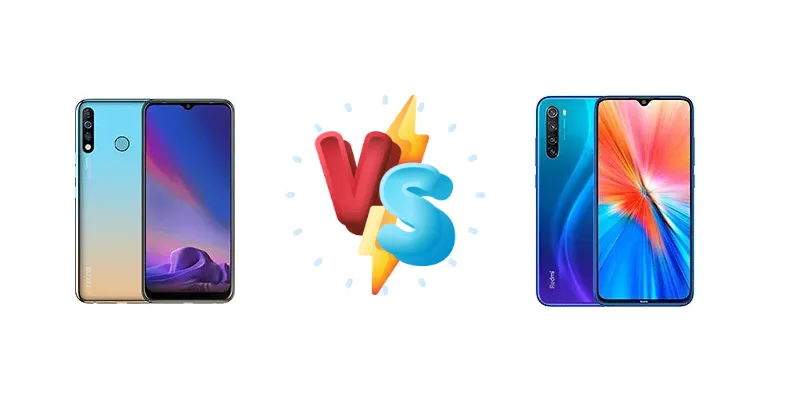
Both the Tecno Camon 12 and the Xiaomi Redmi Note 8 2021 occupy the highly competitive sub-$150 smartphone segment. While both aim to deliver essential features at an accessible price, they diverge significantly in their internal hardware, impacting performance and user experience. This comparison dissects these differences to determine which device offers the best value.
🏆 Quick Verdict
For the average user prioritizing responsiveness and occasional gaming, the Xiaomi Redmi Note 8 2021 is the superior choice. Its Helio G85 chipset provides a noticeable performance uplift over the Camon 12’s Helio P22, making everyday tasks and light gaming smoother. Both offer similar battery endurance, but the Redmi Note 8 2021’s 18W charging is a welcome addition.
| Network |
|---|
| 2G bands | GSM 850 / 900 / 1800 / 1900 | GSM 850 / 900 / 1800 / 1900 |
| 3G bands | HSDPA 850 / 900 / 1700(AWS) / 1900 / 2100 | HSDPA 850 / 900 / 1700(AWS) / 1900 / 2100 |
| 4G bands | 1, 2, 3, 4, 5, 7, 8, 20, 28 | 1, 2, 3, 4, 5, 7, 8, 20, 28, 38, 40 |
| EDGE | Yes | - |
| GPRS | Yes | - |
| Speed | HSPA 42.2/5.76 Mbps, LTE Cat4 150/50 Mbps | HSPA, LTE |
| Technology | GSM / HSPA / LTE | GSM / HSPA / LTE |
| Launch |
|---|
| Announced | 2019, August. Released 2019, August | 2021, May 25 |
| Status | Discontinued | Available. Released 2021, May 27 |
| Body |
|---|
| Build | Glass front, plastic back, plastic frame | Glass front (Gorilla Glass 5), glass back (Gorilla Glass 5), plastic frame |
| Dimensions | 166 x 75.8 x 8.2 mm (6.54 x 2.98 x 0.32 in) | 158.3 x 75.3 x 8.4 mm (6.23 x 2.96 x 0.33 in) |
| SIM | Nano-SIM + Nano-SIM | Nano-SIM + Nano-SIM |
| Weight | 170.7 g (6.03 oz) | 190 g (6.70 oz) |
| Display |
|---|
| Protection | - | Corning Gorilla Glass 5 |
| Resolution | 720 x 1600 pixels, 20:9 ratio (~269 ppi density) | 1080 x 2340 pixels, 19.5:9 ratio (~409 ppi density) |
| Size | 6.52 inches, 102.6 cm2 (~81.6% screen-to-body ratio) | 6.3 inches, 97.4 cm2 (~81.7% screen-to-body ratio) |
| Type | IPS LCD | IPS LCD, 500 nits (typ) |
| Platform |
|---|
| CPU | Octa-core 2.0 GHz Cortex-A53 | Octa-core (2x2.0 GHz Cortex-A75 & 6x1.8 GHz Cortex-A55) |
| Chipset | Mediatek MT6762 Helio P22 (12 nm) | Mediatek MT6769Z Helio G85 (12 nm) |
| GPU | PowerVR GE8320 | Mali-G52 MC2 |
| OS | Android 9.0 (Pie), HIOS 5.5 | Android 11, MIUI 12.5 |
| Memory |
|---|
| Card slot | microSDXC (dedicated slot) | microSDXC (dedicated slot) |
| Internal | 64GB 4GB RAM | 64GB 3GB RAM, 64GB 4GB RAM, 128GB 4GB RAM |
| | eMMC 5.1 | eMMC 5.1 |
| Main Camera |
|---|
| Features | Quad-LED flash, panorama, HDR | LED flash, HDR, panorama |
| Quad | - | 48 MP, f/1.8, 26mm (wide), 1/2.0", 0.8µm, PDAF
8 MP, f/2.2, 120˚ (ultrawide), 1/4.0", 1.12µm
2 MP (macro)
Auxiliary lens |
| Single | 8 MP, AF | 13 MP, f/2.0, (wide), 1/3.1", 1.12µm |
| Triple | 16 MP, PDAF
8 MP
Auxiliary lens | - |
| Video | 1080p@30fps | 1080p@30/120fps; gyro-EIS |
| Selfie camera |
|---|
| Features | HDR | HDR, panorama |
| Single | 16 MP, f/1.8, 26mm (wide), 1/3.06", 1.0µm | 13 MP, f/2.0, (wide), 1/3.1", 1.12µm |
| Video | 1080p@30fps | 1080p@30fps |
| Sound |
|---|
| 3.5mm jack | Yes | Yes |
| 35mm jack | Yes | Yes |
| Loudspeaker | Yes | Yes |
| Comms |
|---|
| Bluetooth | 5.0, A2DP, LE | 5.2, A2DP, LE |
| Infrared port | - | Yes |
| NFC | No | No |
| Positioning | GPS | GPS, GLONASS, GALILEO, BDS |
| Radio | FM radio | FM radio |
| USB | microUSB 2.0 | USB Type-C 2.0, OTG |
| WLAN | Wi-Fi 802.11 a/b/g/n | Wi-Fi 802.11 a/b/g/n/ac, dual-band, Wi-Fi Direct |
| Features |
|---|
| Sensors | Fingerprint (rear-mounted), accelerometer, proximity | Fingerprint (rear-mounted), accelerometer, gyro, proximity, compass |
| Battery |
|---|
| Charging | - | 18W wired |
| Talk time | Up to 7 h (multimedia) | - |
| Type | 4000 mAh, non-removable | Li-Po 4000 mAh |
| Misc |
|---|
| Colors | Dawn Blue, Dark Jade, Sky Cyan | Neptune Blue, Moonlight White, Space Black |
| Models | CC7S | M1908C3JGG |
| Price | About 460 EUR | About 160 EUR |
| SAR | - | 0.97 W/kg (head) 0.75 W/kg (body) |
| SAR EU | - | 0.57 W/kg (head) 0.94 W/kg (body) |
| Tests |
|---|
| Battery life | - |
Endurance rating 102h
|
| Camera | - |
Photo / Video |
| Display | - |
Contrast ratio: 1487:1 (nominal) |
| Loudspeaker | - |
-28.6 LUFS (Average)
|
| Performance | - |
AnTuTu: 180195 (v8), 165779 (v9)
GeekBench: 5259 (v4.4), 1314 (v5.1)
GFXBench: 8.7fps (ES 3.1 onscreen) |
Tecno Camon 12
- Potentially lower price point
- Acceptable battery life
- Functional for basic tasks
- Outdated Helio P22 chipset
- Likely slower charging speeds
- Inferior performance for gaming and multitasking
Xiaomi Redmi Note 8 2021
- More powerful Helio G85 chipset
- Faster 18W charging
- Brighter display for outdoor visibility
- Slightly higher price
- Battery life is comparable, not superior
- May still struggle with demanding games at high settings
Display Comparison
Both devices share a contrast ratio of 1487:1, suggesting similar color reproduction capabilities. However, the Redmi Note 8 2021 boasts a significantly brighter display, reaching a measured 620 nits compared to an unspecified brightness for the Camon 12. This higher peak brightness translates to better visibility outdoors under direct sunlight, a crucial advantage for users frequently exposed to bright environments. While both likely utilize IPS LCD panels, the Redmi Note 8 2021’s superior brightness provides a more comfortable viewing experience.
Camera Comparison
Both phones are advertised as having photo and video capabilities, but detailed sensor information is lacking for the Tecno Camon 12. The Redmi Note 8 2021’s camera system likely features a more advanced image signal processor (ISP) integrated within the Helio G85, potentially leading to better image processing and dynamic range. Without specific sensor details for the Camon 12, it’s difficult to assess its low-light performance or overall image quality. It's reasonable to assume the Redmi Note 8 2021 offers a more versatile and capable camera experience.
Performance
The core difference lies in the chipsets. The Tecno Camon 12 utilizes the Mediatek Helio P22, featuring an octa-core CPU clocked at 2.0 GHz, all Cortex-A53 cores. The Xiaomi Redmi Note 8 2021, however, is powered by the Helio G85. This chipset employs a more modern CPU architecture with two high-performance Cortex-A75 cores at 2.0 GHz and six efficiency-focused Cortex-A55 cores at 1.8 GHz. This architectural shift, combined with a more efficient 12nm process, results in significantly improved multi-core performance and responsiveness on the Redmi Note 8 2021. The G85 also features a more capable GPU, making it better suited for gaming.
Battery Life
Both devices achieve an endurance rating of 102 hours, indicating comparable battery life under similar usage conditions. However, the Redmi Note 8 2021 includes 18W wired charging, a significant advantage over the Camon 12, which likely supports slower charging speeds. This faster charging capability allows the Redmi Note 8 2021 to replenish its battery more quickly, minimizing downtime and providing greater convenience.
Buying Guide
Buy the Tecno Camon 12 if your primary needs are basic communication, social media browsing, and infrequent camera use, and you are on an extremely tight budget. Buy the Xiaomi Redmi Note 8 2021 if you value smoother multitasking, a more responsive user interface, and the ability to play mobile games with acceptable performance, even if it means spending slightly more.
Frequently Asked Questions
❓ Is the Redmi Note 8 2021 capable of playing PUBG Mobile smoothly?
The Helio G85 in the Redmi Note 8 2021 can run PUBG Mobile, but you'll likely need to use medium graphics settings and a balanced frame rate to maintain a consistently smooth experience. The Tecno Camon 12’s Helio P22 would struggle significantly with this title.
❓ How much faster is the Redmi Note 8 2021 in everyday tasks compared to the Camon 12?
The Redmi Note 8 2021’s Helio G85 offers a noticeable improvement in app launch times, multitasking, and overall system responsiveness. The Cortex-A75 cores provide a significant performance boost over the Camon 12’s all-Cortex-A53 configuration, making everyday use feel snappier.
❓ Does the Redmi Note 8 2021 support fast charging with any charger other than the one in the box?
Yes, the Redmi Note 8 2021 supports the Power Delivery (PD) and Quick Charge (QC) standards, meaning you can use compatible third-party chargers to achieve 18W charging speeds. However, ensure the charger is certified for these standards to avoid compatibility issues.