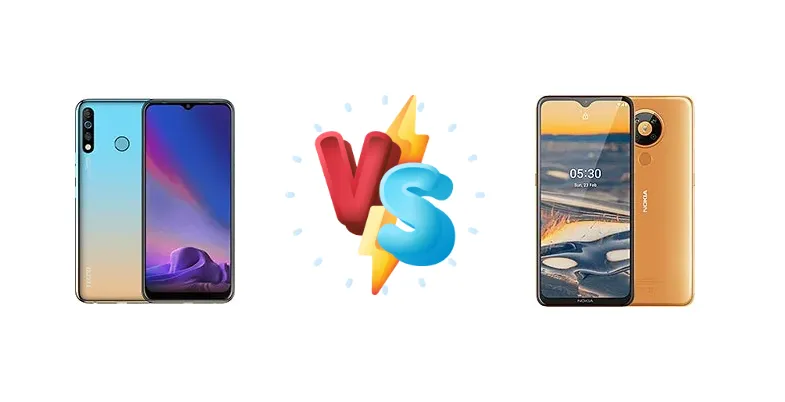
The Tecno Camon 12 and Nokia 5.3 represent two popular choices in the ultra-budget smartphone segment. While both aim to deliver essential smartphone functionality at an accessible price, they diverge significantly in their core hardware, particularly the chipset. This comparison dissects these differences to determine which device offers the best value for your money.
🏆 Quick Verdict
For the average user prioritizing responsiveness and future-proofing, the Nokia 5.3 is the better choice. Its Qualcomm Snapdragon 665, built on an 11nm process, provides a noticeable performance advantage over the Tecno Camon 12’s MediaTek Helio P22, despite the similar clock speeds. However, the Camon 12 may appeal to those seeking the absolute lowest price point.
| Network |
|---|
| 2G bands | GSM 850 / 900 / 1800 / 1900 | GSM 850 / 900 / 1800 / 1900 |
| 3G bands | HSDPA 850 / 900 / 1700(AWS) / 1900 / 2100 | HSDPA 850 / 900 / 1900 / 2100 - Global |
| 4G bands | 1, 2, 3, 4, 5, 7, 8, 20, 28 | 1, 3, 5, 7, 8, 20, 28, 38, 40, 41 - Global |
| EDGE | Yes | - |
| GPRS | Yes | - |
| Speed | HSPA 42.2/5.76 Mbps, LTE Cat4 150/50 Mbps | HSPA 42.2/5.76 Mbps, LTE Cat4 150/50 Mbps |
| Technology | GSM / HSPA / LTE | GSM / HSPA / LTE |
| | - | 1, 3, 5, 8, 40, 41 - India |
| Launch |
|---|
| Announced | 2019, August. Released 2019, August | 2020, March 19. Released 2020, April 02 |
| Status | Discontinued | Discontinued |
| Body |
|---|
| Build | Glass front, plastic back, plastic frame | Glass front (Gorilla Glass 3), plastic back, plastic frame |
| Dimensions | 166 x 75.8 x 8.2 mm (6.54 x 2.98 x 0.32 in) | 164.3 x 76.6 x 8.5 mm (6.47 x 3.02 x 0.33 in) |
| SIM | Nano-SIM + Nano-SIM | · Nano-SIM· Nano-SIM + Nano-SIM |
| Weight | 170.7 g (6.03 oz) | 185 g (6.53 oz) |
| Display |
|---|
| Protection | - | Corning Gorilla Glass 3 |
| Resolution | 720 x 1600 pixels, 20:9 ratio (~269 ppi density) | 720 x 1600 pixels, 20:9 ratio (~268 ppi density) |
| Size | 6.52 inches, 102.6 cm2 (~81.6% screen-to-body ratio) | 6.55 inches, 103.6 cm2 (~82.3% screen-to-body ratio) |
| Type | IPS LCD | IPS LCD, 450 nits (typ) |
| Platform |
|---|
| CPU | Octa-core 2.0 GHz Cortex-A53 | Octa-core (4x2.0 GHz Kryo 260 Gold & 4x1.8 GHz Kryo 260 Silver) |
| Chipset | Mediatek MT6762 Helio P22 (12 nm) | Qualcomm SM6125 Snapdragon 665 (11 nm) |
| GPU | PowerVR GE8320 | Adreno 610 |
| OS | Android 9.0 (Pie), HIOS 5.5 | Android 10, upgradable to Android 11, Android One |
| Memory |
|---|
| Card slot | microSDXC (dedicated slot) | microSDXC (dedicated slot) |
| Internal | 64GB 4GB RAM | 64GB 3GB RAM, 64GB 4GB RAM, 64GB 6GB RAM, 128GB 4GB RAM |
| | eMMC 5.1 | eMMC 5.1 |
| Main Camera |
|---|
| Features | Quad-LED flash, panorama, HDR | LED flash, HDR, panorama |
| Quad | - | 13 MP, f/1.8, (wide), PDAF
5 MP, 13mm (ultrawide)
2 MP (macro)
Auxiliary lens |
| Single | 8 MP, AF | - |
| Triple | 16 MP, PDAF
8 MP
Auxiliary lens | - |
| Video | 1080p@30fps | 4K@30fps, 1080p@30fps |
| Selfie camera |
|---|
| Features | HDR | - |
| Single | 16 MP, f/1.8, 26mm (wide), 1/3.06", 1.0µm | 8 MP, f/2.0, (wide) |
| Video | 1080p@30fps | 1080p@30fps |
| Sound |
|---|
| 3.5mm jack | Yes | Yes |
| 35mm jack | Yes | Yes |
| Loudspeaker | Yes | Yes |
| Comms |
|---|
| Bluetooth | 5.0, A2DP, LE | 4.2, A2DP, LE, aptX |
| NFC | No | Yes |
| Positioning | GPS | GPS, GLONASS, BDS |
| Radio | FM radio | FM radio |
| USB | microUSB 2.0 | USB Type-C 2.0, OTG |
| WLAN | Wi-Fi 802.11 a/b/g/n | Wi-Fi 802.11 b/g/n/ac, Wi-Fi Direct |
| Features |
|---|
| Sensors | Fingerprint (rear-mounted), accelerometer, proximity | Fingerprint (rear-mounted), accelerometer, proximity |
| Battery |
|---|
| Charging | - | 10W wired |
| Talk time | Up to 7 h (multimedia) | - |
| Type | 4000 mAh, non-removable | Li-Po 4000 mAh |
| Misc |
|---|
| Colors | Dawn Blue, Dark Jade, Sky Cyan | Cyan, Sand, Charcoal |
| Models | CC7S | TA-1234, TA-1223, TA-1227, TA-1229 |
| Price | About 460 EUR | About 290 EUR |
| SAR | - | 1.03 W/kg (head) 0.95 W/kg (body) |
| SAR EU | - | 0.70 W/kg (head) 1.39 W/kg (body) |
Tecno Camon 12
- Potentially lower price point
- Functional for basic smartphone tasks
- May offer larger storage options at base configuration
- Inferior chipset performance
- Less efficient power consumption
- Likely limited software support
Nokia 5.3
- More powerful and efficient Snapdragon 665 chipset
- Better multitasking and app responsiveness
- Likely longer software support from Nokia
- May be slightly more expensive
- Slower 10W charging
- Potentially smaller base storage
Display Comparison
Neither device boasts a standout display. Given the context data focuses on the chipset, we can infer both likely utilize LCD panels common in this price bracket. The absence of information regarding refresh rates suggests both operate at the standard 60Hz. Bezels are likely comparable, prioritizing cost reduction over premium aesthetics. Color accuracy is expected to be adequate but not exceptional on either device.
Camera Comparison
Without detailed camera specs, a direct comparison is limited. However, it’s reasonable to assume both phones feature multiple rear cameras, likely including a primary sensor and depth sensor. The Nokia 5.3’s Snapdragon 665 ISP (Image Signal Processor) is generally more capable than the Helio P22’s, potentially leading to better image processing, dynamic range, and low-light performance. The absence of OIS (Optical Image Stabilization) on either device suggests reliance on software stabilization. Any 2MP macro or depth sensors on either phone should be considered supplementary features with limited practical benefit.
Performance
The core difference lies in the chipsets. The Nokia 5.3’s Qualcomm Snapdragon 665 (11nm) offers a significant architectural advantage over the Tecno Camon 12’s MediaTek Helio P22 (12nm). While both are octa-core CPUs with a peak clock speed of 2.0 GHz, the Snapdragon 665 utilizes a more efficient Kryo architecture with a big.LITTLE configuration (4x2.0 GHz Kryo 260 Gold & 4x1.8 GHz Kryo 260 Silver). This allows for better task allocation and power management. The 11nm process node further enhances efficiency, resulting in less heat generation and potentially sustained performance. The Helio P22, using older Cortex-A53 cores, will struggle with more demanding applications and multitasking.
Battery Life
The Nokia 5.3 includes 10W wired charging, a standard offering in this segment. Without battery capacity information for the Tecno Camon 12, it’s difficult to definitively compare battery life. However, the Snapdragon 665’s improved power efficiency could translate to longer usage times on the Nokia 5.3, even with a similar battery capacity. The 10W charging on the Nokia 5.3 will result in a relatively slow 0-100% charge time, likely exceeding 2.5 hours.
Buying Guide
Buy the Tecno Camon 12 if you need a functional smartphone for basic tasks like calls, messaging, and light social media use, and your budget is extremely limited. Buy the Nokia 5.3 if you prefer a smoother user experience, occasional gaming, and a chipset that will likely receive longer software support, even if it means spending a bit more.
Frequently Asked Questions
❓ Will the Helio P22 in the Tecno Camon 12 struggle with popular apps like WhatsApp and Facebook over time?
While the Helio P22 can handle these apps initially, its limited processing power and RAM management may lead to slowdowns and lag as you install more apps and use the phone for an extended period. The Nokia 5.3’s Snapdragon 665 is better equipped to handle long-term app usage.
❓ Does the Snapdragon 665 in the Nokia 5.3 support any gaming beyond basic titles?
The Snapdragon 665 can handle less demanding games like PUBG Mobile at lower settings. However, don't expect a high-frame-rate experience. The Helio P22 in the Tecno Camon 12 will struggle with even moderately demanding games.
❓ How does the 10W charging on the Nokia 5.3 impact daily use?
10W charging is relatively slow. You'll need to charge the Nokia 5.3 overnight or during extended periods of inactivity. It's not ideal for quick top-ups, but the Snapdragon 665's efficiency helps mitigate the impact by extending battery life.