
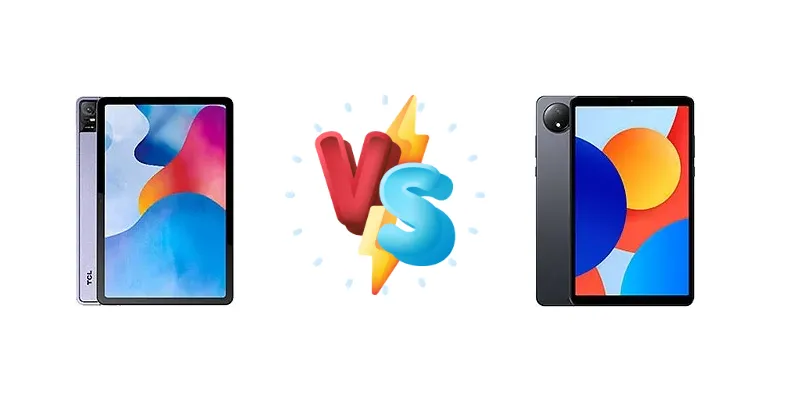
TCL Tab 11 vs Xiaomi Redmi Pad SE 8.7: Which Budget Tablet Reigns Supreme?
| Phones Images | |||||
|---|---|---|---|---|---|
|
🏆 Quick Verdict
For most users, the Xiaomi Redmi Pad SE 8.7 emerges as the better choice. While both tablets share 18W charging, the Redmi Pad SE’s Helio G85 chipset, featuring newer Cortex-A75 cores, provides a noticeable performance edge in demanding tasks and gaming, making it a more future-proof option.
| PHONES | ||
|---|---|---|
| Phone Names | TCL Tab 11 | Xiaomi Redmi Pad SE 8.7 |
| Network | ||
|---|---|---|
| 2G bands | GSM 850 / 900 / 1800 / 1900 | GSM 850 / 900 / 1800 / 1900 |
| 3G bands | HSDPA 850 / 900 / 1700(AWS) / 1900 / 2100 | HSDPA 800 / 850 / 900 / 1700(AWS) / 1900 / 2100 |
| 4G bands | 1, 2, 3, 4, 5, 7, 8, 17, 20, 28, 34, 38, 39, 40, 41, 66 - USA | 1, 2, 3, 4, 5, 7, 8, 13, 18, 19, 20, 26, 28, 38, 40, 41, 66 |
| Speed | HSPA, LTE - cellular model only | HSPA, LTE - cellular model only |
| Technology | GSM / HSPA / LTE | GSM / HSPA / LTE |
| Launch | ||
|---|---|---|
| Announced | 2023, February 26 | 2024, July 29 |
| Status | Available. Released 2023, May | Available. Released 2024, August 08 |
| Body | ||
|---|---|---|
| Build | - | Glass front (Gorilla Glass 3) |
| Dimensions | 259 x 163.6 x 6.9 mm (10.20 x 6.44 x 0.27 in) | 211.6 x 125.5 x 8.8 mm (8.33 x 4.94 x 0.35 in) |
| SIM | Nano-SIM (cellular model only) | Nano-SIM + Nano-SIM (cellular model only) |
| Weight | 462 g (1.02 lb) | 370 / 373 / 375 g (13.05 oz) |
| Stylus support | - | |
| Display | ||
|---|---|---|
| Protection | - | Corning Gorilla Glass 3 |
| Resolution | 1200 x 2000 pixels, 5:3 ratio (~213 ppi density) | 800 x 1340 pixels, 5:3 ratio (~179 ppi density) |
| Size | 10.95 inches, 341.3 cm2 (~80.5% screen-to-body ratio) | 8.7 inches, 214.9 cm2 (~80.9% screen-to-body ratio) |
| Type | IPS | IPS LCD, 1B colors, 90Hz, 600 nits (HBM) |
| Platform | ||
|---|---|---|
| CPU | Octa-core (4x2.0 GHz Cortex-A73 & 4x Cortex-A53) | Octa-core (2x2.0 GHz Cortex-A75 & 6x1.8 GHz Cortex-A55) |
| Chipset | Mediatek MT8183 Helio P60T (12 nm) | Mediatek Helio G85 (12 nm) |
| GPU | PowerVR GE8320 | Mali-G52 MC2 |
| OS | Android 13 | Android 14, HyperOS |
| Memory | ||
|---|---|---|
| Card slot | microSDXC | microSDXC (dedicated slot) |
| Internal | - | 64GB 4GB RAM, 128GB 4GB RAM, 128GB 6GB RAM |
| Main Camera | ||
|---|---|---|
| Features | LED flash | LED flash |
| Single | 8 MP, f/2.0, (wide), 1/4.0", 1.12µm, AF | 8 MP, f/2.0, (wide), 1/4.0", 1.12µm |
| Video | 1080p@30fps | 1080p@30fps |
| Selfie camera | ||
|---|---|---|
| Single | 8 MP, 100˚, (ultrawide), 1/4.0", 1.12µm | 5 MP, f/2.2, (wide), 1/5.0", 1.12µm |
| Video | 1080p@30fps | 1080p@30fps |
| Sound | ||
|---|---|---|
| 3.5mm jack | Unspecified | - |
| 35mm jack | Unspecified | Yes |
| Loudspeaker | Yes, with dual speakers (4 speakers) | Yes, with stereo speakers |
| Comms | ||
|---|---|---|
| Bluetooth | 5.0, A2DP, LE | 5.3, A2DP, LE |
| Infrared port | - | Yes |
| NFC | No | No |
| Positioning | Unspecified | GPS, GALILEO, GLONASS, BDS - cellular model only |
| Radio | Unspecified | FM radio |
| USB | USB Type-C 2.0 | USB Type-C 2.0 |
| WLAN | Wi-Fi 802.11 a/b/g/n/ac, dual-band, Wi-Fi Direct | Wi-Fi 802.11 a/b/g/n/ac, dual-band |
| Features | ||
|---|---|---|
| Sensors | Accelerometer, proximity (accessories only) | Accelerometer, proximity (accessories only), compass |
| Battery | ||
|---|---|---|
| Charging | 18W wired | 18W wired (Int'l) 10W wired (India) |
| Type | Li-Po 8000 mAh | 6650 mAh |
| Misc | ||
|---|---|---|
| Colors | Digital Lavender, Dark Gray | Aurora Green (Forest Green), Sky Blue (Ocean Blue), Graphite Gray (Urban Grey) |
| Models | 9166G, 9466X | 220233L2G |
| Price | About 180 EUR | About 120 EUR |
| SAR | - | 0.90 W/kg (head) 0.65 W/kg (body) |
| SAR EU | - | 0.40 W/kg (head) 0.99 W/kg (body) |
TCL Tab 11
- Potentially larger display size for immersive viewing.
- Established brand reputation in the TV/display space.
- Adequate performance for basic tasks.
- Older processor architecture (Helio P60T).
- Likely slower performance in demanding applications.
- May exhibit more noticeable lag during multitasking.
Xiaomi Redmi Pad SE 8.7
- More modern processor (Helio G85) with faster cores.
- Compact 8.7-inch size for portability.
- Potentially better gaming performance.
- Charging speed is reduced to 10W in India.
- Smaller screen size may not appeal to all users.
- Camera quality is likely similar to the TCL Tab 11.
Display Comparison
Both tablets utilize 12nm process technology, suggesting similar power efficiency considerations in display design. While specific display specs (resolution, panel type) are missing, the 8.7-inch screen size of the Redmi Pad SE suggests a higher pixel density compared to the Tab 11’s larger display, potentially resulting in a sharper image. Bezels are likely comparable given the price point, and color accuracy will likely be standard for this segment – adequate for general use but not color-critical work. The absence of high refresh rate panels is expected in this price bracket.
Camera Comparison
Given the price range, camera performance isn’t a primary focus. Both tablets likely feature modest camera setups. Without specific sensor details, it’s safe to assume image quality will be sufficient for casual snapshots and video calls, but not competitive with smartphones. The presence of a 2MP macro camera on either device is largely a marketing gimmick and shouldn’t influence purchasing decisions. Image processing will likely be basic, prioritizing speed over detail.
Performance
The core difference lies in the chipsets. The Xiaomi Redmi Pad SE 8.7’s Mediatek Helio G85 features two Cortex-A75 cores clocked at 2.0 GHz, paired with six Cortex-A55 cores. This architecture is a step up from the TCL Tab 11’s Mediatek MT8183 Helio P60T, which uses four older Cortex-A73 cores and four Cortex-A53 cores. The A75 cores in the G85 offer significantly improved single-core performance, translating to snappier app launches and smoother multitasking. While both are 12nm chips, the architectural improvements in the G85 provide a tangible performance advantage. The Tab 11’s P60T is still adequate for basic tasks, but will struggle more with demanding applications.
Battery Life
Both tablets support 18W wired charging, but the Redmi Pad SE’s charging speed is 10W in India, creating a regional disparity. While battery capacity isn’t specified, the smaller screen size of the Redmi Pad SE 8.7 may contribute to slightly better battery life despite potentially having a similar capacity to the TCL Tab 11. The 18W charging, when available, will provide a reasonable 0-100% charge time, likely around 2-3 hours, but the difference in processor efficiency could impact overall usage time.
Buying Guide
Buy the TCL Tab 11 if you prioritize a slightly older, but still capable, processor for basic tasks like web browsing and video streaming, and are comfortable with potentially longer loading times. Buy the Xiaomi Redmi Pad SE 8.7 if you value a more responsive experience, especially for gaming or multitasking, and want a tablet that will feel quicker and smoother over its lifespan. The Redmi Pad SE is the better pick for students or anyone who needs a tablet for more than just passive consumption.