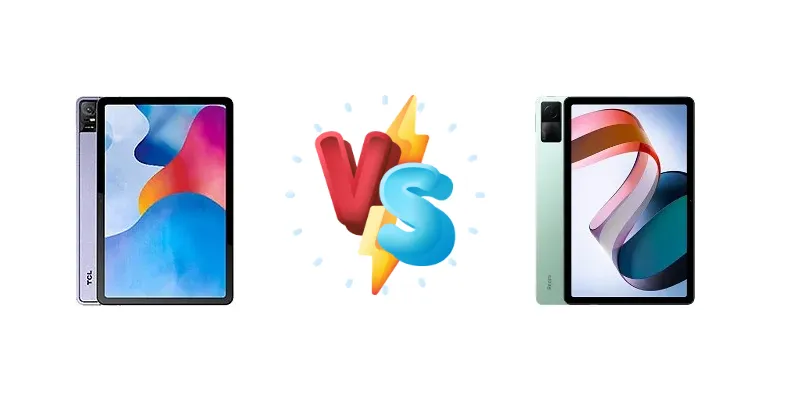
The tablet market is booming, and budget options are increasingly appealing. Today, we're pitting two contenders against each other: the TCL Tab 11 and the Xiaomi Redmi Pad. Both offer compelling features at accessible prices, but which one comes out on top?
🏆 Quick Verdict
The Xiaomi Redmi Pad edges out the TCL Tab 11 thanks to its slightly more powerful chipset, brighter display, and generally more refined software experience. While the TCL offers decent value, the Redmi Pad provides a more polished and enjoyable overall tablet experience.
| Network |
|---|
| 2G bands | GSM 850 / 900 / 1800 / 1900 | N/A |
| 3G bands | HSDPA 850 / 900 / 1700(AWS) / 1900 / 2100 | N/A |
| 4G bands | 1, 2, 3, 4, 5, 7, 8, 17, 20, 28, 34, 38, 39, 40, 41, 66 - USA | N/A |
| EDGE | - | N/A |
| GPRS | - | N/A |
| Speed | HSPA, LTE - cellular model only | - |
| Technology | GSM / HSPA / LTE | No cellular connectivity |
| Launch |
|---|
| Announced | 2023, February 26 | 2022, October 04 |
| Status | Available. Released 2023, May | Available. Released 2022, October 05 |
| Body |
|---|
| Build | - | Glass front, aluminum frame |
| Dimensions | 259 x 163.6 x 6.9 mm (10.20 x 6.44 x 0.27 in) | 250.5 x 158.1 x 7.1 mm (9.86 x 6.22 x 0.28 in) |
| SIM | Nano-SIM (cellular model only) | No |
| Weight | 462 g (1.02 lb) | 465 g (1.03 lb) |
| | Stylus support | - |
| Display |
|---|
| Resolution | 1200 x 2000 pixels, 5:3 ratio (~213 ppi density) | 1200 x 2000 pixels, 5:3 ratio (~220 ppi density) |
| Size | 10.95 inches, 341.3 cm2 (~80.5% screen-to-body ratio) | 10.61 inches, 320.4 cm2 (~80.9% screen-to-body ratio) |
| Type | IPS | IPS LCD, 1B colors, 90Hz, 400 nits (typ) |
| Platform |
|---|
| CPU | Octa-core (4x2.0 GHz Cortex-A73 & 4x Cortex-A53) | Octa-core (2x2.2 GHz Cortex-A76 & 6x2.0 GHz Cortex-A55) |
| Chipset | Mediatek MT8183 Helio P60T (12 nm) | Mediatek Helio G99 (6 nm) |
| GPU | PowerVR GE8320 | Mali-G57 MC2 |
| OS | Android 13 | Android 12, upgradable to Android 13, MIUI 14 |
| Memory |
|---|
| Card slot | microSDXC | microSDXC |
| Internal | - | 64GB 3GB RAM, 128GB 4GB RAM, 128GB 6GB RAM |
| | - | UFS 2.2 |
| Main Camera |
|---|
| Features | LED flash | - |
| Single | 8 MP, f/2.0, (wide), 1/4.0", 1.12µm, AF | 8 MP, f/2.0, (wide), AF |
| Video | 1080p@30fps | 1080p@30fps |
| Selfie camera |
|---|
| Single | 8 MP, 100˚, (ultrawide), 1/4.0", 1.12µm | 8 MP, f/2.3, 105° (ultrawide) |
| Video | 1080p@30fps | 1080p@30fps |
| Sound |
|---|
| 3.5mm jack | Unspecified | No |
| 35mm jack | Unspecified | No |
| Loudspeaker | Yes, with dual speakers (4 speakers) | Yes, with stereo speakers (4 speakers) |
| | - | 24-bit/192kHz audio |
| Comms |
|---|
| Bluetooth | 5.0, A2DP, LE | 5.2, A2DP, LE |
| NFC | No | No |
| Positioning | Unspecified | No |
| Radio | Unspecified | No |
| USB | USB Type-C 2.0 | USB Type-C, OTG |
| WLAN | Wi-Fi 802.11 a/b/g/n/ac, dual-band, Wi-Fi Direct | Wi-Fi 802.11 a/b/g/n/ac, dual-band, Wi-Fi Direct |
| Features |
|---|
| Sensors | Accelerometer, proximity (accessories only) | Accelerometer |
| Battery |
|---|
| Charging | 18W wired | 18W wired |
| Type | Li-Po 8000 mAh | Li-Po 8000 mAh |
| Misc |
|---|
| Colors | Digital Lavender, Dark Gray | Graphite Gray, Moonlight Silver, Mint Green |
| Models | 9166G, 9466X | 22081283G |
| Price | About 180 EUR | About 250 EUR |
| SAR EU | - | 0.36 W/kg (body) |
| Tests |
|---|
| Display | - |
Contrast ratio: 1529:1 (nominal) |
| Loudspeaker | - |
-23.9 LUFS (Very good)
|
| Performance | - |
AnTuTu: 319077 (v9)
GeekBench: 1852 (v5.1)
GFXBench: 13fps (ES 3.1 onscreen) |
TCL Tab 11
- Affordable price
- Decent screen size
- Good for basic tasks
- Older chipset
- Lower brightness display
- Less responsive performance
Xiaomi Redmi Pad
- Brighter and better display
- More powerful chipset
- Smoother performance
- Modern Android experience
- Slightly more expensive than TCL Tab 11
- 18W charging is not the fastest
Display Comparison
The Xiaomi Redmi Pad boasts a brighter display (402 nits vs. likely lower on the TCL Tab 11, though specific brightness data is scarce) and a slightly better contrast ratio, resulting in more vibrant colors and deeper blacks. Both have similar resolutions, but the Redmi Pad's improved brightness makes it more usable outdoors. The Redmi Pad's display also tends to have better color accuracy.
Camera Comparison
Camera quality on budget tablets is rarely a highlight. Both devices likely offer adequate cameras for video calls and casual snapshots, but don't expect flagship-level performance. The Redmi Pad may have a slight edge due to potentially better image processing, but both are unlikely to impress serious photographers. Expect around 8MP front and rear cameras on both.
Performance
The Xiaomi Redmi Pad's Mediatek Helio G99 (6nm) offers a noticeable performance advantage over the TCL Tab 11's Helio P60T (12nm). The G99's Cortex-A76 cores provide a significant boost for demanding apps and games. While both handle basic tasks well, the Redmi Pad feels snappier and more responsive overall. The G99's efficiency also contributes to better battery life.
Battery Life
Both tablets feature 18W wired charging, which is decent but not blazing fast. The Redmi Pad's more efficient chipset (6nm vs 12nm) likely translates to slightly better battery life in real-world usage, although both should comfortably last a full day with moderate use.
Buying Guide
The TCL Tab 11 is a good choice for users prioritizing affordability and basic tablet functionality. The Xiaomi Redmi Pad is ideal for those seeking a better display, smoother performance for everyday tasks and light gaming, and a more modern Android experience.
Frequently Asked Questions
❓ Which tablet is better for gaming?
The Xiaomi Redmi Pad is significantly better for gaming due to its more powerful chipset and smoother performance.
❓ Is the TCL Tab 11 worth buying if I'm on a very tight budget?
Yes, the TCL Tab 11 remains a viable option if price is your absolute top priority and you only need a tablet for basic tasks like browsing and email.
❓ What Android version do these tablets run?
The Xiaomi Redmi Pad typically ships with a more recent version of Android, often with Xiaomi's MIUI for Pad. The TCL Tab 11 may be running an older version, though updates can vary.