
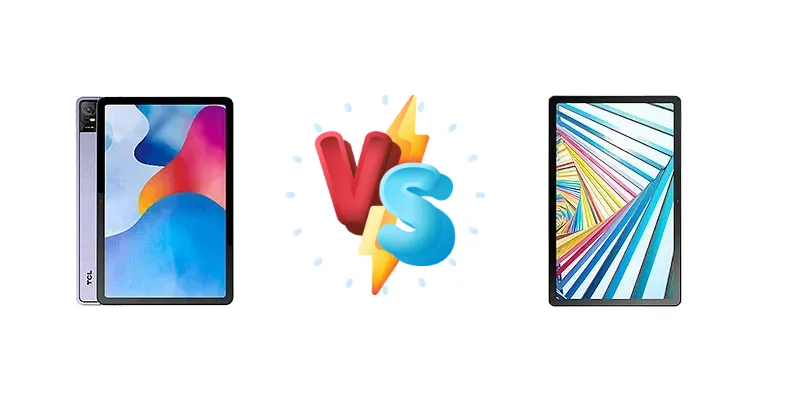
TCL Tab 11 vs. Lenovo Tab M10 Plus (3rd Gen): Which Budget Tablet Reigns Supreme?
| Phones Images | |||||
|---|---|---|---|---|---|
|
🏆 Quick Verdict
For most users, the Lenovo Tab M10 Plus (3rd Gen) with the Snapdragon 680 offers a more refined experience. Its newer 6nm process and generally faster CPU cores translate to smoother multitasking and better long-term performance, despite the TCL Tab 11's slightly faster clock speeds on some cores.
| PHONES | ||
|---|---|---|
| Phone Names | TCL Tab 11 | Lenovo Tab M10 Plus (3rd Gen) |
| Network | ||
|---|---|---|
| 2G bands | GSM 850 / 900 / 1800 / 1900 | GSM 850 / 900 / 1800 / 1900 |
| 3G bands | HSDPA 850 / 900 / 1700(AWS) / 1900 / 2100 | HSDPA 800 / 850 / 900 / 1900 / 2100 |
| 4G bands | 1, 2, 3, 4, 5, 7, 8, 17, 20, 28, 34, 38, 39, 40, 41, 66 - USA | 1, 2, 3, 4, 5, 7, 8, 19, 20, 26, 28, 28, 38, 40, 41 |
| Speed | HSPA, LTE - cellular model only | HSPA 42.2/5.76 Mbps, LTE Cat13 390/75 Mbps - cellular model only |
| Technology | GSM / HSPA / LTE | GSM / HSPA / LTE |
| Launch | ||
|---|---|---|
| Announced | 2023, February 26 | 2022, May |
| Status | Available. Released 2023, May | Available. Released 2022, May |
| Body | ||
|---|---|---|
| Dimensions | 259 x 163.6 x 6.9 mm (10.20 x 6.44 x 0.27 in) | 251.2 x 158.8 x 7.5 mm (9.89 x 6.25 x 0.30 in) |
| SIM | Nano-SIM (cellular model only) | Nano-SIM (cellular model only) |
| Weight | 462 g (1.02 lb) | 465 g (1.03 lb) |
| Stylus support | Stylus support | |
| Display | ||
|---|---|---|
| Resolution | 1200 x 2000 pixels, 5:3 ratio (~213 ppi density) | 1200 x 2000 pixels, 5:3 ratio (~220 ppi density) |
| Size | 10.95 inches, 341.3 cm2 (~80.5% screen-to-body ratio) | 10.61 inches, 320.4 cm2 (~80.3% screen-to-body ratio) |
| Type | IPS | IPS LCD, 400 nits (typ) |
| Platform | ||
|---|---|---|
| CPU | Octa-core (4x2.0 GHz Cortex-A73 & 4x Cortex-A53) | Octa-core (4x2.4 GHz Kryo 265 Gold & 4x1.9 GHz Kryo 265 Silver) - LTE model Octa-core (2x2.0 GHz Cortex-A75 & 6x1.8 GHz Cortex-A55) - Wi-Fi only model |
| Chipset | Mediatek MT8183 Helio P60T (12 nm) | Qualcomm SM6225 Snapdragon 680 4G (6 nm) - LTE model Mediatek MT6769V/CU Helio G80 (12 nm) - Wi-Fi only model |
| GPU | PowerVR GE8320 | Adreno 610 - LTE model Mali-G52 MC2 - Wi-Fi only model |
| OS | Android 13 | Android 12 |
| Memory | ||
|---|---|---|
| Card slot | microSDXC | microSDXC (dedicated slot) |
| Internal | - | 32GB 3GB RAM, 64GB 4GB RAM, 128GB 4GB RAM, 128GB 6GB RAM |
| - | eMCP/uMCP | |
| Main Camera | ||
|---|---|---|
| Features | LED flash | - |
| Single | 8 MP, f/2.0, (wide), 1/4.0", 1.12µm, AF | 8 MP, AF |
| Video | 1080p@30fps | 1080p |
| Selfie camera | ||
|---|---|---|
| Single | 8 MP, 100˚, (ultrawide), 1/4.0", 1.12µm | 8 MP |
| Video | 1080p@30fps | - |
| Sound | ||
|---|---|---|
| 3.5mm jack | Unspecified | Yes |
| 35mm jack | Unspecified | Yes |
| Loudspeaker | Yes, with dual speakers (4 speakers) | Yes, with stereo speakers (4 speakers) |
| Comms | ||
|---|---|---|
| Bluetooth | 5.0, A2DP, LE | 5.0, A2DP, LE |
| NFC | No | No |
| Positioning | Unspecified | GPS, GLONASS, BDS - cellular model only |
| Radio | Unspecified | FM Radio |
| USB | USB Type-C 2.0 | USB Type-C 2.0 |
| WLAN | Wi-Fi 802.11 a/b/g/n/ac, dual-band, Wi-Fi Direct | Wi-Fi 802.11 a/b/g/n/ac, dual-band, Wi-Fi Direct |
| Features | ||
|---|---|---|
| Sensors | Accelerometer, proximity (accessories only) | Accelerometer, proximity, gyro |
| Battery | ||
|---|---|---|
| Charging | 18W wired | 20W wired |
| Type | Li-Po 8000 mAh | Li-Po 7700 mAh |
| Misc | ||
|---|---|---|
| Colors | Digital Lavender, Dark Gray | Storm Grey, Frost Blue |
| Models | 9166G, 9466X | - |
| Price | About 180 EUR | About 260 EUR |
TCL Tab 11
- Potentially lower price point.
- Slightly higher display resolution.
- Simple and straightforward Android experience.
- Older, less efficient Helio P60T chipset.
- Likely shorter software support.
- Slower charging speed (18W).
Lenovo Tab M10 Plus (3rd Gen)
- More efficient Snapdragon 680 chipset (LTE model).
- Faster 20W charging.
- Option for 4G LTE connectivity.
- Wi-Fi only model uses older Helio G80 chipset.
- Slightly lower display resolution.
- May be slightly more expensive.
Display Comparison
Neither tablet boasts a particularly standout display. Both likely utilize IPS LCD panels, common in this price bracket. However, detailed specs like peak brightness and color gamut coverage are unavailable. The TCL Tab 11's display resolution is 2000 x 1200, while the Lenovo Tab M10 Plus (3rd Gen) is 1920 x 1200. While the TCL has a slightly higher resolution, the difference is unlikely to be noticeable to the average user. Bezels are expected to be relatively thick on both devices, reflecting their budget positioning.
Camera Comparison
Camera performance is unlikely to be a deciding factor for buyers in this segment. Both tablets likely feature basic camera setups. Detailed sensor information is scarce, but it's safe to assume both rely on relatively low-resolution sensors. Focusing on megapixel counts alone is misleading; image processing and sensor size are far more important. Expect acceptable results in good lighting conditions, but poor performance in low light. The TCL Tab 11 and Lenovo Tab M10 Plus (3rd Gen) are not designed for serious photography.
Performance
This is where the key differences emerge. The Lenovo Tab M10 Plus (3rd Gen) offers a choice of chipsets: the Qualcomm Snapdragon 680 (6nm) in the 4G LTE model, or the MediaTek Helio G80 (12nm) in the Wi-Fi only version. The TCL Tab 11 is equipped with the MediaTek MT8183 Helio P60T (12nm). The Snapdragon 680, built on a 6nm process, provides a significant efficiency advantage over the 12nm Helio P60T and G80. While the Helio P60T has Cortex-A73 cores clocked at 2.0 GHz, the Snapdragon 680’s Kryo 265 Gold cores, clocked at 2.4 GHz, generally offer superior single-core performance. The Snapdragon 680’s architecture is also more modern, leading to better sustained performance and potentially longer software support. The Wi-Fi only Lenovo model with the Helio G80 will likely perform similarly to the TCL Tab 11, but the Snapdragon 680 version is the clear winner.
Battery Life
The Lenovo Tab M10 Plus (3rd Gen) features 20W wired charging, slightly faster than the TCL Tab 11’s 18W charging. While battery capacity isn’t specified, both tablets likely house batteries in the 5000-7000 mAh range. The Snapdragon 680’s superior power efficiency should translate to longer battery life on the Lenovo Tab M10 Plus (3rd Gen), even with similar battery capacities. The faster charging also means less time tethered to an outlet.
Buying Guide
Buy the TCL Tab 11 if you prioritize a simple, straightforward tablet experience for basic tasks like web browsing and video playback, and are looking for the absolute lowest price point. Buy the Lenovo Tab M10 Plus (3rd Gen) if you value smoother performance for multitasking, potentially longer software support due to the Qualcomm chipset, and the option of 4G LTE connectivity for on-the-go use.