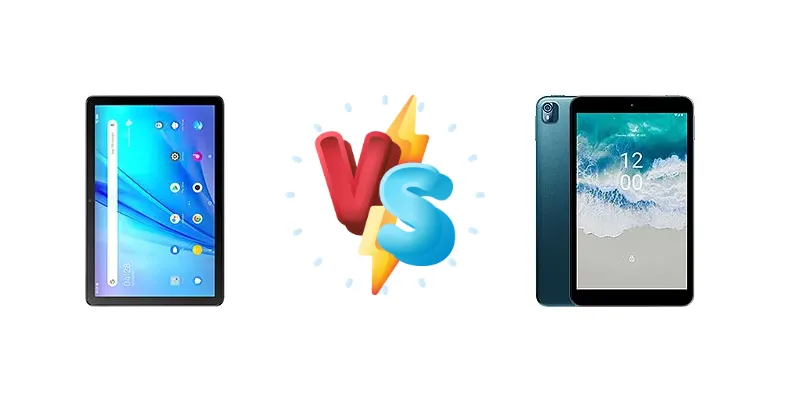
The sub-$200 Android tablet market is fiercely competitive, and the TCL Tab 10s and Nokia T10 are two strong contenders. Both aim to deliver a functional tablet experience without breaking the bank, but they take different approaches to achieving this. The TCL Tab 10s leans on a more established, albeit older, Mediatek chipset, while the Nokia T10 opts for the newer, power-efficient Unisoc T606. This comparison dives deep into the specifics to determine which tablet best suits your needs.
🏆 Quick Verdict
For most users, the TCL Tab 10s emerges as the better choice. Its Mediatek MT8768 chipset, despite being older, offers a noticeable performance advantage over the Unisoc T606 in the Nokia T10, making it more suitable for multitasking and demanding applications. The faster 18W charging is also a significant benefit, offsetting the likely similar battery capacities.
| Network |
|---|
| 2G bands | GSM 850 / 900 / 1800 / 1900 | GSM 850 / 900 / 1800 / 1900 |
| 3G bands | HSDPA 850 / 900 / 1700(AWS) / 1900 / 2100 | HSDPA 850 / 900 / 2100 |
| 4G bands | 1, 2, 3, 4, 5, 7, 8, 17, 18, 19, 20, 26, 28, 34, 38, 39, 40, 41 | 1, 3, 5, 7, 8, 20, 28, 38, 40, 41 |
| Speed | HSPA, LTE - cellular model only | HSPA 42.2/5.76 Mbps, LTE Cat4 150/50 Mbps |
| Technology | GSM / HSPA / LTE | GSM / HSPA / LTE |
| Launch |
|---|
| Announced | 2021, January 12 | 2022, July 12 |
| Status | Available. Released 2021, April 26 | Available. Released 2022, August 20 |
| Body |
|---|
| Build | - | Glass front, plastic back, plastic frame |
| Dimensions | 241 x 158.6 x 8.3 mm (9.49 x 6.24 x 0.33 in) | 208 x 123.2 x 9 mm (8.19 x 4.85 x 0.35 in) |
| SIM | Nano-SIM (cellular model only) | Nano-SIM |
| Weight | 464 g (1.02 lb) | 375 g (13.23 oz) |
| | - | Splash resistant |
| Display |
|---|
| Resolution | 1200 x 1920 pixels, 16:10 ratio (~224 ppi density) | 800 x 1280 pixels, 16:10 ratio (~189 ppi density) |
| Size | 10.1 inches, 295.8 cm2 (~77.4% screen-to-body ratio) | 8.0 inches, 185.6 cm2 (~72.4% screen-to-body ratio) |
| Type | IPS LCD | IPS LCD, 360 nits (typ), 450 nits (peak) |
| Platform |
|---|
| CPU | Octa-core (4x2.0 GHz Cortex-A53 & 4x1.5 GHz Cortex-A53) | Octa-core (2x1.6 GHz Cortex-A75 & 6x1.6 GHz Cortex-A55) |
| Chipset | Mediatek MT8768 | Unisoc T606 (12 nm) |
| GPU | PowerVR GE8320 | Mali-G57 MP1 |
| OS | Android 10 | Android 12, upgradable to Android 13 |
| Memory |
|---|
| Card slot | microSDXC | microSDXC |
| Internal | 32GB 3GB RAM, 64GB 4GB RAM | 32GB 3GB RAM, 64GB 4GB RAM |
| | eMMC 5.1 | - |
| Main Camera |
|---|
| Features | LED flash | LED flash |
| Single | 8 MP, f/2.0, (wide), 1/4.0", 1.12µm, AF | 8 MP, 1/4.0", 1.12µm, AF |
| Video | 1080p@30fps | 1080p |
| Selfie camera |
|---|
| Single | 5 MP, f/2.2, (wide), 1/5.0", 1.12µm | 2 MP, 1/5.0", 1.65µm |
| Video | 1080p@30fps | 720p |
| Sound |
|---|
| 3.5mm jack | Yes | Yes |
| 35mm jack | Yes | Yes |
| Loudspeaker | Yes, with dual speakers | Yes, with stereo speakers |
| Comms |
|---|
| Bluetooth | 5.0, A2DP, LE | 5.0, A2DP, LE |
| NFC | No | No |
| Positioning | GPS - cellular model only | GPS, GLONASS, GALILEO |
| Radio | No | No |
| USB | USB Type-C 2.0 | USB Type-C 2.0, OTG |
| WLAN | Wi-Fi 802.11 a/b/g/n/ac, dual-band, Wi-Fi Direct | Wi-Fi 802.11 a/b/g/n/ac, dual-band |
| Features |
|---|
| Sensors | Accelerometer, proximity | Accelerometer, proximity |
| Battery |
|---|
| Charging | 18W wired | 10W wired |
| Type | Li-Po 8000 mAh | Li-Po 5250 mAh |
| Misc |
|---|
| Colors | Gray, Silver | Ocean Blue |
| Models | 9080G, 9081X | TA-1503, TA-1472, TA-1462, TA-1457 |
| Price | About 170 EUR | About 160 EUR |
| SAR | - | 1.19 W/kg (body) |
| SAR EU | - | 0.27 W/kg (head) 1.57 W/kg (body) |
TCL Tab 10s
- Faster charging (18W)
- Potentially better performance with Mediatek MT8768
- More responsive multitasking
- Older chipset architecture
- Likely less optimized software
Nokia T10
- More power-efficient Unisoc T606 chipset
- Clean, stock Android experience
- Potentially longer battery life during light use
- Slower charging (10W)
- Lower overall performance
- Less responsive multitasking
Display Comparison
Neither TCL nor Nokia provide display specs beyond resolution, making a direct comparison difficult. However, given the price point, both likely utilize IPS LCD panels. The real differentiator will be color accuracy and peak brightness, which are unknown. Bezels are expected to be substantial on both devices, reflecting their budget nature. Without detailed display calibration data, it's safe to assume a similar viewing experience.
Camera Comparison
Camera performance is unlikely to be a deciding factor for either tablet. Both are expected to feature basic camera setups geared towards video calls rather than photography. Without specific sensor details, it’s reasonable to assume similar image quality. Focusing on megapixel counts would be misleading; image processing and sensor size are far more important, and neither manufacturer provides this information.
Performance
The core difference lies in the chipsets. The TCL Tab 10s’ Mediatek MT8768 features an octa-core configuration split between 2.0 GHz and 1.5 GHz Cortex-A53 cores. This architecture, while older, benefits from higher clock speeds. The Nokia T10’s Unisoc T606, built on a more efficient 12nm process, uses a big.LITTLE configuration with 1.6 GHz Cortex-A75 and Cortex-A55 cores. While the A75 cores are more powerful individually, the MT8768’s higher core count and clock speeds likely translate to better overall performance in multi-threaded tasks. The Unisoc T606 prioritizes efficiency, potentially offering longer battery life during light use, but will struggle with demanding applications. The lack of LPDDR5x RAM on either device suggests a focus on cost savings.
Battery Life
Battery capacity is not specified for either device, but given their similar size and target market, they are likely in the 5000-6000 mAh range. However, the TCL Tab 10s’ 18W wired charging offers a significant advantage over the Nokia T10’s 10W charging. This means the TCL Tab 10s will reach a full charge much faster, reducing downtime and improving usability. While the Unisoc T606’s efficiency might slightly extend battery life during light use, the faster charging of the TCL Tab 10s is a more tangible benefit for most users.
Buying Guide
Buy the TCL Tab 10s if you prioritize performance for light gaming, streaming, and multitasking. It’s ideal for users who want a tablet that can handle more than just basic web browsing and video playback. Buy the Nokia T10 if battery life and a clean, stock Android experience are paramount. It’s a better fit for users who primarily need a tablet for reading, light web browsing, and occasional video consumption, and who value simplicity and software updates.
Frequently Asked Questions
❓ Will the Mediatek MT8768 in the TCL Tab 10s struggle with graphically intensive games?
While the MT8768 isn't a gaming powerhouse, it should handle casual games and older titles adequately. Demanding, modern games will likely require reduced graphics settings and may still experience some lag. The Unisoc T606 in the Nokia T10 will likely perform even worse in these scenarios.
❓ How important is the difference in charging speed between 10W and 18W?
The difference is substantial. 18W charging will significantly reduce the time it takes to fully charge the TCL Tab 10s, potentially shaving off an hour or more compared to the Nokia T10's 10W charging. This is particularly beneficial for users who rely on their tablet throughout the day.
❓ Does the Nokia T10 receive regular software updates?
Nokia is known for providing relatively timely software updates, even on its budget devices. You can expect to receive security patches and potentially Android version upgrades for a reasonable period, offering a more secure and up-to-date experience compared to some other brands in this price range.
❓ Is the Unisoc T606 chipset known for overheating?
The Unisoc T606 is generally considered a thermally efficient chipset. It's unlikely to overheat during normal use, even under moderate load. However, prolonged gaming or demanding tasks may cause some throttling to prevent overheating.