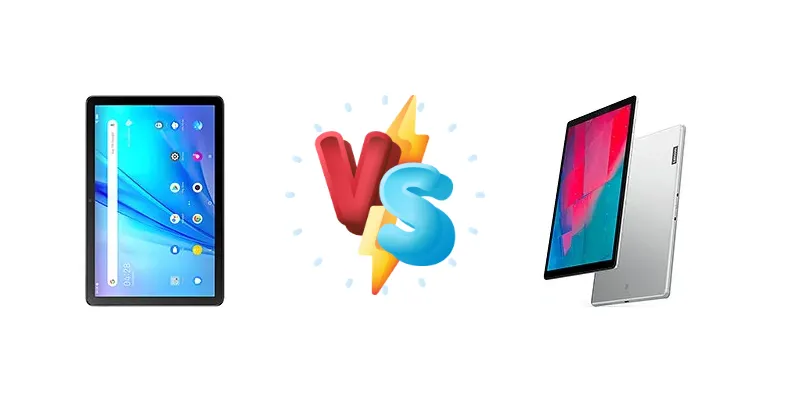
The sub-$200 Android tablet market is fiercely competitive. Both the TCL Tab 10s and the Lenovo Tab M10 HD Gen 2 aim to deliver a functional tablet experience without breaking the bank. However, they achieve this with different approaches to chipset selection and power delivery, impacting performance and usability. This comparison dives deep into the specifics to determine which tablet offers the best value.
🏆 Quick Verdict
For most users, the TCL Tab 10s emerges as the better choice. While both tablets target the budget segment, the TCL Tab 10s’ Mediatek MT8768 chipset, with its more balanced core configuration and slightly higher clock speeds, provides a noticeably smoother experience for multitasking and demanding applications, despite the Lenovo’s more efficient 12nm process.
| Network |
|---|
| 2G bands | GSM 850 / 900 / 1800 / 1900 | GSM 850 / 900 / 1800 / 1900 |
| 3G bands | HSDPA 850 / 900 / 1700(AWS) / 1900 / 2100 | HSDPA 800 / 850 / 900 / 1900 / 2100 |
| 4G bands | 1, 2, 3, 4, 5, 7, 8, 17, 18, 19, 20, 26, 28, 34, 38, 39, 40, 41 | 1, 2, 3, 4, 5, 7, 8, 19, 20, 28, 38, 40 |
| Speed | HSPA, LTE - cellular model only | HSPA, LTE - cellular model only |
| Technology | GSM / HSPA / LTE | GSM / HSPA / LTE |
| Launch |
|---|
| Announced | 2021, January 12 | 2020, August 31. Released 2020, November |
| Status | Available. Released 2021, April 26 | Discontinued |
| Body |
|---|
| Dimensions | 241 x 158.6 x 8.3 mm (9.49 x 6.24 x 0.33 in) | 241.5 x 149.4 x 8.3 mm (9.51 x 5.88 x 0.33 in) |
| SIM | Nano-SIM (cellular model only) | Nano-SIM (cellular model only) |
| Weight | 464 g (1.02 lb) | 420 g (14.82 oz) |
| Display |
|---|
| Resolution | 1200 x 1920 pixels, 16:10 ratio (~224 ppi density) | 800 x 1280 pixels, 16:10 ratio (~149 ppi density) |
| Size | 10.1 inches, 295.8 cm2 (~77.4% screen-to-body ratio) | 10.1 inches, 295.8 cm2 (~82.0% screen-to-body ratio) |
| Type | IPS LCD | IPS LCD, 400 nits (typ) |
| Platform |
|---|
| CPU | Octa-core (4x2.0 GHz Cortex-A53 & 4x1.5 GHz Cortex-A53) | Octa-core (4x2.3 GHz Cortex-A53 & 4x1.8 GHz Cortex-A53) |
| Chipset | Mediatek MT8768 | Mediatek MT6762 Helio P22T (12 nm) |
| GPU | PowerVR GE8320 | PowerVR GE8320 |
| OS | Android 10 | Android 10 |
| Memory |
|---|
| Card slot | microSDXC | microSDXC (dedicated slot) |
| Internal | 32GB 3GB RAM, 64GB 4GB RAM | 32GB 2GB RAM, 64GB 4GB RAM |
| | eMMC 5.1 | eMMC 5.1 |
| Main Camera |
|---|
| Features | LED flash | - |
| Single | 8 MP, f/2.0, (wide), 1/4.0", 1.12µm, AF | 8 MP, AF |
| Video | 1080p@30fps | 1080p@30fps |
| Selfie camera |
|---|
| Single | 5 MP, f/2.2, (wide), 1/5.0", 1.12µm | 5 MP |
| Video | 1080p@30fps | - |
| Sound |
|---|
| 3.5mm jack | Yes | Yes |
| 35mm jack | Yes | Yes |
| Loudspeaker | Yes, with dual speakers | Yes, with stereo speakers |
| Comms |
|---|
| Bluetooth | 5.0, A2DP, LE | 5.0, LE |
| NFC | No | No |
| Positioning | GPS - cellular model only | GPS, GLONASS - cellular model only |
| Radio | No | FM radio |
| USB | USB Type-C 2.0 | USB Type-C 2.0, OTG, magnetic connector |
| WLAN | Wi-Fi 802.11 a/b/g/n/ac, dual-band, Wi-Fi Direct | Wi-Fi 802.11 a/b/g/n/ac, dual-band, Wi-Fi Direct |
| Features |
|---|
| Sensors | Accelerometer, proximity | Accelerometer, proximity |
| Battery |
|---|
| Charging | 18W wired | 10W wired |
| Type | Li-Po 8000 mAh | Li-Po 5000 mAh |
| Misc |
|---|
| Colors | Gray, Silver | Iron Gray, Platinum Gray |
| Models | 9080G, 9081X | TB-X306X |
| Price | About 170 EUR | About 170 EUR |
TCL Tab 10s
- Faster chipset (MT8768) for smoother multitasking
- 18W fast charging for quicker top-ups
- Potentially better performance in demanding apps
- Likely shorter battery life under heavy load
- Chipset manufactured on a larger process node
Lenovo Tab M10 HD Gen 2
- More power-efficient chipset (MT6762, 12nm)
- Potentially longer battery life for basic tasks
- Lower price point (potentially)
- Slower chipset for multitasking and demanding apps
- Slower 10W charging
Display Comparison
Neither TCL nor Lenovo provide detailed display specifications beyond resolution. However, the core performance difference impacts the display experience. A faster chipset like the MT8768 in the TCL Tab 10s can render UI elements and video frames more smoothly, even if the panels themselves are similar in quality. The absence of high refresh rate support on either device means the chipset’s ability to deliver consistent frame rates is more crucial. Bezels are likely comparable given the price point, and color accuracy is expected to be standard for budget tablets.
Camera Comparison
Both tablets are unlikely to excel in photography. Given the target price point, camera quality is not a primary focus. Detailed camera specs are unavailable, but it’s safe to assume both feature basic sensors suitable for casual snapshots. Any differences in image quality will likely be minimal and overshadowed by the limitations of the sensors themselves. Focusing on camera performance for either device would be a misallocation of expectations.
Performance
The core difference lies in the chipsets. The Lenovo Tab M10 HD Gen 2 utilizes the Mediatek MT6762 Helio P22T, a 12nm process chip with an octa-core CPU configuration of 4x2.3 GHz Cortex-A53 and 4x1.8 GHz Cortex-A53 cores. The TCL Tab 10s, conversely, features the Mediatek MT8768, with an octa-core CPU of 4x2.0 GHz Cortex-A53 and 4x1.5 GHz Cortex-A53 cores. While the Lenovo boasts higher peak clock speeds on its faster cores, the TCL’s configuration offers a more balanced approach. The 12nm process of the P22T *should* translate to better power efficiency, but the MT8768’s architecture appears to provide a more consistent performance level, especially during multitasking. Neither chipset is a gaming powerhouse, but the TCL will likely handle less demanding titles with fewer stutters.
Battery Life
The Lenovo Tab M10 HD Gen 2 benefits from a more efficient chipset (MT6762, 12nm) and slower charging at 10W. The TCL Tab 10s, with its MT8768, supports 18W charging, potentially offering faster top-ups, but at the cost of potentially reduced battery life during intensive use. The actual battery capacity of both devices is not specified, but the Lenovo’s efficiency advantage will likely result in longer runtimes for similar usage scenarios, particularly for passive tasks like video streaming. However, the faster charging of the TCL Tab 10s could mitigate this difference for users who prefer quick bursts of power.
Buying Guide
Buy the TCL Tab 10s if you prioritize a more responsive user experience for everyday tasks like browsing, streaming, and light gaming. It’s ideal for users who frequently switch between apps or need a tablet that won’t struggle with moderately demanding applications. Buy the Lenovo Tab M10 HD Gen 2 if battery life and efficiency are paramount, and your usage is primarily limited to basic tasks like video playback and reading. Its 12nm process offers better power efficiency, but at the cost of overall performance.
Frequently Asked Questions
❓ Will the Lenovo Tab M10 HD Gen 2 struggle with multiple apps open simultaneously?
Yes, the Mediatek MT6762 Helio P22T, while efficient, is not designed for heavy multitasking. Expect noticeable slowdowns and app reloading when switching between several open applications. The TCL Tab 10s with its MT8768 will handle this scenario more gracefully.
❓ Is the 18W charging on the TCL Tab 10s significantly faster than the 10W charging on the Lenovo?
Yes, 18W charging will noticeably reduce charging times compared to 10W. While neither tablet offers incredibly fast charging, the TCL Tab 10s will get you back up and running quicker, especially if you frequently find yourself needing a quick power boost.
❓ Can either of these tablets handle popular mobile games like PUBG or Call of Duty?
Both tablets will struggle with graphically demanding games like PUBG or Call of Duty. You'll likely need to play on the lowest settings with reduced frame rates to achieve a playable experience. The TCL Tab 10s might offer slightly better performance, but neither is a gaming-focused device.