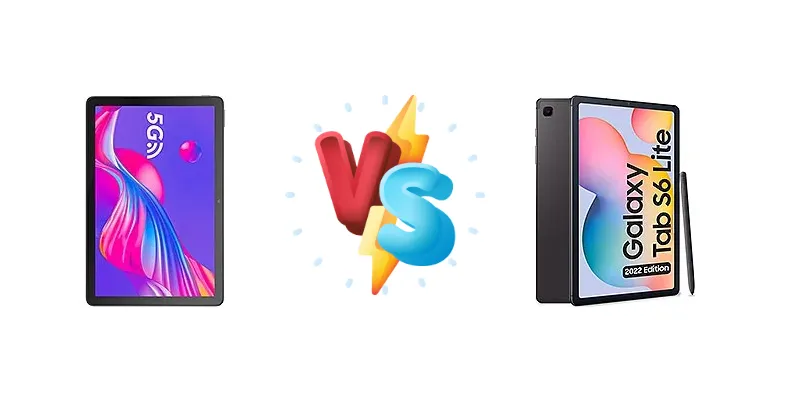
The tablet market has a sweet spot for affordable, everyday use. The TCL Tab 10s 5G and the Samsung Galaxy Tab S6 Lite (2022) both aim for this, but take different approaches. The TCL prioritizes 5G connectivity at a lower price point, while the Samsung leverages its established brand and refined software experience. This comparison dives deep into the hardware and software to determine which tablet delivers the best value.
🏆 Quick Verdict
For the average user prioritizing connectivity and a larger screen, the TCL Tab 10s 5G offers compelling value. While the Samsung Tab S6 Lite (2022) boasts a more efficient chipset and Samsung’s software ecosystem, the TCL’s 5G capability and potentially lower price make it the winner for those needing on-the-go connectivity.
| Network |
|---|
| 2G bands | GSM 850 / 900 / 1800 / 1900 | GSM 850 / 900 / 1800 / 1900 |
| 3G bands | HSDPA 850 / 900 / 1900 / 2100 | HSDPA 850 / 900 / 1700(AWS) / 1800 / 2100 |
| 4G bands | 1, 3, 5, 7, 8, 20, 28, 32, 38, 40, 41 | 1, 2, 3, 4, 5, 7, 8, 12, 17, 20, 28, 38, 40, 41, 66 |
| 5G bands | 1, 3, 5, 7, 8, 20, 28, 40, 41, 77, 78 SA/NSA/Sub6 | - |
| Speed | HSPA, LTE, 5G | HSPA, LTE - cellular model only |
| Technology | GSM / HSPA / LTE / 5G | GSM / HSPA / LTE |
| Launch |
|---|
| Announced | 2022, February 27 | 2022, May 14 |
| Status | Available. Released 2022, Q3 | Available. Released 2022, May 23 |
| Body |
|---|
| Build | - | Glass front, aluminum back, aluminum frame |
| Dimensions | 241.7 x 158.6 x 8.5 mm (9.52 x 6.24 x 0.33 in) | 244.5 x 154.3 x 7 mm (9.63 x 6.07 x 0.28 in) |
| SIM | Nano-SIM | Nano-SIM (cellular model only) |
| Weight | 490 g (1.08 lb) | 465/467 g (1.03 lb) |
| | - | Stylus support |
| Display |
|---|
| Resolution | 1200 x 1920 pixels, 16:10 ratio (~224 ppi density) | 1200 x 2000 pixels, 5:3 ratio (~224 ppi density) |
| Size | 10.1 inches, 295.8 cm2 (~77.2% screen-to-body ratio) | 10.4 inches, 307.9 cm2 (~81.6% screen-to-body ratio) |
| Type | IPS LCD | TFT LCD |
| Platform |
|---|
| CPU | Octa-core (2x2.4 GHz Cortex-A78 & 6x2.0 GHz Cortex-A55) | Octa-core (2x2.3 GHz Kryo 470 Gold & 6x1.8 GHz Kryo 470 Silver)Octa-core (2x2.3 GHz Kryo 465 Gold & 6x1.8 GHz Kryo 465 Silver) |
| Chipset | Mediatek MT8771 | Qualcomm SM7150 Snapdragon 732G (8 nm)Qualcomm SM7125 Snapdragon 720G (8 nm) |
| GPU | Mali-G57 MC2 | Adreno 618 |
| OS | Android 12 | Android 12, upgradable to Android 14, One UI 6 |
| Memory |
|---|
| Card slot | microSDXC | microSDXC (dedicated slot) |
| Internal | 64GB 4GB RAM | 64GB 4GB RAM, 128GB 4GB RAM |
| | eMMC 5.1 | - |
| Main Camera |
|---|
| Features | LED flash | HDR, panorama |
| Single | 8 MP, f/2.0, (wide), 1/4.0", 1.12µm, AF | 8 MP, (wide), 1/4.0", 1.12µm |
| Video | 1080p@30fps | 1080p@30fps |
| Selfie camera |
|---|
| Single | 5 MP, f/2.2, (wide), 1/5.0", 1.12µm | 5 MP, (wide), 1/5.0", 1.12µm |
| Video | 1080p@30fps | 1080p@30fps |
| Sound |
|---|
| 3.5mm jack | Yes | Yes |
| 35mm jack | Yes | Yes |
| Loudspeaker | Yes, with dual speakers | Yes, with stereo speakers |
| | - | Tuned by AKG |
| Comms |
|---|
| Bluetooth | 5.1, A2DP, LE | 5.0, A2DP, LE |
| NFC | No | No |
| Positioning | GPS | GPS, GLONASS, BDS, GALILEO, QZSS - cellular model only |
| Radio | FM radio, RDS | No |
| USB | USB Type-C 2.0 | USB Type-C |
| WLAN | Wi-Fi 802.11 a/b/g/n/ac, dual-band, Wi-Fi Direct | Wi-Fi 802.11 a/b/g/n/ac, dual-band, Wi-Fi Direct |
| Features |
|---|
| Sensors | Accelerometer, proximity | Accelerometer, proximity, gyro |
| | - | ANT+ |
| Battery |
|---|
| Charging | 18W wired | 15W wired |
| Type | Li-Po 8000 mAh | Li-Po 7040 mAh |
| Misc |
|---|
| Colors | Dark Gray | Chiffon Pink, Angora Blue, Oxford Gray |
| Models | 9183G | SM-P613, SM-P619 |
| Price | About 350 EUR | About 400 EUR |
| SAR | - | 1.01 W/kg (body) |
TCL Tab 10s 5G
- Integrated 5G connectivity for on-the-go access.
- Potentially lower price point for budget-conscious buyers.
- Larger display size for enhanced media consumption.
- Mediatek MT8771 chipset may exhibit throttling under sustained load.
- Software updates may be less frequent compared to Samsung.
Samsung Galaxy Tab S6 Lite (2022)
- Qualcomm Snapdragon 732G offers better sustained performance and efficiency.
- Samsung’s One UI provides a polished and feature-rich software experience.
- More compact form factor for improved portability.
- Lacks integrated 5G connectivity.
- Charging speed is slower at 15W.
Display Comparison
Neither TCL nor Samsung provided display specs beyond size. However, given the price points, both likely utilize IPS LCD panels. The TCL Tab 10s 5G’s larger screen size will be beneficial for media consumption, while the Samsung Tab S6 Lite (2022)'s smaller size enhances portability. The absence of high refresh rates or OLED technology is expected in this segment, meaning color accuracy and viewing angles will be standard for IPS LCDs. Bezels are likely comparable, focusing on cost reduction rather than premium aesthetics.
Camera Comparison
Camera performance is unlikely to be a deciding factor for either tablet. Both will likely feature basic camera setups geared towards video calls and casual snapshots. The TCL Tab 10s 5G and Samsung Tab S6 Lite (2022) likely prioritize the front-facing camera for video conferencing. Details on sensor size and aperture are unavailable, but expect limited low-light performance from both devices. Any included macro cameras are likely to be low resolution and offer minimal benefit.
Performance
The TCL Tab 10s 5G’s Mediatek MT8771, with its Cortex-A78 cores, aims for strong single-core performance, suitable for everyday tasks and light multitasking. However, the Qualcomm Snapdragon 732G (or 720G variant) in the Samsung Tab S6 Lite (2022), built on an 8nm process, generally offers superior sustained performance and power efficiency. The Snapdragon’s Kryo cores are optimized for mobile gaming and demanding applications. While both tablets likely feature similar RAM configurations, the Snapdragon’s architectural advantages give the Samsung an edge in demanding scenarios. The TCL's chipset is newer, but the Snapdragon's optimization and efficiency are key advantages.
Battery Life
The TCL Tab 10s 5G’s 18W charging is slightly faster than the Samsung Tab S6 Lite (2022)’s 15W charging. However, the Snapdragon 732G’s superior power efficiency could offset the TCL’s faster charging. Real-world battery life will depend heavily on usage patterns, but the Samsung is likely to offer longer screen-on time for similar tasks. The TCL’s 5G connectivity will also impact battery life, potentially requiring more frequent charging during extended use.
Buying Guide
Buy the TCL Tab 10s 5G if you need consistent 5G connectivity for streaming, remote work, or travel, and a larger display for media consumption. Buy the Samsung Galaxy Tab S6 Lite (2022) if you prioritize a more polished software experience, slightly better performance in sustained tasks, and a more compact form factor for portability, and don't require 5G.
Frequently Asked Questions
❓ Will the TCL Tab 10s 5G's 5G connectivity significantly impact battery life?
Yes, utilizing 5G will consume more power than Wi-Fi. Expect a noticeable reduction in battery life when actively using 5G for streaming, downloading, or browsing. However, the TCL's larger battery capacity may mitigate this to some extent.
❓ Is the Snapdragon 732G in the Samsung Tab S6 Lite (2022) capable of handling demanding games?
The Snapdragon 732G is a capable mid-range chipset. It can handle most Android games at medium to high settings. However, for graphically intensive titles, you may need to lower the settings to maintain a smooth frame rate. It's not a gaming powerhouse, but it's more than adequate for casual gaming.
❓ How does Samsung's One UI compare to the software experience on the TCL Tab 10s 5G?
Samsung's One UI is known for its polished interface, extensive features, and regular software updates. The TCL Tab 10s 5G likely runs a more basic version of Android with fewer pre-installed apps and potentially slower update cycles. One UI offers a more refined and feature-rich experience, but some users may prefer the cleaner, less cluttered interface of the TCL.
❓ Does the TCL Tab 10s 5G support expandable storage via microSD card?
While not explicitly stated in the provided specs, TCL tablets often include microSD card slots for expandable storage. This is a significant advantage for users who need to store large files or media content, as it allows them to increase the tablet's storage capacity without paying for more expensive internal storage options.