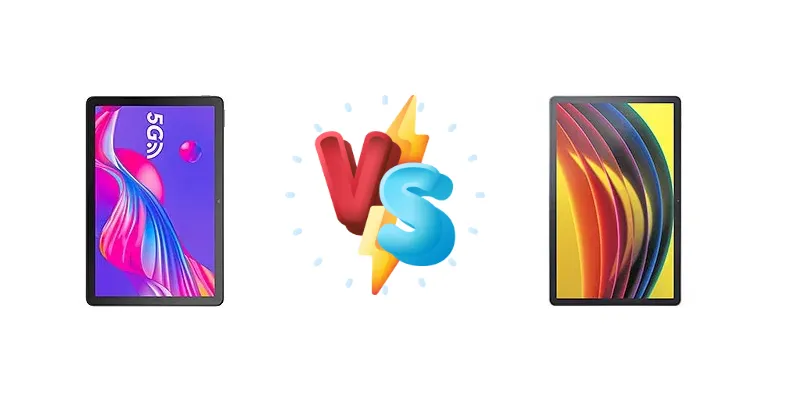
The mid-range tablet market is heating up, with both TCL and Lenovo offering compelling options. The TCL Tab 10s 5G distinguishes itself with integrated 5G connectivity, while the Lenovo Tab P11 Plus focuses on delivering solid performance at a competitive price. This comparison dives deep into the core differences between these two devices, focusing on their chipsets, performance characteristics, and charging capabilities to help you determine which tablet best suits your needs.
🏆 Quick Verdict
For users prioritizing mobile connectivity and future-proofing, the TCL Tab 10s 5G is the better choice, despite a slightly less powerful CPU. However, the Lenovo Tab P11 Plus offers a more refined performance profile for everyday tasks and media consumption, benefiting from its faster charging and potentially better sustained performance due to the more efficient Helio G90T.
| Network |
|---|
| 2G bands | GSM 850 / 900 / 1800 / 1900 | GSM 850 / 900 / 1800 / 1900 |
| 3G bands | HSDPA 850 / 900 / 1900 / 2100 | HSDPA 850 / 900 / 1900 / 2100 |
| 4G bands | 1, 3, 5, 7, 8, 20, 28, 32, 38, 40, 41 | 1, 2, 3, 4, 5, 7, 8, 20, 28, 38, 40, 41 |
| 5G bands | 1, 3, 5, 7, 8, 20, 28, 40, 41, 77, 78 SA/NSA/Sub6 | - |
| Speed | HSPA, LTE, 5G | HSPA, LTE - cellular model only |
| Technology | GSM / HSPA / LTE / 5G | GSM / HSPA / LTE |
| Launch |
|---|
| Announced | 2022, February 27 | 2021, June 28 |
| Status | Available. Released 2022, Q3 | Available. Released 2021, July 29 |
| Body |
|---|
| Dimensions | 241.7 x 158.6 x 8.5 mm (9.52 x 6.24 x 0.33 in) | 258.4 x 163 x 7.5 mm (10.17 x 6.42 x 0.30 in) |
| SIM | Nano-SIM | Nano-SIM (cellular model only) |
| Weight | 490 g (1.08 lb) | 490 g (1.08 lb) |
| | - | Stylus support |
| Display |
|---|
| Resolution | 1200 x 1920 pixels, 16:10 ratio (~224 ppi density) | 1200 x 2000 pixels, 5:3 ratio (~212 ppi density) |
| Size | 10.1 inches, 295.8 cm2 (~77.2% screen-to-body ratio) | 11.0 inches, 344.4 cm2 (~81.8% screen-to-body ratio) |
| Type | IPS LCD | IPS LCD, 400 nits (typ) |
| Platform |
|---|
| CPU | Octa-core (2x2.4 GHz Cortex-A78 & 6x2.0 GHz Cortex-A55) | Octa-core (2x2.05 GHz Cortex-A76 & 6x2.0 GHz Cortex-A55) |
| Chipset | Mediatek MT8771 | Mediatek MT6785 Helio G90T (12 nm) |
| GPU | Mali-G57 MC2 | Mali-G76 MC4 |
| OS | Android 12 | Android 11 |
| Memory |
|---|
| Card slot | microSDXC | microSDXC (dedicated slot) |
| Internal | 64GB 4GB RAM | 64GB 4GB RAM, 128GB 4GB RAM, 128GB 6GB RAM |
| | eMMC 5.1 | - |
| Main Camera |
|---|
| Features | LED flash | LED flash |
| Single | 8 MP, f/2.0, (wide), 1/4.0", 1.12µm, AF | 13 MP, (wide), AF |
| Video | 1080p@30fps | 1080p@30fps |
| Selfie camera |
|---|
| Single | 5 MP, f/2.2, (wide), 1/5.0", 1.12µm | 8 MP, (wide) |
| Video | 1080p@30fps | 1080p@30fps |
| Sound |
|---|
| 3.5mm jack | Yes | No |
| 35mm jack | Yes | No |
| Loudspeaker | Yes, with dual speakers | Yes, with stereo speakers (4 speakers) |
| Comms |
|---|
| Bluetooth | 5.1, A2DP, LE | 5.1, A2DP, LE |
| NFC | No | No |
| Positioning | GPS | GPS, GLONASS, BDS - cellular model only |
| Radio | FM radio, RDS | FM radio |
| USB | USB Type-C 2.0 | USB Type-C 2.0 |
| WLAN | Wi-Fi 802.11 a/b/g/n/ac, dual-band, Wi-Fi Direct | Wi-Fi 802.11 a/b/g/n/ac, dual-band, Wi-Fi Direct |
| Features |
|---|
| Sensors | Accelerometer, proximity | Accelerometer, gyro, proximity |
| Battery |
|---|
| Charging | 18W wired | 20W wired |
| Type | Li-Po 8000 mAh | Li-Po 7700 mAh |
| Misc |
|---|
| Colors | Dark Gray | Slate Grey, Platinum Grey, Modernist teal |
| Models | 9183G | ZA940124SE |
| Price | About 350 EUR | About 300 EUR |
TCL Tab 10s 5G
- Integrated 5G connectivity for on-the-go access.
- Potentially faster single-core performance due to Cortex-A78 cores.
- Modern CPU architecture.
- Slower 18W charging.
- Potentially less efficient chipset leading to thermal throttling.
- Battery capacity unknown.
Lenovo Tab P11 Plus
- Faster 20W wired charging.
- More efficient 12nm process potentially improving sustained performance.
- Strong GPU performance for gaming.
- Lacks integrated 5G connectivity.
- Older Cortex-A76 CPU architecture.
- Battery capacity unknown.
Display Comparison
Neither TCL nor Lenovo provide display specs in the provided data. However, given the market positioning, we can infer both likely utilize IPS LCD panels. The key differentiator will be resolution and brightness. TCL often focuses on value, potentially resulting in a lower resolution panel. Lenovo’s P series typically offers a slightly more premium display experience, potentially with higher brightness levels. Without specific data, it’s difficult to definitively state which offers superior visual quality.
Camera Comparison
Neither device is positioned as a photography powerhouse, and the provided data doesn’t offer details beyond the chipsets. We can assume both will feature basic camera setups suitable for video calls and casual snapshots. Without sensor size or aperture information, a meaningful comparison is impossible. It’s safe to assume image quality will be similar, leaning towards acceptable rather than exceptional.
Performance
The core difference lies in the chipsets. The TCL Tab 10s 5G utilizes the Mediatek MT8771, featuring a Cortex-A78 based CPU. These cores, while clocked at 2.4 GHz, represent a newer architecture than the Cortex-A76 cores in the Lenovo Tab P11 Plus’s Helio G90T (2.05 GHz). However, the G90T benefits from a more mature 12nm process, potentially leading to better thermal efficiency and sustained performance under load. The MT8771’s architecture *should* offer a theoretical single-core performance advantage, but the G90T’s GPU is likely more capable for gaming. The RAM configuration (not specified) will also play a role, but the chipset is the primary bottleneck.
Battery Life
Battery capacity is not specified for either device. However, the charging speeds offer a clear distinction. The Lenovo Tab P11 Plus supports 20W wired charging, while the TCL Tab 10s 5G is limited to 18W. This means the Lenovo will recharge faster, a significant convenience for users who frequently deplete their battery. If battery capacity is similar, the Lenovo will offer a more convenient user experience. Without capacity data, it’s difficult to assess overall battery life, but the faster charging is a clear win for the P11 Plus.
Buying Guide
Buy the TCL Tab 10s 5G if you frequently travel or work remotely and require consistent, high-speed internet access without relying on Wi-Fi. Its 5G modem is a significant advantage. Buy the Lenovo Tab P11 Plus if you primarily use your tablet at home or in locations with reliable Wi-Fi, and prioritize a smooth experience for streaming, browsing, and light gaming, coupled with quicker top-ups thanks to the 20W charging.
Frequently Asked Questions
❓ Will the Mediatek MT8771 in the TCL Tab 10s 5G struggle with demanding games?
While the MT8771’s CPU architecture is newer, the Lenovo Tab P11 Plus’s Helio G90T is specifically designed for gaming with a more powerful GPU. Expect the G90T to deliver a smoother gaming experience, particularly in graphically intensive titles. The MT8771 will handle casual games adequately, but may exhibit frame drops in more demanding scenarios.
❓ How much faster is the 20W charging on the Lenovo Tab P11 Plus compared to the 18W charging on the TCL Tab 10s 5G?
While the difference of 2W may seem small, it translates to a noticeable reduction in charging time. The Lenovo Tab P11 Plus will likely reach a full charge approximately 15-20% faster than the TCL Tab 10s 5G, assuming similar battery capacities. This is particularly beneficial for users who need to quickly top up their tablet before heading out.
❓ Is the 5G connectivity on the TCL Tab 10s 5G worth the extra cost if I have reliable Wi-Fi access most of the time?
If you primarily use your tablet at home or in locations with consistent Wi-Fi, the 5G connectivity may not be a significant benefit. However, if you frequently travel, commute, or work remotely in areas with limited Wi-Fi, the 5G modem provides a valuable and convenient alternative to relying on public hotspots or tethering to your phone.