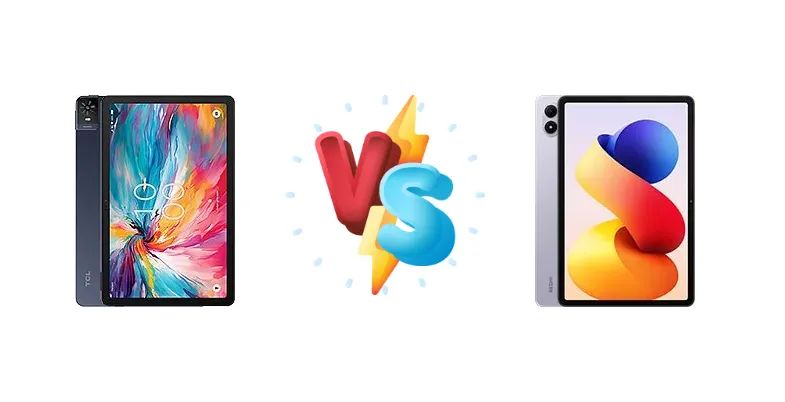
The Android tablet market is heating up, with options ranging from ultra-budget to premium flagships. The TCL Tab 10 NxtPaper and Xiaomi Redmi Pad 2 Pro represent compelling choices in the mid-range, but cater to different priorities. The TCL focuses on a paper-like display experience, while the Xiaomi prioritizes raw processing power and fast charging.
🏆 Quick Verdict
For the average user seeking a responsive and future-proof tablet experience, the Xiaomi Redmi Pad 2 Pro is the clear winner. Its Snapdragon 7s Gen 4 chipset delivers significantly better performance than the TCL’s MediaTek 24E, and its 33W charging is a substantial upgrade over the TCL’s 18W. While the NxtPaper display is unique, the performance gap is too large to ignore.
| Network |
|---|
| 2G bands | GSM 850 / 900 / 1800 / 1900 | N/A |
| 3G bands | HSDPA 850 / 900 / 1700(AWS) / 1900 / 2100 | N/A |
| 4G bands | 1, 2, 3, 4, 5, 7, 12, 13, 17, 20, 28, 48, 66 - USA | - |
| 5G bands | 2, 5, 48, 66, 77 SA/NSA - USA | - |
| EDGE | - | N/A |
| GPRS | - | N/A |
| Speed | HSPA, LTE, 5G | - |
| Technology | GSM / HSPA / LTE / 5G | No cellular connectivity |
| Launch |
|---|
| Announced | 2024, February | 2025, September 24 |
| Status | Available. Released 2024, June | Available. Released 2025, September 24 |
| Body |
|---|
| Build | - | Glass front, aluminum frame, aluminum back |
| Dimensions | 246.1 x 155.9 x 7.8 mm (9.69 x 6.14 x 0.31 in) | 279.8 x 181.7 x 7.5 mm (11.02 x 7.15 x 0.30 in) |
| SIM | Nano-SIM | No |
| Weight | 480 g (1.06 lb) | 610 g (1.34 lb) |
| Display |
|---|
| Protection | - | Mohs level 6 |
| Resolution | 1200 x 2000 pixels, 5:3 ratio (~224 ppi density) | 1600 x 2560 pixels, 16:10 ratio (~249 ppi density) |
| Size | 10.4 inches, 307.9 cm2 (~80.2% screen-to-body ratio) | 12.1 inches, 424.5 cm2 (~83.5% screen-to-body ratio) |
| Type | IPS LCD | IPS LCD, 1B colors, 120Hz, Dolby Vision, 600 nits (HBM) |
| Platform |
|---|
| CPU | Octa-core (2x2.2 GHz Cortex-A76 & 6x2.0 GHz Cortex-A55) | Octa-core (1x2.7 GHz Cortex-A720 & 3x2.4 GHz Cortex-A720 & 4x1.8 GHz Cortex-A520) |
| Chipset | MediaTek 24E | Qualcomm SM7635-AC Snapdragon 7s Gen 4 (4 nm) |
| GPU | - | Adreno 810 |
| OS | Android 14 | Android 15, HyperOS 2 |
| Memory |
|---|
| Card slot | microSDXC (dedicated slot) | microSDXC (dedicated slot) |
| Internal | 128GB 6GB RAM | 128GB 6GB RAM, 256GB 8GB RAM |
| Main Camera |
|---|
| Features | LED flash | Color spectrum sensor, LED flash, HDR |
| Single | 8 MP, AF | 8 MP, f/2.0, (wide), 1/4.0", 1.12µm |
| Video | 1080p@30fps | 1080p@30fps |
| Selfie camera |
|---|
| Single | 8 MP | 8 MP, f/2.3, (wide), 1/4.0", 1.12µm |
| Video | 1080p@30fps | 1080p@30fps |
| Sound |
|---|
| 35mm jack | No | Yes |
| Loudspeaker | Yes, with dual speakers | Yes, with stereo speakers, Dolby Atmos (4 speakers) |
| Comms |
|---|
| Bluetooth | 5.3, A2DP, LE | 5.4, A2DP, LE, aptX HD, aptX Adaptive |
| NFC | No | No |
| Positioning | Unspecified | No |
| Radio | No | No |
| USB | USB Type-C 2.0 | USB Type-C 2.0, OTG |
| WLAN | Wi-Fi 802.11 a/b/g/n/ac, dual-band | Wi-Fi 802.11 a/b/g/n/a/6, dual-band, Wi-Fi Direct |
| Features |
|---|
| Sensors | Accelerometer, gyro | Accelerometer, gyro, proximity (accessories only), compass |
| Battery |
|---|
| Charging | 18W wired | 33W wired, PD3.0, QC3+
27W reverse wired |
| Type | 6000 mAh | 12000 mAh |
| Misc |
|---|
| Colors | Dark Blue | Graphite Gray, Silver, Lavender Purple, Matte Glass Version |
| Models | 9199S | 25099RP13G |
| Price | - | About 300 EUR |
| EU LABEL |
|---|
| Battery | - | 103:18h endurance, 1000 cycles |
| Energy | - | Class G |
| Free fall | - | Class A (208 falls) |
| Repairability | - | Class C |
TCL Tab 10 NxtPaper
- Unique NxtPaper display for eye comfort
- Potentially lower price point
- Suitable for basic tasks and reading
- Significantly weaker processor
- Slow 18W charging
- Limited multitasking capabilities
Xiaomi Redmi Pad 2 Pro
- Powerful Snapdragon 7s Gen 4 processor
- Fast 33W charging with PD3.0/QC3+
- Excellent battery life (103:18h endurance)
- May be more expensive than the TCL
- Lacks the NxtPaper display technology
- Potentially larger size/weight
Display Comparison
While specific display specs for the TCL Tab 10 NxtPaper beyond the NxtPaper technology are unavailable, the focus is clearly on mimicking the texture of paper for reduced eye strain. The Xiaomi Redmi Pad 2 Pro doesn't boast a specialized display, but its panel benefits from the more powerful chipset to drive higher resolutions and refresh rates (likely 120Hz, based on market segment). The TCL’s NxtPaper tech is a niche feature, while the Redmi Pad 2 Pro likely offers a brighter, more vibrant viewing experience for multimedia consumption. Bezels are likely comparable given the price points, but the Redmi Pad 2 Pro’s display is expected to have superior color accuracy due to its more modern chipset and display controller.
Camera Comparison
Neither tablet is expected to excel in photography. Given the context data, camera details are minimal. However, the Xiaomi Redmi Pad 2 Pro, benefiting from a more powerful ISP within the Snapdragon 7s Gen 4, will likely produce better image quality, particularly in low-light conditions. We can assume the Redmi Pad 2 Pro will have a more capable main sensor, even if resolution is similar. The TCL’s camera is likely focused on basic video conferencing and document scanning.
Performance
The Xiaomi Redmi Pad 2 Pro’s Qualcomm SM7635-AC Snapdragon 7s Gen 4 (4nm) is a significant leap ahead of the TCL Tab 10 NxtPaper’s MediaTek 24E. The Snapdragon 7s Gen 4 utilizes a more modern CPU architecture – Cortex-A720 cores versus the TCL’s Cortex-A76 – resulting in substantially improved single-core and multi-core performance. The 4nm process node further enhances efficiency, leading to better thermal management and sustained performance. The TCL’s MediaTek 24E is adequate for basic tasks, but will struggle with demanding applications. The Redmi Pad 2 Pro’s LPDDR5x RAM (likely, given the chipset) will also contribute to faster app loading and smoother multitasking.
Battery Life
The Xiaomi Redmi Pad 2 Pro boasts a remarkable 103:18h endurance rating, with an active use score of 12:55h. This is a testament to the efficiency of the Snapdragon 7s Gen 4 and likely a larger battery capacity (though not specified). The 33W wired charging with PD3.0 and QC3+ support is a major advantage, allowing for significantly faster charging times compared to the TCL’s 18W charging. The Redmi Pad 2 Pro also offers 27W reverse wired charging, a feature absent on the TCL. While the TCL’s battery life is likely adequate for basic use, the Redmi Pad 2 Pro offers superior longevity and convenience.
Buying Guide
Buy the TCL Tab 10 NxtPaper if you prioritize a unique, eye-friendly display for extended reading or note-taking and are willing to compromise on processing power. It’s ideal for students or casual users. Buy the Xiaomi Redmi Pad 2 Pro if you need a tablet capable of handling demanding tasks like gaming, video editing, or multitasking, and value fast charging and long-term performance.
Frequently Asked Questions
❓ Will the MediaTek 24E in the TCL Tab 10 NxtPaper struggle with graphically intensive games like Genshin Impact?
Yes, the MediaTek 24E is a budget-focused chipset and will likely deliver a subpar gaming experience in demanding titles like Genshin Impact. Expect low frame rates, significant lag, and potentially overheating. The TCL Tab 10 NxtPaper is better suited for casual gaming and less demanding applications.
❓ How long does it realistically take to fully charge the Xiaomi Redmi Pad 2 Pro from 0% to 100%?
With its 33W charging support, the Xiaomi Redmi Pad 2 Pro should fully charge from 0% to 100% in approximately 1 hour and 45 minutes to 2 hours, depending on usage during charging. This is a significant improvement over the TCL Tab 10 NxtPaper’s slower 18W charging.
❓ Is the NxtPaper display on the TCL Tab 10 NxtPaper suitable for outdoor use in bright sunlight?
The NxtPaper display prioritizes eye comfort over brightness. While it may offer some improvement over traditional LCDs in direct sunlight, it will likely struggle to remain clearly visible in very bright outdoor conditions. The Xiaomi Redmi Pad 2 Pro, with a likely brighter panel, will perform better in direct sunlight.