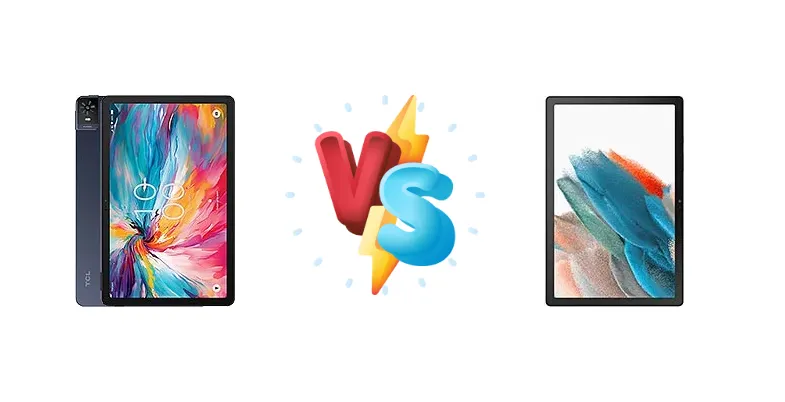
The budget tablet market is fiercely competitive, with the TCL Tab 10 NxtPaper and Samsung Galaxy Tab A8 10.5 (2021) vying for dominance. Both aim to deliver a capable tablet experience without breaking the bank, but they take different approaches to achieving this. This comparison dissects their core components to reveal which tablet offers the best value for your money.
🏆 Quick Verdict
For most users, the TCL Tab 10 NxtPaper is the stronger choice. Its MediaTek 24E chipset, featuring Cortex-A76 cores, provides a noticeable performance advantage over the Samsung’s Unisoc Tiger T618, making it better suited for multitasking and demanding applications. While the Samsung benefits from brand recognition, the TCL delivers more raw power for the price.
| Network |
|---|
| 2G bands | GSM 850 / 900 / 1800 / 1900 | GSM 850 / 900 / 1800 / 1900 |
| 3G bands | HSDPA 850 / 900 / 1700(AWS) / 1900 / 2100 | HSDPA 850 / 900 / 1700(AWS) / 1900 / 2100 |
| 4G bands | 1, 2, 3, 4, 5, 7, 12, 13, 17, 20, 28, 48, 66 - USA | 1, 2, 3, 4, 5, 7, 8, 12, 17, 20, 28, 38, 40, 41, 66 |
| 5G bands | 2, 5, 48, 66, 77 SA/NSA - USA | - |
| Speed | HSPA, LTE, 5G | HSPA, LTE - cellular model only |
| Technology | GSM / HSPA / LTE / 5G | GSM / HSPA / LTE |
| Launch |
|---|
| Announced | 2024, February | 2021, December 15 |
| Status | Available. Released 2024, June | Available. Released 2022, January 17 |
| Body |
|---|
| Dimensions | 246.1 x 155.9 x 7.8 mm (9.69 x 6.14 x 0.31 in) | 246.8 x 161.9 x 6.9 mm (9.72 x 6.37 x 0.27 in) |
| SIM | Nano-SIM | Nano-SIM (cellular model only) |
| Weight | 480 g (1.06 lb) | 508 g (1.12 lb) |
| Display |
|---|
| Resolution | 1200 x 2000 pixels, 5:3 ratio (~224 ppi density) | 1200 x 1920 pixels, 16:10 ratio (~216 ppi density) |
| Size | 10.4 inches, 307.9 cm2 (~80.2% screen-to-body ratio) | 10.5 inches, 319.7 cm2 (~80.0% screen-to-body ratio) |
| Type | IPS LCD | TFT LCD |
| Platform |
|---|
| CPU | Octa-core (2x2.2 GHz Cortex-A76 & 6x2.0 GHz Cortex-A55) | Octa-core (2x2.0 GHz Cortex-A75 & 6x2.0 GHz Cortex-A55) |
| Chipset | MediaTek 24E | Unisoc Tiger T618 (12 nm) |
| GPU | - | Mali G52 MP2 |
| OS | Android 14 | Android 11, upgradable to Android 14, One UI 6 |
| Memory |
|---|
| Card slot | microSDXC (dedicated slot) | microSDXC (dedicated slot) |
| Internal | 128GB 6GB RAM | 32GB 2GB RAM, 32GB 3GB RAM, 64GB 2GB RAM, 64GB 3GB RAM, 64GB 4GB RAM, 128GB 3GB RAM, 128GB 4GB RAM |
| Main Camera |
|---|
| Features | LED flash | - |
| Single | 8 MP, AF | 8 MP, AF |
| Video | 1080p@30fps | 1080p@30fps |
| Selfie camera |
|---|
| Single | 8 MP | 5 MP |
| Video | 1080p@30fps | 1080p@30fps |
| Sound |
|---|
| 3.5mm jack | - | Yes |
| 35mm jack | No | Yes |
| Loudspeaker | Yes, with dual speakers | Yes, with stereo speakers (4 speakers) |
| Comms |
|---|
| Bluetooth | 5.3, A2DP, LE | 5.0, A2DP, LE |
| NFC | No | No |
| Positioning | Unspecified | GPS, GLONASS, BDS, GALILEO, QZSS - cellular model only |
| Radio | No | No |
| USB | USB Type-C 2.0 | USB Type-C 2.0 |
| WLAN | Wi-Fi 802.11 a/b/g/n/ac, dual-band | Wi-Fi 802.11 a/b/g/n/ac, dual-band, Wi-Fi Direct |
| Features |
|---|
| Sensors | Accelerometer, gyro | Accelerometer, gyro, proximity, compass |
| Battery |
|---|
| Charging | 18W wired | 15W wired |
| Type | 6000 mAh | Li-Po 7040 mAh |
| Misc |
|---|
| Colors | Dark Blue | Gray, Silver, Pink Gold |
| Models | 9199S | SM-X200, SM-X205 |
| Price | - | About 230 EUR |
| SAR EU | - | 0.92 W/kg (body) |
TCL Tab 10 NxtPaper
- More powerful CPU with Cortex-A76 cores
- Faster 18W charging
- NxtPaper display reduces eye strain
- Less established brand recognition
- Limited camera specifications
Samsung Galaxy Tab A8 10.5 (2021)
- Samsung ecosystem integration
- Familiar user interface
- Generally reliable software updates
- Less powerful Unisoc Tiger T618 chipset
- Slower 15W charging
- Standard LCD display
Display Comparison
Both tablets feature 10.1-inch and 10.5-inch displays respectively, but the TCL NxtPaper distinguishes itself with its namesake technology. While specific brightness nits aren't provided, the NxtPaper display is engineered to mimic the paper-like texture, reducing eye strain during prolonged reading. The Samsung Tab A8, lacking this specialized tech, relies on a standard LCD panel. The TCL’s focus on a matte finish and reduced blue light emission is a significant advantage for users who spend hours reading ebooks or articles. Bezels appear comparable based on available imagery, and color accuracy data is unavailable for either device, suggesting both target the budget segment where color fidelity isn't a primary concern.
Camera Comparison
Camera performance is unlikely to be a deciding factor for either tablet. Both are equipped with basic camera setups geared towards video calls and casual snapshots. Details on sensor sizes and apertures are scarce, but given the price point, expectations should be tempered. The TCL and Samsung likely employ similar low-resolution sensors, prioritizing cost over image quality. Any 2MP macro or depth sensors present on either device are unlikely to deliver significant value.
Performance
The core difference lies in the chipsets. The TCL Tab 10 NxtPaper utilizes the MediaTek 24E, featuring a more modern CPU architecture with 2x2.2 GHz Cortex-A76 cores and 6x2.0 GHz Cortex-A55 cores. The Samsung Galaxy Tab A8 employs the Unisoc Tiger T618 (12 nm), with 2x2.0 GHz Cortex-A75 cores and 6x2.0 GHz Cortex-A55 cores. The Cortex-A76 cores in the TCL offer a performance uplift over the A75 cores in the Samsung, particularly in single-core tasks. While both use the same Cortex-A55 efficiency cores, the MediaTek’s higher clock speeds and newer architecture translate to a smoother user experience. RAM configurations are not specified, but the TCL’s chipset is better equipped to handle multitasking. Thermal management data is unavailable, but the 12nm process of the Unisoc chip may lead to slightly higher temperatures under sustained load.
Battery Life
Battery capacity isn't specified for either device, but the TCL Tab 10 NxtPaper supports 18W wired charging, while the Samsung Galaxy Tab A8 is limited to 15W. This suggests the TCL could potentially charge faster, offsetting any potential differences in battery size. Real-world battery life will depend heavily on usage patterns, but the more efficient MediaTek 24E chipset in the TCL could contribute to slightly longer runtimes, especially during less demanding tasks. The 3W difference in charging wattage isn't massive, but it could shave off some time during a full charge.
Buying Guide
Buy the TCL Tab 10 NxtPaper if you prioritize performance for everyday tasks, light gaming, and appreciate a display designed for extended reading sessions. Buy the Samsung Galaxy Tab A8 10.5 (2021) if you value the Samsung ecosystem, prefer a more established brand, and primarily need a tablet for basic media consumption and web browsing. The Samsung is a safer, more predictable experience, while the TCL offers more potential.
Frequently Asked Questions
❓ Is the MediaTek 24E chipset in the TCL Tab 10 NxtPaper capable of handling demanding games?
While the MediaTek 24E isn't a gaming powerhouse, it's capable of running many popular mobile games at medium settings. The Cortex-A76 cores provide a performance boost over the Samsung's Unisoc chip, but don't expect flagship-level gaming performance. Lighter games and casual gaming are ideal.
❓ Does the Samsung Galaxy Tab A8 support Samsung DeX for a desktop-like experience?
No, the Samsung Galaxy Tab A8 (2021) does not support Samsung DeX. This feature is typically reserved for Samsung's higher-end tablets. The Tab A8 is designed for basic tablet functionality, not as a desktop replacement.
❓ How does the NxtPaper display affect color accuracy on the TCL Tab 10 NxtPaper?
The NxtPaper display prioritizes eye comfort and a paper-like texture over absolute color accuracy. While suitable for reading and general use, professional color-sensitive work is not recommended. Colors may appear slightly muted compared to a traditional LCD.