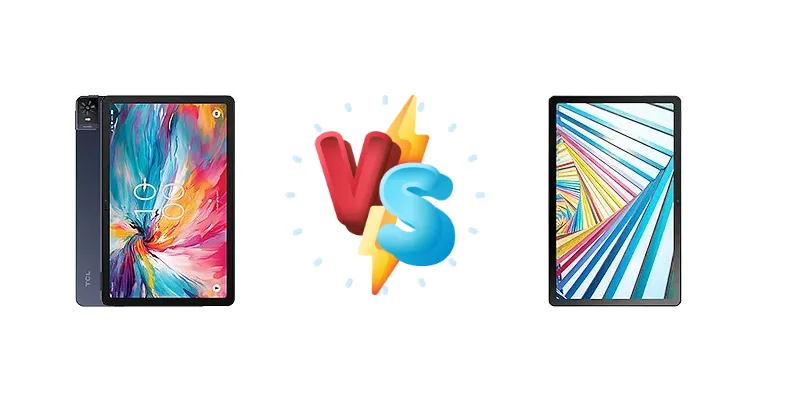
The budget tablet market is fiercely competitive, with options catering to diverse needs. The TCL Tab 10 NxtPaper prioritizes eye comfort with its unique display technology, while the Lenovo Tab M10 Plus (3rd Gen) aims for a balance of performance and features. This comparison dissects their key differences to determine which tablet delivers the best value for your money.
🏆 Quick Verdict
For users prioritizing a paper-like reading experience and extended battery life, the TCL Tab 10 NxtPaper is the better choice. However, the Lenovo Tab M10 Plus (3rd Gen), particularly the LTE model with the Snapdragon 680, offers a noticeable performance edge for multitasking and gaming, making it ideal for more demanding users.
| Network |
|---|
| 2G bands | GSM 850 / 900 / 1800 / 1900 | GSM 850 / 900 / 1800 / 1900 |
| 3G bands | HSDPA 850 / 900 / 1700(AWS) / 1900 / 2100 | HSDPA 800 / 850 / 900 / 1900 / 2100 |
| 4G bands | 1, 2, 3, 4, 5, 7, 12, 13, 17, 20, 28, 48, 66 - USA | 1, 2, 3, 4, 5, 7, 8, 19, 20, 26, 28, 28, 38, 40, 41 |
| 5G bands | 2, 5, 48, 66, 77 SA/NSA - USA | - |
| Speed | HSPA, LTE, 5G | HSPA 42.2/5.76 Mbps, LTE Cat13 390/75 Mbps - cellular model only |
| Technology | GSM / HSPA / LTE / 5G | GSM / HSPA / LTE |
| Launch |
|---|
| Announced | 2024, February | 2022, May |
| Status | Available. Released 2024, June | Available. Released 2022, May |
| Body |
|---|
| Dimensions | 246.1 x 155.9 x 7.8 mm (9.69 x 6.14 x 0.31 in) | 251.2 x 158.8 x 7.5 mm (9.89 x 6.25 x 0.30 in) |
| SIM | Nano-SIM | Nano-SIM (cellular model only) |
| Weight | 480 g (1.06 lb) | 465 g (1.03 lb) |
| | - | Stylus support |
| Display |
|---|
| Resolution | 1200 x 2000 pixels, 5:3 ratio (~224 ppi density) | 1200 x 2000 pixels, 5:3 ratio (~220 ppi density) |
| Size | 10.4 inches, 307.9 cm2 (~80.2% screen-to-body ratio) | 10.61 inches, 320.4 cm2 (~80.3% screen-to-body ratio) |
| Type | IPS LCD | IPS LCD, 400 nits (typ) |
| Platform |
|---|
| CPU | Octa-core (2x2.2 GHz Cortex-A76 & 6x2.0 GHz Cortex-A55) | Octa-core (4x2.4 GHz Kryo 265 Gold & 4x1.9 GHz Kryo 265 Silver) - LTE model Octa-core (2x2.0 GHz Cortex-A75 & 6x1.8 GHz Cortex-A55) - Wi-Fi only model |
| Chipset | MediaTek 24E | Qualcomm SM6225 Snapdragon 680 4G (6 nm) - LTE model Mediatek MT6769V/CU Helio G80 (12 nm) - Wi-Fi only model |
| GPU | - | Adreno 610 - LTE model Mali-G52 MC2 - Wi-Fi only model |
| OS | Android 14 | Android 12 |
| Memory |
|---|
| Card slot | microSDXC (dedicated slot) | microSDXC (dedicated slot) |
| Internal | 128GB 6GB RAM | 32GB 3GB RAM, 64GB 4GB RAM, 128GB 4GB RAM, 128GB 6GB RAM |
| | - | eMCP/uMCP |
| Main Camera |
|---|
| Features | LED flash | - |
| Single | 8 MP, AF | 8 MP, AF |
| Video | 1080p@30fps | 1080p |
| Selfie camera |
|---|
| Single | 8 MP | 8 MP |
| Video | 1080p@30fps | - |
| Sound |
|---|
| 3.5mm jack | - | Yes |
| 35mm jack | No | Yes |
| Loudspeaker | Yes, with dual speakers | Yes, with stereo speakers (4 speakers) |
| Comms |
|---|
| Bluetooth | 5.3, A2DP, LE | 5.0, A2DP, LE |
| NFC | No | No |
| Positioning | Unspecified | GPS, GLONASS, BDS - cellular model only |
| Radio | No | FM Radio |
| USB | USB Type-C 2.0 | USB Type-C 2.0 |
| WLAN | Wi-Fi 802.11 a/b/g/n/ac, dual-band | Wi-Fi 802.11 a/b/g/n/ac, dual-band, Wi-Fi Direct |
| Features |
|---|
| Sensors | Accelerometer, gyro | Accelerometer, proximity, gyro |
| Battery |
|---|
| Charging | 18W wired | 20W wired |
| Type | 6000 mAh | Li-Po 7700 mAh |
| Misc |
|---|
| Colors | Dark Blue | Storm Grey, Frost Blue |
| Models | 9199S | - |
| Price | - | About 260 EUR |
TCL Tab 10 NxtPaper
- Exceptional eye comfort with NxtPaper display
- Potentially longer battery life due to display and chipset efficiency
- Matte finish reduces glare for outdoor use
- Lower processing power compared to Snapdragon 680
- Display may not be ideal for color-critical tasks
Lenovo Tab M10 Plus (3rd Gen)
- Faster performance, especially with Snapdragon 680 variant
- 20W fast charging
- LTE connectivity option for on-the-go use
- Display may cause more eye strain during prolonged use
- Helio G80 variant offers less performance than Snapdragon 680
Display Comparison
The TCL Tab 10 NxtPaper’s defining feature is its NxtPaper display, designed to mimic the texture of paper, reducing eye strain. While specific nit brightness isn't provided, the focus is on minimizing blue light and glare. The Lenovo Tab M10 Plus (3rd Gen) likely offers higher peak brightness for better outdoor visibility, typical of IPS LCD panels. The NxtPaper’s matte finish will reduce reflections, a significant advantage for reading in bright environments. Bezels are likely comparable, given both tablets target a similar price point, but the NxtPaper’s display technology is the key differentiator, prioritizing comfort over color accuracy.
Camera Comparison
Camera performance is unlikely to be a primary concern for buyers in this segment. Both tablets likely feature modest camera setups. Without specific sensor details, it’s safe to assume the Lenovo Tab M10 Plus (3rd Gen) may offer slightly better image quality due to the more powerful ISP within the Snapdragon 680 chipset. However, neither tablet is expected to compete with smartphone cameras; they are sufficient for basic video calls and occasional snapshots. Focusing on megapixel counts alone would be misleading without knowing sensor size and lens quality.
Performance
The Lenovo Tab M10 Plus (3rd Gen) presents two chipset options: the Qualcomm Snapdragon 680 (6nm) in the LTE model and the MediaTek Helio G80 (12nm) in the Wi-Fi only version. The Snapdragon 680, built on a more efficient 6nm process, offers superior performance and thermal management compared to the MediaTek Helio G80. The TCL Tab 10 NxtPaper utilizes the MediaTek 24E. While both the Snapdragon 680 and Helio G80 feature octa-core CPUs, the Snapdragon 680’s Kryo 265 Gold cores (2.4 GHz) provide a performance advantage over the Cortex-A75 cores (2.0 GHz) found in the Helio G80 and the Cortex-A76 cores (2.2 GHz) in the MediaTek 24E. This translates to smoother multitasking and faster app loading times on the Lenovo, especially the Snapdragon variant. The 6nm node of the Snapdragon 680 also contributes to better battery efficiency.
Battery Life
The TCL Tab 10 NxtPaper’s focus on eye comfort often correlates with optimized power consumption. While specific battery capacities aren’t provided, the MediaTek 24E’s efficiency, combined with the NxtPaper display’s lower power draw, likely results in excellent battery life. The Lenovo Tab M10 Plus (3rd Gen) supports 20W wired charging, slightly faster than the TCL’s 18W charging. However, the Snapdragon 680’s efficiency could offset the slightly faster charging, resulting in comparable real-world usage times. The Lenovo’s larger battery (likely, given the chipset) will provide more total capacity, but the TCL’s optimized power draw could lead to longer sustained use.
Buying Guide
Buy the TCL Tab 10 NxtPaper if you need a comfortable display for extended reading, note-taking, or digital art, and value long battery life over raw processing power. Buy the Lenovo Tab M10 Plus (3rd Gen) if you prefer a more responsive experience for everyday tasks, streaming, and light gaming, and require the option of cellular connectivity with the LTE variant.
Frequently Asked Questions
❓ Is the TCL Tab 10 NxtPaper’s display suitable for drawing or digital note-taking with a stylus?
The NxtPaper display’s paper-like texture provides a unique tactile experience that can enhance digital note-taking and drawing. However, it’s important to note that the display isn’t specifically designed for stylus input and may not offer the same level of precision as tablets with dedicated stylus support. The matte finish may also reduce the vibrancy of colors.
❓ Which version of the Lenovo Tab M10 Plus (3rd Gen) should I buy – the Wi-Fi or LTE model?
If you plan to use the tablet primarily at home or in locations with Wi-Fi access, the Wi-Fi model is sufficient. However, if you need internet connectivity on the go, the LTE model with the Snapdragon 680 is highly recommended. The Snapdragon 680 offers a significant performance boost over the Helio G80 in the Wi-Fi model, making it a worthwhile upgrade for users who require cellular connectivity.
❓ How does the MediaTek 24E in the TCL Tab 10 NxtPaper compare to the MediaTek Helio G80 in the Lenovo Tab M10 Plus?
The MediaTek Helio G80 generally outperforms the MediaTek 24E in terms of raw processing power. The Helio G80 features more powerful CPU cores and a more capable GPU, making it better suited for gaming and multitasking. However, the TCL Tab 10 NxtPaper’s NxtPaper display and optimized power consumption may compensate for the lower processing power in certain use cases, such as reading and media consumption.