
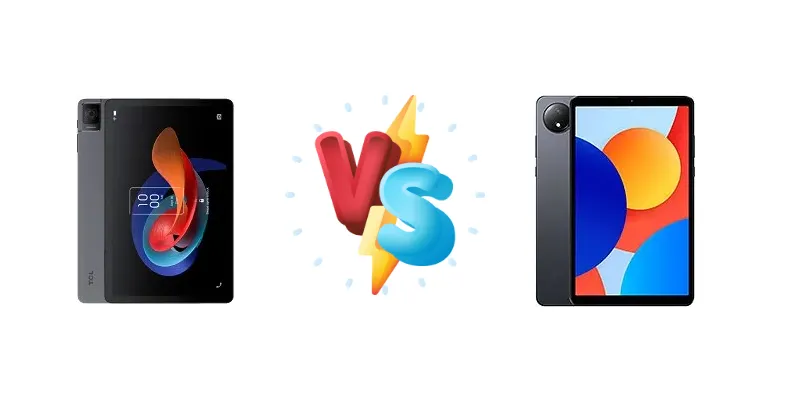
Redmi Pad SE 8.7 vs TCL Tab 10 Gen2: Which Budget Tablet Reigns Supreme?
| Phones Images | |||||
|---|---|---|---|---|---|
|
🏆 Quick Verdict
For most users, the Xiaomi Redmi Pad SE 8.7 is the better choice. Its Helio G85 chipset provides a noticeable performance uplift over the TCL Tab 10 Gen2’s Helio P22T, and the availability of 18W charging (depending on region) significantly reduces charging times. While the TCL offers a slightly larger screen, the Redmi Pad SE’s superior processing power makes it more versatile.
| PHONES | ||
|---|---|---|
| Phone Names | TCL Tab 10 Gen2 | Xiaomi Redmi Pad SE 8.7 |
| Network | ||
|---|---|---|
| 2G bands | GSM 850 / 900 / 1800 / 1900 | GSM 850 / 900 / 1800 / 1900 |
| 3G bands | HSDPA 850 / 900 / 1700(AWS) / 1900 / 2100 | HSDPA 800 / 850 / 900 / 1700(AWS) / 1900 / 2100 |
| 4G bands | 1, 2, 3, 4, 5, 7, 8, 12, 13, 17, 20, 28, 34, 38, 39, 40, 41, 66 | 1, 2, 3, 4, 5, 7, 8, 13, 18, 19, 20, 26, 28, 38, 40, 41, 66 |
| Speed | HSPA, LTE - cellular model only | HSPA, LTE - cellular model only |
| Technology | GSM / HSPA / LTE | GSM / HSPA / LTE |
| Launch | ||
|---|---|---|
| Announced | 2023, August 29 | 2024, July 29 |
| Status | Available. Released 2023, September | Available. Released 2024, August 08 |
| Body | ||
|---|---|---|
| Build | Glass front, aluminum frame | Glass front (Gorilla Glass 3) |
| Dimensions | 244.9 x 154.7 x 7.4 mm (9.64 x 6.09 x 0.29 in) | 211.6 x 125.5 x 8.8 mm (8.33 x 4.94 x 0.35 in) |
| SIM | Nano-SIM (cellular model only) | Nano-SIM + Nano-SIM (cellular model only) |
| Weight | 425 g (14.99 oz) | 370 / 373 / 375 g (13.05 oz) |
| Display | ||
|---|---|---|
| Protection | - | Corning Gorilla Glass 3 |
| Resolution | 1200 x 2000 pixels, 5:3 ratio (~225 ppi density) | 800 x 1340 pixels, 5:3 ratio (~179 ppi density) |
| Size | 10.36 inches, 305.5 cm2 (~80.6% screen-to-body ratio) | 8.7 inches, 214.9 cm2 (~80.9% screen-to-body ratio) |
| Type | IPS LCD, 350 nits | IPS LCD, 1B colors, 90Hz, 600 nits (HBM) |
| Platform | ||
|---|---|---|
| CPU | Octa-core (4x2.0 GHz Cortex-A53 & 4x1.5 GHz Cortex-A53) | Octa-core (2x2.0 GHz Cortex-A75 & 6x1.8 GHz Cortex-A55) |
| Chipset | Mediatek MT6762 Helio P22T (12 nm) | Mediatek Helio G85 (12 nm) |
| GPU | PowerVR GE8320 | Mali-G52 MC2 |
| OS | Android 13 | Android 14, HyperOS |
| Memory | ||
|---|---|---|
| Card slot | microSDXC (dedicated slot) | microSDXC (dedicated slot) |
| Internal | 64GB 4GB RAM, 128GB 4GB | 64GB 4GB RAM, 128GB 4GB RAM, 128GB 6GB RAM |
| Main Camera | ||
|---|---|---|
| Features | LED flash | LED flash |
| Single | 8 MP | 8 MP, f/2.0, (wide), 1/4.0", 1.12µm |
| Video | 1080p@30fps | 1080p@30fps |
| Selfie camera | ||
|---|---|---|
| Single | 5 MP | 5 MP, f/2.2, (wide), 1/5.0", 1.12µm |
| Video | 1080p@30fps | 1080p@30fps |
| Sound | ||
|---|---|---|
| 35mm jack | No | Yes |
| Loudspeaker | Yes, with dual speakers | Yes, with stereo speakers |
| Comms | ||
|---|---|---|
| Bluetooth | 5.0, A2DP, LE | 5.3, A2DP, LE |
| Infrared port | - | Yes |
| NFC | No | No |
| Positioning | Unspecified | GPS, GALILEO, GLONASS, BDS - cellular model only |
| Radio | Unspecified | FM radio |
| USB | USB Type-C 2.0 | USB Type-C 2.0 |
| WLAN | Wi-Fi 802.11 a/b/g/n/ac, dual-band, Wi-Fi Direct | Wi-Fi 802.11 a/b/g/n/ac, dual-band |
| Features | ||
|---|---|---|
| Sensors | Accelerometer | Accelerometer, proximity (accessories only), compass |
| Battery | ||
|---|---|---|
| Charging | 10W wired | 18W wired (Int'l) 10W wired (India) |
| Type | Li-Po 6000 mAh | 6650 mAh |
| Misc | ||
|---|---|---|
| Colors | Space Gray, Glacier Blue | Aurora Green (Forest Green), Sky Blue (Ocean Blue), Graphite Gray (Urban Grey) |
| Models | 8196G, 8496G | 220233L2G |
| Price | About 170 EUR | About 120 EUR |
| SAR | - | 0.90 W/kg (head) 0.65 W/kg (body) |
| SAR EU | - | 0.40 W/kg (head) 0.99 W/kg (body) |
TCL Tab 10 Gen2
- Larger 10.1-inch display for immersive viewing.
- Potentially lower price point (depending on retailer).
- Acceptable for basic tasks like web browsing and video playback.
- Significantly slower Helio P22T processor.
- Slow 10W charging.
- Likely to struggle with multitasking and demanding apps.
Xiaomi Redmi Pad SE 8.7
- Faster and more efficient Helio G85 processor.
- Faster 18W charging (International markets).
- More responsive user experience for everyday tasks.
- Smaller 8.7-inch display.
- May be slightly more expensive than the TCL Tab 10 Gen2.
- Camera performance is likely to be similar to the TCL Tab 10 Gen2.
Display Comparison
Both tablets utilize 12nm process technology, but the display differences are subtle. While specific screen resolutions aren't provided, the TCL Tab 10 Gen2 boasts a 10.1-inch display, offering a larger viewing area compared to the Redmi Pad SE 8.7’s 8.7-inch panel. However, without knowing the panel type (IPS, TFT) or peak brightness for either device, it’s difficult to assess color accuracy or outdoor visibility. The smaller screen size of the Redmi Pad SE may result in a higher pixel density, potentially leading to a sharper image, but this is speculative without further data.
Camera Comparison
Neither tablet is expected to excel in photography. Given the target price point, camera quality is likely to be basic. Without specific sensor details, it’s safe to assume both feature modest camera setups primarily suitable for video calls and casual snapshots. Focusing on camera specs would be misleading without knowing sensor size, aperture, or image processing capabilities. The absence of OIS (Optical Image Stabilization) is almost certain on both devices.
Performance
The core difference lies in the chipsets. The Xiaomi Redmi Pad SE 8.7’s Mediatek Helio G85 is a significant upgrade over the TCL Tab 10 Gen2’s Helio P22T. The G85 features two Cortex-A75 cores clocked at 2.0 GHz alongside six Cortex-A55 cores at 1.8 GHz, while the P22T relies on four Cortex-A53 cores at 2.0 GHz and four at 1.5 GHz. This architectural difference translates to a substantial performance advantage for the Redmi Pad SE, particularly in demanding tasks and gaming. The A75 cores offer a much higher IPC (Instructions Per Clock) than the A53 cores, resulting in snappier responsiveness. While both use 12nm fabrication, the G85’s more modern architecture delivers better efficiency and performance.
Battery Life
Battery capacity isn’t specified, but the charging wattage is a key differentiator. The Redmi Pad SE 8.7 supports 18W wired charging (in international markets, 10W in India), while the TCL Tab 10 Gen2 is limited to 10W. This means the Redmi Pad SE will charge significantly faster, reducing downtime. Even with a similar battery capacity, the faster charging speed provides a tangible benefit. The 10W charging on the TCL Tab 10 Gen2 will likely require several hours for a full charge, while the Redmi Pad SE could potentially reach full charge in under three hours with 18W support.
Buying Guide
Buy the TCL Tab 10 Gen2 if you prioritize a larger display for media consumption and are on a very tight budget, accepting a slower processor and slower charging speeds. Buy the Xiaomi Redmi Pad SE 8.7 if you value performance for light gaming, multitasking, and faster charging, even if it means a slightly smaller screen. The Redmi Pad SE is the better all-rounder for most users.