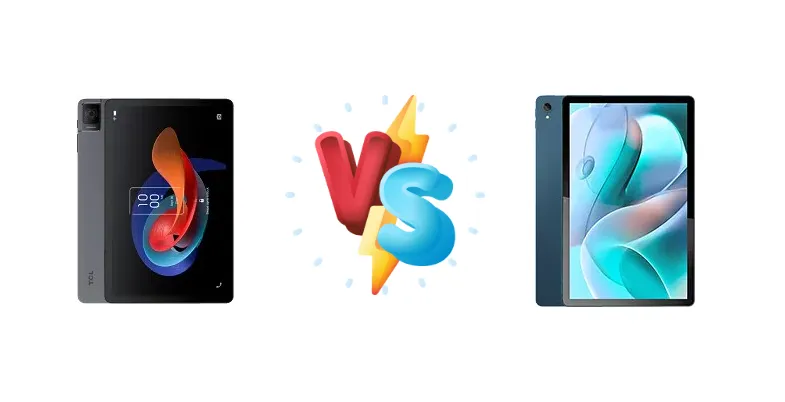
The tablet market offers a wide range of options, but finding the right balance between price and performance can be challenging. We're pitting the TCL Tab 10 Gen2, a budget-friendly option, against the Motorola Moto Tab G70, which aims for a more substantial performance uplift. This comparison will dissect their core components to determine which tablet delivers the best experience for your needs.
🏆 Quick Verdict
For the average user prioritizing smooth multitasking and occasional gaming, the Motorola Moto Tab G70 is the clear winner. Its Helio G90T chipset provides a significant performance advantage over the TCL Tab 10 Gen2's Helio P22T, justifying the potential price difference. However, the TCL remains a viable option for basic tasks.
| Network |
|---|
| 2G bands | GSM 850 / 900 / 1800 / 1900 | GSM 850 / 900 / 1800 / 1900 |
| 3G bands | HSDPA 850 / 900 / 1700(AWS) / 1900 / 2100 | HSDPA 850 / 900 / 1900 / 2100 |
| 4G bands | 1, 2, 3, 4, 5, 7, 8, 12, 13, 17, 20, 28, 34, 38, 39, 40, 41, 66 | 1, 2, 4, 7, 8, 20, 28, 38, 40, 41 |
| Speed | HSPA, LTE - cellular model only | HSPA 42.2/5.76 Mbps, LTE Cat4 150/50 Mbps - cellular model only |
| Technology | GSM / HSPA / LTE | GSM / HSPA / LTE |
| Launch |
|---|
| Announced | 2023, August 29 | 2022, January 12 |
| Status | Available. Released 2023, September | Available. Released 2022, January 13 |
| Body |
|---|
| Build | Glass front, aluminum frame | Glass front, aluminum back, aluminum frame |
| Dimensions | 244.9 x 154.7 x 7.4 mm (9.64 x 6.09 x 0.29 in) | 258.4 x 163 x 7.5 mm (10.17 x 6.42 x 0.30 in) |
| SIM | Nano-SIM (cellular model only) | Nano-SIM (cellular model only) |
| Weight | 425 g (14.99 oz) | 500 g (1.10 lb) |
| | - | Water repellent design |
| Display |
|---|
| Resolution | 1200 x 2000 pixels, 5:3 ratio (~225 ppi density) | 1200 x 2000 pixels, 5:3 ratio (~212 ppi density) |
| Size | 10.36 inches, 305.5 cm2 (~80.6% screen-to-body ratio) | 11.0 inches, 344.4 cm2 (~81.8% screen-to-body ratio) |
| Type | IPS LCD, 350 nits | IPS LCD, 400 nits (typ) |
| Platform |
|---|
| CPU | Octa-core (4x2.0 GHz Cortex-A53 & 4x1.5 GHz Cortex-A53) | Octa-core (2x2.05 GHz Cortex-A76 & 6x2.0 GHz Cortex-A55) |
| Chipset | Mediatek MT6762 Helio P22T (12 nm) | Mediatek MT6785 Helio G90T (12 nm) |
| GPU | PowerVR GE8320 | Mali-G76 MC4 |
| OS | Android 13 | Android 11 |
| Memory |
|---|
| Card slot | microSDXC (dedicated slot) | microSDXC (dedicated slot) |
| Internal | 64GB 4GB RAM, 128GB 4GB | 64GB 4GB RAM, 128GB 6GB RAM |
| | - | eMMC 5.1 |
| Main Camera |
|---|
| Features | LED flash | LED flash |
| Single | 8 MP | 13 MP, f/2.2, 26mm (wide), AF |
| Video | 1080p@30fps | 1080p@30fps |
| Selfie camera |
|---|
| Single | 5 MP | 8 MP, f/2.0, 26mm (wide) |
| Video | 1080p@30fps | 1080p@30fps |
| Sound |
|---|
| 3.5mm jack | - | Yes |
| 35mm jack | No | Yes |
| Loudspeaker | Yes, with dual speakers | Yes, with stereo speakers (4 speakers) |
| Comms |
|---|
| Bluetooth | 5.0, A2DP, LE | 5.2, A2DP, LE |
| NFC | No | No |
| Positioning | Unspecified | GPS, GLONASS - cellular model only |
| Radio | Unspecified | No |
| USB | USB Type-C 2.0 | USB Type-C 2.0, OTG |
| WLAN | Wi-Fi 802.11 a/b/g/n/ac, dual-band, Wi-Fi Direct | Wi-Fi 802.11 a/b/g/n/ac, dual-band, Wi-Fi Direct |
| Features |
|---|
| Sensors | Accelerometer | Accelerometer, gyro, proximity |
| Battery |
|---|
| Charging | 10W wired | 20W wired |
| Type | Li-Po 6000 mAh | Li-Po 7700 mAh |
| Misc |
|---|
| Colors | Space Gray, Glacier Blue | Modernist Teal, Blue |
| Models | 8196G, 8496G | - |
| Price | About 170 EUR | About 380 EUR |
TCL Tab 10 Gen2
- Lower price point makes it accessible.
- Potentially lighter and more portable.
- Sufficient for basic tasks like reading and browsing.
- Significantly slower performance compared to the G70.
- Slower charging speed.
- May struggle with multitasking and demanding apps.
Motorola Moto Tab G70
- Much faster performance thanks to the Helio G90T.
- Faster 20W charging.
- Better suited for gaming and multitasking.
- Likely more expensive than the TCL Tab 10 Gen2.
- Potentially slightly heavier.
- May not offer a dramatically superior display.
Display Comparison
Both tablets utilize 12nm process technology, but the differences begin with their core processing power. While specific display specs are unavailable, the TCL Tab 10 Gen2 likely targets a more cost-effective LCD panel. The Moto Tab G70, positioned slightly higher, may offer improved color accuracy and viewing angles. The lack of information on refresh rates or resolution means the G70's advantage is likely limited to image processing capabilities stemming from its more powerful chipset.
Camera Comparison
Given the budget nature of both tablets, camera performance isn't a primary focus. Detailed camera specs are unavailable, but it's safe to assume both feature modest camera setups. The G70's more powerful ISP (Image Signal Processor), integrated within the Helio G90T, will likely result in slightly better image quality and faster processing, but don't expect flagship-level photography from either device. The presence of any OIS (Optical Image Stabilization) is unlikely on either model.
Performance
The core differentiator lies in the chipsets. The TCL Tab 10 Gen2's MediaTek Helio P22T features an octa-core CPU with a split configuration of 4x2.0 GHz Cortex-A53 and 4x1.5 GHz Cortex-A53 cores. This is a relatively basic configuration geared towards efficiency. In contrast, the Motorola Moto Tab G70 boasts the MediaTek Helio G90T, utilizing a more modern architecture with 2x2.05 GHz Cortex-A76 and 6x2.0 GHz Cortex-A55 cores. The Cortex-A76 cores represent a significant architectural improvement, offering substantially higher single-core performance, crucial for app responsiveness and smoother multitasking. This translates to a noticeably faster and more fluid user experience on the Moto Tab G70.
Battery Life
While battery capacity isn't specified, the Motorola Moto Tab G70's 20W wired charging is a significant advantage over the TCL Tab 10 Gen2's 10W charging. This faster charging speed will drastically reduce the time spent tethered to a power outlet, making the G70 more convenient for on-the-go users. Even with a similar battery capacity, the G90T's improved power efficiency could contribute to slightly longer real-world battery life.
Buying Guide
Buy the TCL Tab 10 Gen2 if you need a basic tablet for light tasks like web browsing, email, and video calls, and your budget is extremely limited. It's ideal for users who prioritize portability and simplicity. Buy the Motorola Moto Tab G70 if you prefer a more responsive experience for multitasking, streaming, and light gaming. It's a better choice for students, entertainment enthusiasts, and anyone who wants a tablet that can handle more demanding applications.
Frequently Asked Questions
❓ Will the Motorola Moto Tab G70 handle demanding games like PUBG Mobile?
The Helio G90T chipset in the Moto Tab G70 is capable of running PUBG Mobile at medium settings with reasonable frame rates. While it won't deliver a flagship gaming experience, it's a significant step up from the TCL Tab 10 Gen2 and provides a playable experience for casual gamers.
❓ Is the performance difference between the Helio P22T and Helio G90T noticeable in everyday use?
Yes, the difference is quite noticeable. The Helio G90T's more modern CPU architecture and higher clock speeds result in significantly faster app launch times, smoother multitasking, and a more responsive overall user experience. The TCL Tab 10 Gen2 may exhibit lag or slowdowns when running multiple apps or demanding tasks.
❓ How long will it take to fully charge each tablet?
With 10W charging, the TCL Tab 10 Gen2 will likely take 3-4 hours to fully charge. The Motorola Moto Tab G70's 20W charging should reduce this to around 1.5-2 hours, offering a much faster turnaround time.
❓ Which tablet is better for video streaming?
The Motorola Moto Tab G70 is better suited for video streaming due to its faster processor, which will handle decoding and playback more efficiently, resulting in smoother streaming and less buffering. While both can stream, the G70 provides a more reliable experience.