
TCL Tab 10 Gen2 vs. Lenovo Tab M10 Plus (3rd Gen): Which Budget Tablet Reigns Supreme?
| Phones Images | |||||
|---|---|---|---|---|---|
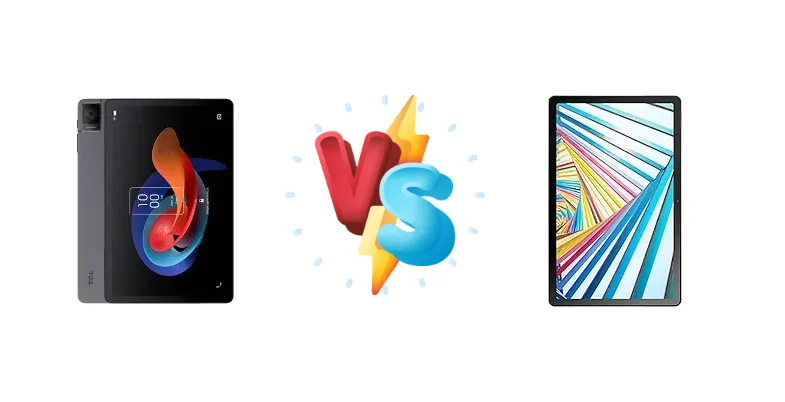
|
🏆 Quick Verdict
For the average user prioritizing responsiveness and faster charging, the Lenovo Tab M10 Plus (3rd Gen) with the Snapdragon 680 is the better choice. While the TCL Tab 10 Gen2 offers a functional experience, the Lenovo’s more modern chipset and 20W charging provide a noticeable performance and convenience advantage.
| PHONES | ||
|---|---|---|
| Phone Names | TCL Tab 10 Gen2 | Lenovo Tab M10 Plus (3rd Gen) |
| Network | ||
|---|---|---|
| 2G bands | GSM 850 / 900 / 1800 / 1900 | GSM 850 / 900 / 1800 / 1900 |
| 3G bands | HSDPA 850 / 900 / 1700(AWS) / 1900 / 2100 | HSDPA 800 / 850 / 900 / 1900 / 2100 |
| 4G bands | 1, 2, 3, 4, 5, 7, 8, 12, 13, 17, 20, 28, 34, 38, 39, 40, 41, 66 | 1, 2, 3, 4, 5, 7, 8, 19, 20, 26, 28, 28, 38, 40, 41 |
| Speed | HSPA, LTE - cellular model only | HSPA 42.2/5.76 Mbps, LTE Cat13 390/75 Mbps - cellular model only |
| Technology | GSM / HSPA / LTE | GSM / HSPA / LTE |
| Launch | ||
|---|---|---|
| Announced | 2023, August 29 | 2022, May |
| Status | Available. Released 2023, September | Available. Released 2022, May |
| Body | ||
|---|---|---|
| Build | Glass front, aluminum frame | - |
| Dimensions | 244.9 x 154.7 x 7.4 mm (9.64 x 6.09 x 0.29 in) | 251.2 x 158.8 x 7.5 mm (9.89 x 6.25 x 0.30 in) |
| SIM | Nano-SIM (cellular model only) | Nano-SIM (cellular model only) |
| Weight | 425 g (14.99 oz) | 465 g (1.03 lb) |
| - | Stylus support | |
| Display | ||
|---|---|---|
| Resolution | 1200 x 2000 pixels, 5:3 ratio (~225 ppi density) | 1200 x 2000 pixels, 5:3 ratio (~220 ppi density) |
| Size | 10.36 inches, 305.5 cm2 (~80.6% screen-to-body ratio) | 10.61 inches, 320.4 cm2 (~80.3% screen-to-body ratio) |
| Type | IPS LCD, 350 nits | IPS LCD, 400 nits (typ) |
| Platform | ||
|---|---|---|
| CPU | Octa-core (4x2.0 GHz Cortex-A53 & 4x1.5 GHz Cortex-A53) | Octa-core (4x2.4 GHz Kryo 265 Gold & 4x1.9 GHz Kryo 265 Silver) - LTE model Octa-core (2x2.0 GHz Cortex-A75 & 6x1.8 GHz Cortex-A55) - Wi-Fi only model |
| Chipset | Mediatek MT6762 Helio P22T (12 nm) | Qualcomm SM6225 Snapdragon 680 4G (6 nm) - LTE model Mediatek MT6769V/CU Helio G80 (12 nm) - Wi-Fi only model |
| GPU | PowerVR GE8320 | Adreno 610 - LTE model Mali-G52 MC2 - Wi-Fi only model |
| OS | Android 13 | Android 12 |
| Memory | ||
|---|---|---|
| Card slot | microSDXC (dedicated slot) | microSDXC (dedicated slot) |
| Internal | 64GB 4GB RAM, 128GB 4GB | 32GB 3GB RAM, 64GB 4GB RAM, 128GB 4GB RAM, 128GB 6GB RAM |
| - | eMCP/uMCP | |
| Main Camera | ||
|---|---|---|
| Features | LED flash | - |
| Single | 8 MP | 8 MP, AF |
| Video | 1080p@30fps | 1080p |
| Selfie camera | ||
|---|---|---|
| Single | 5 MP | 8 MP |
| Video | 1080p@30fps | - |
| Sound | ||
|---|---|---|
| 3.5mm jack | - | Yes |
| 35mm jack | No | Yes |
| Loudspeaker | Yes, with dual speakers | Yes, with stereo speakers (4 speakers) |
| Comms | ||
|---|---|---|
| Bluetooth | 5.0, A2DP, LE | 5.0, A2DP, LE |
| NFC | No | No |
| Positioning | Unspecified | GPS, GLONASS, BDS - cellular model only |
| Radio | Unspecified | FM Radio |
| USB | USB Type-C 2.0 | USB Type-C 2.0 |
| WLAN | Wi-Fi 802.11 a/b/g/n/ac, dual-band, Wi-Fi Direct | Wi-Fi 802.11 a/b/g/n/ac, dual-band, Wi-Fi Direct |
| Features | ||
|---|---|---|
| Sensors | Accelerometer | Accelerometer, proximity, gyro |
| Battery | ||
|---|---|---|
| Charging | 10W wired | 20W wired |
| Type | Li-Po 6000 mAh | Li-Po 7700 mAh |
| Misc | ||
|---|---|---|
| Colors | Space Gray, Glacier Blue | Storm Grey, Frost Blue |
| Models | 8196G, 8496G | - |
| Price | About 170 EUR | About 260 EUR |
TCL Tab 10 Gen2
- Lower price point makes it very accessible.
- Functional for basic tasks like reading and web browsing.
- Acceptable battery life for light usage.
- Significantly slower performance compared to the Lenovo.
- Slow 10W charging.
- Limited multitasking capabilities.
Lenovo Tab M10 Plus (3rd Gen)
- Faster and more responsive performance with Snapdragon 680 (or Helio G80).
- 20W fast charging significantly reduces charging time.
- Better suited for multitasking and light gaming.
- Slightly higher price than the TCL Tab 10 Gen2.
- Display specifications are not detailed.
- Camera performance is likely basic.
Display Comparison
Neither TCL nor Lenovo provide detailed display specifications beyond screen size. However, the core difference lies beneath the surface. While both likely utilize IPS LCD panels, the processing power of the Lenovo Tab M10 Plus allows for potentially smoother animations and faster response times when interacting with the display. The lack of high refresh rate support on either device means the display experience will be similar for static content, but the Lenovo’s chipset will handle dynamic content more efficiently.
Camera Comparison
Camera performance is unlikely to be a deciding factor for either tablet, as both are positioned as budget devices. Detailed camera specs are unavailable, but it’s safe to assume both feature basic camera setups suitable for casual snapshots and video calls. Focusing on the chipset, the Lenovo’s image signal processor (ISP) within the Snapdragon 680 or Helio G80 will likely offer slightly better image processing capabilities than the ISP in the Helio P22T, resulting in marginally improved image quality in favorable lighting conditions.
Performance
The performance gap is the most significant differentiator. The Lenovo Tab M10 Plus (3rd Gen) offers two chipset options: the Qualcomm Snapdragon 680 (6nm) in the 4G LTE model, and the MediaTek Helio G80 (12nm) in the Wi-Fi only model. Both represent a substantial upgrade over the TCL Tab 10 Gen2’s MediaTek MT6762 Helio P22T (12nm). The Snapdragon 680, built on a 6nm process, delivers superior power efficiency and performance compared to the P22T. The Kryo 265 Gold cores in the Snapdragon 680, clocked at 2.4 GHz, outperform the Cortex-A53 cores in the P22T, which are split between 2.0 GHz and 1.5 GHz. This translates to faster app loading times, smoother multitasking, and a more responsive user experience on the Lenovo. Even the Wi-Fi only model with the Helio G80 will offer a performance advantage due to its more modern Cortex-A75 cores.
Battery Life
While battery capacity isn’t specified, the Lenovo Tab M10 Plus (3rd Gen) gains a significant advantage with its 20W wired charging. The TCL Tab 10 Gen2 is limited to 10W charging. This difference in charging speed dramatically impacts usability; the Lenovo can replenish its battery much faster, minimizing downtime. While a larger battery capacity on the TCL Tab 10 Gen2 might partially offset this, the faster charging of the Lenovo is a more impactful benefit for most users.
Buying Guide
Buy the TCL Tab 10 Gen2 if you need a basic tablet for light tasks like reading ebooks, browsing the web, and occasional video streaming, and are on a very tight budget. Its Helio P22T chipset is sufficient for these workloads. Buy the Lenovo Tab M10 Plus (3rd Gen) if you prefer a smoother, more responsive experience for multitasking, gaming, and faster charging, even if it means spending a bit more. The Snapdragon 680 offers a significant performance uplift and the 20W charging is a substantial convenience.