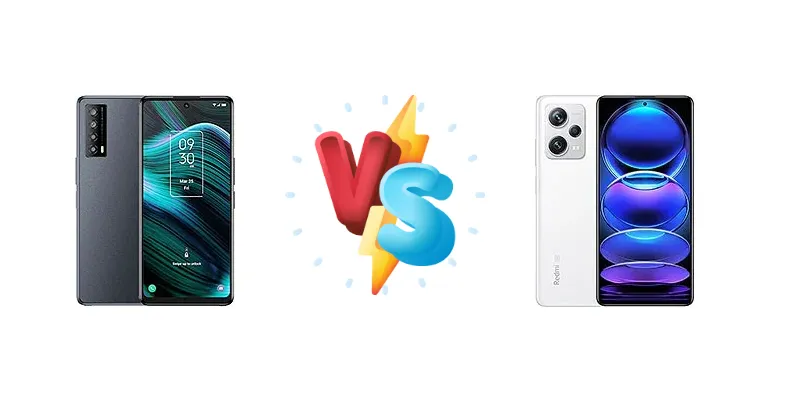
The TCL Stylus and Xiaomi Redmi Note 12 Pro+ represent distinct approaches to the mid-range smartphone market. The TCL prioritizes integrated stylus functionality, while the Xiaomi focuses on delivering flagship-level charging speeds and a high-resolution camera. This comparison dissects their core components to determine which device best suits your needs.
🏆 Quick Verdict
For the average user prioritizing speed and camera capabilities, the Xiaomi Redmi Note 12 Pro+ is the clear winner. Its Dimensity 1080 chipset and 120W charging significantly outperform the TCL Stylus. However, if stylus input is essential, the TCL offers a unique experience at a lower price point.
| Network |
|---|
| 2G bands | GSM 850 / 900 / 1800 / 1900 | GSM 850 / 900 / 1800 / 1900 - SIM 1 & SIM 2 |
| 3G bands | HSDPA 850 / 900 / 1700(AWS) / 1900 / 2100 | HSDPA 800 / 850 / 900 / 1900 / 2100 |
| 4G bands | 2, 4, 5, 12, 25, 26, 41, 66, 71 | 1, 3, 5, 8, 19, 34, 38, 39, 40, 41 - International, China |
| 5G bands | 25, 41, 66, 77 SA/NSA/Sub6 | 1, 3, 5, 8, 28, 38, 40, 41, 77, 78 SA/NSA - International |
| Speed | HSPA, LTE, 5G | HSPA, LTE-A (CA), 5G |
| Technology | GSM / HSPA / LTE / 5G | GSM / CDMA / HSPA / EVDO / LTE / 5G |
| | - | 1, 3, 5, 8, 28, 38, 41, 77, 78 SA/NSA - China |
| Launch |
|---|
| Announced | 2022, June 02 | 2022, October 27 |
| Status | Available. Released 2022, June 02 | Available. Released 2022, November 01 |
| Body |
|---|
| Build | Glass front, plastic frame, plastic back | Glass front (Gorilla Glass 5), glass back |
| Dimensions | 169.6 x 76.5 x 9 mm (6.68 x 3.01 x 0.35 in) | 162.9 x 76 x 8.9 mm (6.41 x 2.99 x 0.35 in) |
| SIM | Nano-SIM | Dual SIM (Nano-SIM, dual stand-by) |
| Weight | 213 g (7.51 oz) | 208.4 g (7.34 oz) |
| | Stylus | IP53, dust and splash resistant |
| Display |
|---|
| Protection | NEG | Corning Gorilla Glass 5 |
| Resolution | 1080 x 2460 pixels (~395 ppi density) | 1080 x 2400 pixels, 20:9 ratio (~395 ppi density) |
| Size | 6.81 inches, 110.1 cm2 (~84.9% screen-to-body ratio) | 6.67 inches, 107.4 cm2 (~86.8% screen-to-body ratio) |
| Type | IPS LCD, 500 nits (typ) | OLED, 1B colors, 120Hz, Dolby Vision, HDR10+, 500 nits (typ), 900 nits (HBM) |
| Platform |
|---|
| CPU | Octa-core (2x2.2 GHz Cortex-A76 & 6x2.0 GHz Cortex-A55) | Octa-core (2x2.6 GHz Cortex-A78 & 6x2.0 GHz Cortex-A55) |
| Chipset | Mediatek Dimensity 700 (7 nm) | Mediatek MT6877V Dimensity 1080 (6 nm) |
| GPU | Mali-G57 MC2 | Mali-G68 MC4 |
| OS | Android 12, TCL UI 4.0 | Android 12, MIUI 13 |
| Memory |
|---|
| Card slot | microSDXC (dedicated slot) | No |
| Internal | 128GB 4GB RAM | 256GB 8GB RAM, 256GB 12GB RAM |
| | - | UFS 2.2 |
| Main Camera |
|---|
| Features | LED flash, HDR, panorama | Dual-LED dual-tone flash, HDR, panorama |
| Single | 13 MP, f/2.3, 19mm (ultrawide), 1/3", 1.12µm | - |
| Triple | 50 MP, f/1.8, 28mm (wide), 1/2.76", 0.64µm, PDAF
5 MP, 115˚ (ultrawide)
2 MP (macro)
Auxiliary lens | 200 MP, f/1.7, 24mm (wide), 1/1.4", 0.56µm, PDAF, OIS
8 MP, f/2.2, 120˚ (ultrawide), 1/4", 1.12µm
2 MP, f/2.4, (macro) |
| Video | 1080p@30fps | 4K@30fps, 1080p@30/60/120fps, 720p@960fps |
| Selfie camera |
|---|
| Features | HDR | HDR |
| Single | 13 MP, f/2.3, 19mm (ultrawide), 1/3", 1.12µm | 16 MP, f/2.5, (wide), 1/3.06", 1.0µm |
| Video | 1080p@30fps | 1080p@30/60fps |
| Sound |
|---|
| 3.5mm jack | Yes | Yes |
| 35mm jack | Yes | - |
| Loudspeaker | Yes, with stereo speakers | Yes, with stereo speakers |
| | - | 24-bit/192kHz audio |
| Comms |
|---|
| Bluetooth | 5.2, A2DP, LE | 5.2, A2DP, LE |
| Infrared port | - | Yes |
| NFC | Yes | Yes (market/region dependent) |
| Positioning | GPS | GPS (L1), GLONASS (G1), BDS (B1I+B1c), GALILEO (E1), QZSS (L1) |
| Radio | Unspecified | No |
| USB | USB Type-C 2.0, OTG | USB Type-C 2.0, OTG |
| WLAN | Wi-Fi 802.11 a/b/g/n/ac, dual-band, Wi-Fi Direct | Wi-Fi 802.11 a/b/g/n/ac/6, dual-band, Wi-Fi Direct |
| Features |
|---|
| Sensors | Fingerprint (side-mounted), accelerometer, gyro, proximity, compass, barometer | Fingerprint (side-mounted), accelerometer, proximity, gyro, compass |
| Battery |
|---|
| Charging | 18W wired | 120W wired, PD3.0, 100% in 19 min (advertised) |
| Type | Li-Ion 4000 mAh | Li-Po 5000 mAh, non-removable |
| Misc |
|---|
| Colors | Lunar Black | Arctic White, Iceberg Blue, Obsidian Black, Trend edition |
| Models | T779W | 22101316UCP, 22101316UG |
| Price | About 240 EUR | $ 348.00 / £ 439.00 / € 399.00 / ₹ 29,949 |
| SAR | 1.25 W/kg (head) 1.25 W/kg (body) | - |
| Tests |
|---|
| Battery life | - |
Endurance rating 88h
|
| Camera | - |
Photo / Video |
| Display | - |
Contrast ratio: Infinite (nominal) |
| Loudspeaker | - |
-26.7 LUFS (Good)
|
| Performance | - |
AnTuTu: 498710 (v9)
GeekBench: 2208 (v5.1), 2372 (v6)
GFXBench: 22fps (ES 3.1 onscreen) |
TCL Stylus
- Integrated Stylus for precise input
- Potentially lower price point
- Acceptable performance for basic tasks
- Slower processor (Dimensity 700)
- Slow charging (18W)
- Likely inferior camera system
Xiaomi Redmi Note 12 Pro+
- Faster processor (Dimensity 1080)
- Ultra-fast 120W charging
- Likely superior camera capabilities
- No integrated stylus
- Potentially higher price
- May require a separate charger for full 120W speed
Display Comparison
The Xiaomi Redmi Note 12 Pro+ boasts an 'Infinite' (nominal) contrast ratio, suggesting a high-quality AMOLED panel, though specific brightness data is missing. The TCL Stylus’s display specifications are not provided, implying a more standard LCD panel. The Redmi Note 12 Pro+'s likely AMOLED technology will deliver superior color vibrancy and deeper blacks, benefiting media consumption. Without specific nit ratings for the TCL, it's reasonable to assume the Redmi Note 12 Pro+ offers a more visually immersive experience.
Camera Comparison
While the Xiaomi Redmi Note 12 Pro+’s camera specifications are limited to 'Photo / Video', its positioning suggests a more advanced system. The absence of detailed camera specs for the TCL Stylus implies a more basic setup. The Redmi Note 12 Pro+ likely benefits from more sophisticated image processing algorithms and potentially larger sensor sizes, leading to better low-light performance and dynamic range. The Redmi Note 12 Pro+'s camera is likely the stronger performer, though a direct comparison requires detailed sensor and aperture information.
Performance
The Xiaomi Redmi Note 12 Pro+’s Mediatek Dimensity 1080 (6nm) represents a significant leap in performance over the TCL Stylus’s Dimensity 700 (7nm). The 6nm process node allows for greater transistor density and improved power efficiency. Furthermore, the Redmi Note 12 Pro+ utilizes Cortex-A78 cores clocked at 2.6 GHz, compared to the TCL’s Cortex-A76 cores at 2.2 GHz. This translates to faster application loading times, smoother multitasking, and a more responsive gaming experience on the Xiaomi. While both utilize Cortex-A55 efficiency cores at 2.0 GHz, the architectural advantage of the Dimensity 1080 is substantial.
Battery Life
The Xiaomi Redmi Note 12 Pro+’s 120W wired charging is its standout feature, promising a full charge in just 19 minutes (advertised). This is a massive advantage over the TCL Stylus’s 18W charging. While the TCL Stylus’s battery capacity is not specified, the Redmi Note 12 Pro+ boasts an endurance rating of 88 hours, indicating a substantial battery life. The faster charging speed of the Redmi Note 12 Pro+ mitigates any potential disadvantage from a slightly smaller battery capacity, offering significantly less downtime.
Buying Guide
Buy the TCL Stylus if you require a built-in stylus for note-taking, sketching, or precise navigation and are willing to compromise on raw processing power and charging speed. Buy the Xiaomi Redmi Note 12 Pro+ if you prioritize fast charging, a capable camera system, and a smoother overall user experience, especially for gaming and demanding applications.
Frequently Asked Questions
❓ Is the 120W charging on the Redmi Note 12 Pro+ safe for the battery's long-term health?
Xiaomi employs multiple layers of safety protocols, including temperature monitoring and optimized charging algorithms, to mitigate potential battery degradation from fast charging. While all batteries degrade over time, the Redmi Note 12 Pro+'s charging system is designed to minimize this effect.
❓ How does the Dimensity 700 in the TCL Stylus handle multitasking compared to the Dimensity 1080 in the Redmi Note 12 Pro+?
The Dimensity 1080's more powerful CPU cores and improved architecture provide a significantly smoother multitasking experience. The TCL Stylus may exhibit slowdowns or app reloading when switching between multiple demanding applications, whereas the Redmi Note 12 Pro+ should handle these tasks with greater ease.
❓ Does the Xiaomi Redmi Note 12 Pro+ support video recording at 4K resolution?
While not explicitly stated in the provided data, Xiaomi typically includes 4K video recording capabilities in their Pro+ models. It's highly probable the Redmi Note 12 Pro+ supports 4K recording, though the exact frame rate options would require further specification review.
❓ Is the stylus on the TCL Stylus pressure sensitive, and can it be used with all apps?
The provided data does not specify pressure sensitivity. However, most stylus implementations offer some level of pressure detection for more natural writing and drawing. App compatibility will vary; while many note-taking and creative apps support styluses, some may require specific settings or updates.