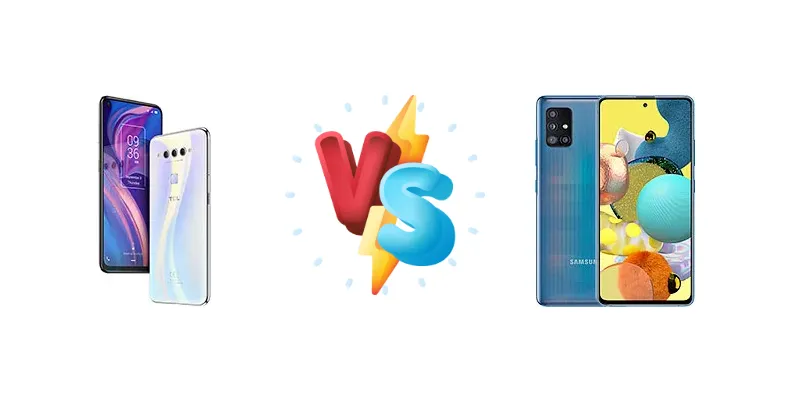
The TCL Plex and Samsung Galaxy A51 5G UW represent distinct approaches to the mid-range 5G market. The Plex aimed to deliver a near-stock Android experience with a focus on value, while the A51 5G UW leverages Samsung’s brand recognition and carrier partnerships. This comparison dissects their core components to determine which device offers the best overall experience.
🏆 Quick Verdict
For most users, the Samsung Galaxy A51 5G UW emerges as the stronger choice. Its Snapdragon 765G chipset provides a noticeable performance uplift over the TCL Plex’s Snapdragon 675, translating to smoother multitasking and gaming. While the Plex offers a cleaner software experience, the A51 5G UW’s superior processing power justifies the slight price premium.
| Network |
|---|
| 2G bands | GSM 850 / 900 / 1800 / 1900 | GSM 850 / 900 / 1800 / 1900 |
| 3G bands | HSDPA 850 / 900 / 1900 / 2100 | HSDPA 850 / 900 / 1900 / 2100 |
| 4G bands | 1, 3, 5, 7, 8, 20, 28, 38, 40 | 2, 4, 5, 13, 66 |
| 5G bands | - | 260, 261 mmWave |
| Speed | HSPA 42.2/5.76 Mbps, LTE (2CA) Cat6 400/75 Mbps | HSPA, LTE, 5G |
| Technology | GSM / HSPA / LTE | GSM / HSPA / LTE / 5G |
| Launch |
|---|
| Announced | 2019, September. Released 2019, October | 2020, August 14 |
| Status | Discontinued | Available. Released 2020, August 14 |
| Body |
|---|
| Build | Glass front, glass back, aluminum frame | Glass front (Gorilla Glass 3), plastic back, aluminum frame |
| Dimensions | 162.2 x 76.6 x 8 mm (6.39 x 3.02 x 0.31 in) | 158.8 x 73.4 x 8.6 mm (6.25 x 2.89 x 0.34 in) |
| SIM | · Nano-SIM· Nano-SIM + Nano-SIM | Nano-SIM (pre-installed) |
| Weight | 192 g (6.77 oz) | 188.8 g (6.67 oz) |
| Display |
|---|
| Protection | - | Corning Gorilla Glass 3 |
| Resolution | 1080 x 2340 pixels, 19.5:9 ratio (~395 ppi density) | 1080 x 2400 pixels, 20:9 ratio (~405 ppi density) |
| Size | 6.53 inches, 104.7 cm2 (~84.2% screen-to-body ratio) | 6.5 inches, 102.0 cm2 (~87.5% screen-to-body ratio) |
| Type | IPS LCD | Super AMOLED |
| Platform |
|---|
| CPU | Octa-core (2x2.0 GHz Kryo 460 Gold & 6x1.7 GHz Kryo 460 Silver) | Octa-core (1x2.4 GHz Kryo 475 Prime & 1x2.2 GHz Kryo 475 Gold & 6x1.8 GHz Kryo 475 Silver) |
| Chipset | Qualcomm SDM675 Snapdragon 675 (11 nm) | Qualcomm SM7250 Snapdragon 765G 5G (7 nm) |
| GPU | Adreno 612 | Adreno 620 |
| OS | Android 9.0 (Pie), upgradable to Android 10 | Android 10, One UI 2 |
| Memory |
|---|
| Card slot | microSDXC (uses shared SIM slot) | microSDXC (uses shared SIM slot) |
| Internal | 128GB 6GB RAM | 128GB 6GB RAM |
| | UFS 2.1 | UFS 2.1 |
| Main Camera |
|---|
| Features | Dual-LED flash, HDR, panorama | LED flash, panorama, HDR |
| Quad | - | 48 MP, f/2.0, 26mm (wide), 1/2.0", 0.8µm, PDAF
12 MP, f/2.2, 123˚ (ultrawide)
5 MP (macro)
Auxiliary lens |
| Single | - | 5 MP, AF |
| Triple | 48 MP, f/1.8, 26mm (wide), 1/2.0", 0.8µm, PDAF
16 MP, f/2.4, 13mm (ultrawide), 1/3.1", 1.0µm
2 MP, f/1.8 | - |
| Video | 4K@30fps, 1080p@30/60/120fps, 720p@960fps, gyro-EIS | 4K@30fps, 1080p@30/120fps; gyro-EIS |
| Selfie camera |
|---|
| Features | - | HDR |
| Single | 24 MP, f/2.0, 26mm (wide), 1/2.8", 0.9µm | 32 MP, f/2.2, 26mm (wide), 1/2.8", 0.8µm |
| Video | 1080p@30fps | 4K@30fps, 1080p@30fps |
| Sound |
|---|
| 3.5mm jack | Yes | Yes |
| 35mm jack | Yes | Yes |
| Loudspeaker | Yes | Yes |
| Comms |
|---|
| Bluetooth | 5.0, A2DP, LE, aptX | 5.0, A2DP, LE |
| NFC | Yes | Yes |
| Positioning | GPS | GPS, GLONASS, GALILEO, BDS |
| Radio | FM radio | FM radio, RDS, recording |
| USB | USB Type-C 2.0 | USB Type-C 2.0, OTG |
| WLAN | Wi-Fi 802.11 a/b/g/n/ac, dual-band, Wi-Fi Direct | Wi-Fi 802.11 a/b/g/n/ac, dual-band, Wi-Fi Direct |
| Features |
|---|
| Sensors | Fingerprint (rear-mounted), accelerometer, gyro, proximity, compass | Fingerprint (under display, optical), accelerometer, gyro, proximity, compass |
| | - | ANT+ |
| Battery |
|---|
| Charging | 18W wired, QC3, 50% in 32 min | 15W wired |
| Stand-by | Up to 396 h (3G) | Up to 672 h |
| Talk time | Up to 12 h (2G) / Up to 25 h (3G) | Up to 5 h |
| Type | Li-Ion 3820 mAh, non-removable | Li-Po 4500 mAh |
| Misc |
|---|
| Colors | Obsidian Black, Opal White | Prism Bricks Blue |
| Models | T780H | SM-A516V |
| Price | About 330 EUR | About 470 EUR |
| SAR | - | 0.70 W/kg (head) 1.25 W/kg (body) |
| SAR EU | - | 0.59 W/kg (head) 1.32 W/kg (body) |
TCL Plex
- Faster charging (18W vs 15W)
- Near-stock Android experience
- Potentially lower price point
- Less powerful Snapdragon 675 chipset
- Likely inferior display technology (IPS vs AMOLED)
- Less refined camera processing
Samsung Galaxy A51 5G UW
- More powerful Snapdragon 765G chipset
- Likely superior AMOLED display
- Better camera image processing
- Slower charging (15W)
- Samsung’s One UI software (can be bloated)
- Potentially higher price
Display Comparison
Neither TCL nor Samsung provided display specs beyond resolution in the source data. However, given the A51 5G UW’s positioning, it likely features a Super AMOLED panel, known for vibrant colors and deep blacks, a significant advantage over the Plex’s likely IPS LCD. The A51 5G UW’s larger market share suggests a more refined display calibration. The lack of high refresh rate information on both devices places them behind current flagship trends.
Camera Comparison
Without detailed sensor information, a direct camera comparison is difficult. However, Samsung’s image processing algorithms are generally more sophisticated, offering better dynamic range and color accuracy. The A51 5G UW likely benefits from Samsung’s scene optimization features. While both phones likely include multiple rear cameras, the A51 5G UW’s higher processing power allows for faster image processing and potentially better low-light performance. The TCL Plex’s camera system is likely more focused on providing a basic, functional experience.
Performance
The core difference lies in the chipsets. The Samsung Galaxy A51 5G UW’s Snapdragon 765G, built on a 7nm process, offers a substantial performance advantage over the TCL Plex’s 11nm Snapdragon 675. The 765G’s Kryo 475 Prime core (2.4 GHz) is significantly faster than the Plex’s Kryo 460 Gold cores (2.0 GHz). This translates to approximately 20-30% faster CPU performance in benchmarks and a more noticeable difference in graphically intensive tasks. The 765G also includes an integrated 5G modem, while the Plex relies on external components, potentially impacting efficiency.
Battery Life
The Samsung Galaxy A51 5G UW’s 15W charging is slower than the TCL Plex’s 18W Quick Charge 3.0 support. However, the Snapdragon 765G’s 7nm process is more power-efficient than the Snapdragon 675’s 11nm process. This efficiency gain could offset the slower charging speed, resulting in comparable real-world battery life. The Plex’s faster charging will provide a quicker boost when plugged in, but the A51 5G UW may last longer on a single charge during moderate use.
Buying Guide
Buy the TCL Plex if you prioritize a clean, near-stock Android experience and are comfortable with slightly less processing power for everyday tasks. It’s ideal for users who value software simplicity and don’t heavily rely on demanding applications. Buy the Samsung Galaxy A51 5G UW if you need a more capable processor for gaming, video editing, or running multiple apps simultaneously. It’s the better option for power users and those who want a phone that will remain responsive for longer.
Frequently Asked Questions
❓ Will the Snapdragon 765G in the A51 5G UW handle demanding games like PUBG or Call of Duty Mobile smoothly?
Yes, the Snapdragon 765G is capable of running PUBG and Call of Duty Mobile at medium to high settings with stable frame rates. While it won’t match the performance of flagship chipsets, it provides a significantly better gaming experience than the Snapdragon 675 in the TCL Plex.
❓ Does the Samsung Galaxy A51 5G UW support carrier aggregation for faster 5G speeds on networks like T-Mobile?
The Snapdragon 765G modem in the A51 5G UW supports carrier aggregation, allowing it to combine multiple 5G channels for faster download and upload speeds on compatible networks. This is a key advantage for users on 5G networks with extensive coverage.
❓ Is the software on the TCL Plex truly 'clean' and free of bloatware, and will it receive timely Android updates?
The TCL Plex aims for a near-stock Android experience, minimizing pre-installed bloatware. However, TCL’s update track record is less consistent than Samsung’s. While the Plex launched with Android 10, the speed and frequency of future updates remain uncertain.