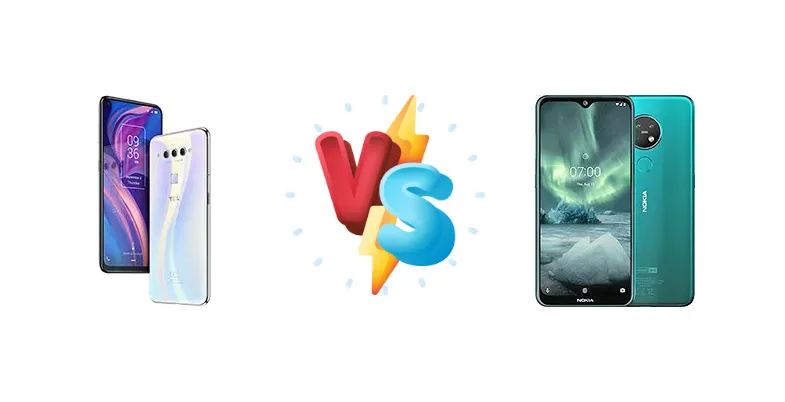
The TCL Plex and Nokia 7.2 represent a fascinating intersection of value and features in the mid-range smartphone market. Both devices aimed to deliver a compelling experience without breaking the bank, but they took different approaches. The TCL Plex, with its newer Snapdragon 675 chipset, promises a performance edge, while the Nokia 7.2 leverages a focus on display quality and a clean Android experience. This comparison dissects the key differences to determine which phone offers the best overall package.
🏆 Quick Verdict
For the average user prioritizing performance and faster charging, the TCL Plex emerges as the winner. Its Snapdragon 675 offers a noticeable performance uplift over the Nokia 7.2’s Snapdragon 660, and the 18W Quick Charge support significantly reduces charging times. While the Nokia 7.2 boasts a respectable display, the Plex’s performance advantage is more impactful for daily use.
| Network |
|---|
| 2G bands | GSM 850 / 900 / 1800 / 1900 | GSM 850 / 900 / 1800 / 1900 |
| 3G bands | HSDPA 850 / 900 / 1900 / 2100 | HSDPA 850 / 900 / 2100 - ROW |
| 4G bands | 1, 3, 5, 7, 8, 20, 28, 38, 40 | 1, 3, 5, 7, 8, 20, 28, 38, 40, 41 - ROW |
| Speed | HSPA 42.2/5.76 Mbps, LTE (2CA) Cat6 400/75 Mbps | HSPA 42.2/5.76 Mbps, LTE (2CA) Cat6 300/50 Mbps or LTE Cat4 150/50 Mbps |
| Technology | GSM / HSPA / LTE | GSM / HSPA / LTE |
| | - | 1, 3, 5, 8, 40, 41 - IN |
| Launch |
|---|
| Announced | 2019, September. Released 2019, October | 2019, September 05. Released 2019, September 23 |
| Status | Discontinued | Discontinued |
| Body |
|---|
| Build | Glass front, glass back, aluminum frame | Glass front (Gorilla Glass 3), glass back (Gorilla Glass 3), plastic frame |
| Dimensions | 162.2 x 76.6 x 8 mm (6.39 x 3.02 x 0.31 in) | 159.9 x 75.2 x 8.3 mm (6.30 x 2.96 x 0.33 in) |
| SIM | · Nano-SIM· Nano-SIM + Nano-SIM | · Nano-SIM· Nano-SIM + Nano-SIM |
| Weight | 192 g (6.77 oz) | 180 g (6.35 oz) |
| Display |
|---|
| Protection | - | Corning Gorilla Glass 3 |
| Resolution | 1080 x 2340 pixels, 19.5:9 ratio (~395 ppi density) | 1080 x 2280 pixels, 19:9 ratio (~400 ppi density) |
| Size | 6.53 inches, 104.7 cm2 (~84.2% screen-to-body ratio) | 6.3 inches, 99.1 cm2 (~82.4% screen-to-body ratio) |
| Type | IPS LCD | IPS LCD, HDR10 |
| Platform |
|---|
| CPU | Octa-core (2x2.0 GHz Kryo 460 Gold & 6x1.7 GHz Kryo 460 Silver) | Octa-core (4x2.2 GHz Kryo 260 Gold & 4x1.8 GHz Kryo 260 Silver) |
| Chipset | Qualcomm SDM675 Snapdragon 675 (11 nm) | Qualcomm SDM660 Snapdragon 660 (14 nm) |
| GPU | Adreno 612 | Adreno 512 |
| OS | Android 9.0 (Pie), upgradable to Android 10 | Android 9.0 (Pie), upgradable to Android 11, Android One |
| Memory |
|---|
| Card slot | microSDXC (uses shared SIM slot) | microSDXC (dedicated slot) |
| Internal | 128GB 6GB RAM | 64GB 4GB RAM, 64GB 6GB RAM, 128GB 4GB RAM, 128GB 6GB RAM |
| | UFS 2.1 | eMMC 5.1 |
| Main Camera |
|---|
| Features | Dual-LED flash, HDR, panorama | Zeiss optics, LED flash, panorama, HDR |
| Triple | 48 MP, f/1.8, 26mm (wide), 1/2.0", 0.8µm, PDAF
16 MP, f/2.4, 13mm (ultrawide), 1/3.1", 1.0µm
2 MP, f/1.8 | 48 MP, f/1.8, (wide), 1/2.0", 0.8µm, PDAF
8 MP, f/2.2, 13mm (ultrawide), 1/4.0", 1.12µm
Auxiliary lens |
| Video | 4K@30fps, 1080p@30/60/120fps, 720p@960fps, gyro-EIS | 4K@30fps, 1080p@30fps (gyro-EIS) |
| Selfie camera |
|---|
| Features | - | Zeiss optics, HDR |
| Single | 24 MP, f/2.0, 26mm (wide), 1/2.8", 0.9µm | 20 MP, f/2.0, (wide), 1/3", 0.9µm |
| Video | 1080p@30fps | 1080p@30fps |
| Sound |
|---|
| 3.5mm jack | Yes | Yes |
| 35mm jack | Yes | Yes |
| Loudspeaker | Yes | Yes |
| Comms |
|---|
| Bluetooth | 5.0, A2DP, LE, aptX | 5.0, A2DP, EDR, LE, aptX |
| NFC | Yes | Yes (excl. India) |
| Positioning | GPS | GPS, GLONASS, GALILEO, BDS |
| Radio | FM radio | FM radio |
| USB | USB Type-C 2.0 | USB Type-C 2.0, OTG |
| WLAN | Wi-Fi 802.11 a/b/g/n/ac, dual-band, Wi-Fi Direct | Wi-Fi 802.11 b/g/n/ac, dual-band, Wi-Fi Direct |
| Features |
|---|
| Sensors | Fingerprint (rear-mounted), accelerometer, gyro, proximity, compass | Fingerprint (rear-mounted), accelerometer, gyro, proximity, compass |
| Battery |
|---|
| Charging | 18W wired, QC3, 50% in 32 min | 10W wired |
| Stand-by | Up to 396 h (3G) | - |
| Talk time | Up to 12 h (2G) / Up to 25 h (3G) | - |
| Type | Li-Ion 3820 mAh, non-removable | Li-Po 3500 mAh, non-removable |
| Misc |
|---|
| Colors | Obsidian Black, Opal White | Cyan Green, Charcoal, Ice |
| Models | T780H | TA-1193, TA-1178, TA-1196, TA-1181 |
| Price | About 330 EUR | About 240 EUR |
| SAR | - | 1.15 W/kg (head) 0.90 W/kg (body) |
| SAR EU | - | 0.99 W/kg (head) 1.44 W/kg (body) |
| Tests |
|---|
| Audio quality | - |
Noise -93.0dB / Crosstalk -93.4dB |
| Battery life | - |
Endurance rating 69h
|
| Camera | - |
Photo / Video |
| Display | - |
Contrast ratio: 1342:1 (nominal) |
| Loudspeaker | - |
-29.6 LUFS (Average)
|
| Performance | - |
AnTuTu: 139495 (v7), 164484 (v8)
GeekBench: 5440 (v4.4), 1398 (v5.1)
GFXBench: 8.1fps (ES 3.1 onscreen) |
TCL Plex
- Faster Snapdragon 675 processor
- 18W Quick Charge support for rapid charging
- More efficient 11nm process node
- Limited display specifications available
- Camera performance less documented
Nokia 7.2
- Brighter display with good contrast ratio
- Clean Android experience
- Zeiss optics for potentially better image quality
- Slower Snapdragon 660 processor
- Slow 10W charging
- Older 14nm process node
Display Comparison
The Nokia 7.2’s display boasts a measured peak brightness of 585 nits and a 1342:1 contrast ratio, providing a vibrant and visible viewing experience, particularly outdoors. While the TCL Plex’s display specifications aren’t explicitly provided, it’s reasonable to assume it falls within a similar range given its market positioning. However, the Nokia 7.2’s contrast ratio, while nominally 1342:1, is a key strength. The lack of detailed display specs for the Plex makes a direct comparison difficult, but the Nokia 7.2’s measured brightness gives it a slight edge for users who frequently consume content in bright environments.
Camera Comparison
Both phones feature photo and video capabilities, but detailed camera specifications are limited. Without information on sensor size, aperture, or image processing algorithms, a definitive comparison is challenging. However, the focus should be on real-world image quality rather than megapixel counts. The Nokia 7.2’s camera is known for its Zeiss optics, which typically deliver good color accuracy and sharpness. The TCL Plex’s camera performance is less documented, making it difficult to assess its strengths and weaknesses. The absence of OIS (Optical Image Stabilization) details for either phone suggests that low-light performance may be a limiting factor.
Performance
The core difference between these two phones lies in their chipsets. The TCL Plex utilizes the Qualcomm Snapdragon 675 (11nm), featuring an octa-core CPU with a Kryo 460 Gold/Silver configuration clocked up to 2.0 GHz. This is a significant step up from the Nokia 7.2’s Snapdragon 660 (14nm), which has an octa-core Kryo 260 Gold/Silver configuration topping out at 2.2 GHz. Despite the slightly higher clock speed of the 660, the 675’s newer architecture and smaller 11nm process node translate to better power efficiency and sustained performance. The 675’s CPU architecture is more modern, offering improved IPC (Instructions Per Clock) which means it can accomplish more with each clock cycle. This difference will be most noticeable in demanding tasks like gaming and video editing.
Battery Life
Both the TCL Plex and Nokia 7.2 achieve an endurance rating of 69 hours, suggesting comparable battery life under similar usage conditions. However, the charging speeds differ significantly. The TCL Plex supports 18W wired charging with Quick Charge 3.0, allowing it to reach 50% charge in just 32 minutes. The Nokia 7.2 is limited to 10W wired charging, resulting in a considerably slower charging experience. This difference in charging speed is a major advantage for the TCL Plex, especially for users who frequently need to top up their battery quickly.
Buying Guide
Buy the TCL Plex if you need a phone that can handle multitasking, moderate gaming, and benefits from quicker charging speeds. It’s ideal for users who frequently switch between apps or enjoy mobile games. Buy the Nokia 7.2 if you prioritize a clean Android experience, a slightly brighter display, and are less concerned with raw processing power. It’s a good choice for users who primarily use their phone for communication, browsing, and basic photography.
Frequently Asked Questions
❓ Will the Snapdragon 675 in the TCL Plex handle demanding games like PUBG or Call of Duty Mobile smoothly?
Yes, the Snapdragon 675 is capable of running PUBG and Call of Duty Mobile at medium to high settings with playable frame rates. While it won't deliver a flagship-level gaming experience, it provides a significant improvement over the Snapdragon 660 in the Nokia 7.2, offering smoother gameplay and reduced lag.
❓ How much slower is the 10W charging on the Nokia 7.2 compared to the 18W Quick Charge on the TCL Plex?
The difference is substantial. The TCL Plex can reach 50% charge in 32 minutes, while the Nokia 7.2 will take considerably longer – likely over 1.5 to 2 hours to reach the same level. This makes the TCL Plex a much more convenient option for users who need to quickly top up their battery.
❓ Does the Nokia 7.2's clean Android experience offer faster software updates compared to the TCL Plex?
Historically, Nokia has prioritized timely Android updates as part of its Android One program. TCL's update track record is less consistent. Therefore, the Nokia 7.2 is likely to receive faster and more frequent software updates, providing access to the latest features and security patches.