
TCL Plex vs. Google Pixel 4a 5G: A Deep Dive into Mid-Range 5G Performance
| Phones Images | |||||
|---|---|---|---|---|---|
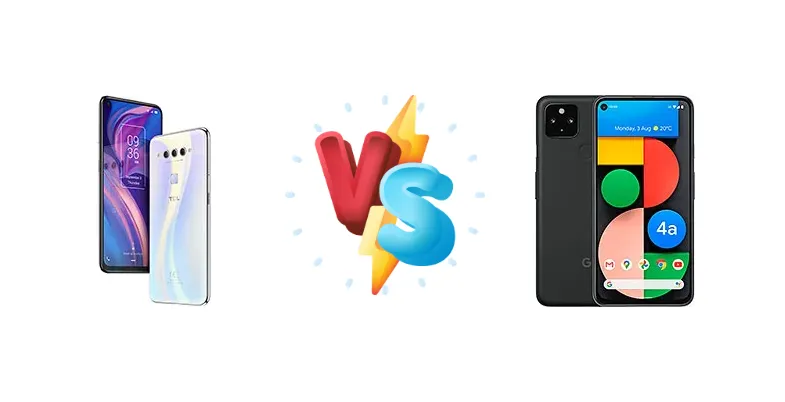
|
🏆 Quick Verdict
For the average user prioritizing camera quality and software support, the Google Pixel 4a 5G is the clear winner. Its Snapdragon 765G offers a noticeable performance uplift and benefits from Google’s renowned computational photography. However, the TCL Plex presents a strong value proposition for those seeking a functional 5G device at a potentially lower cost.
| PHONES | ||
|---|---|---|
| Phone Names | TCL Plex | Google Pixel 4a 5G |
| Network | ||
|---|---|---|
| 2G bands | GSM 850 / 900 / 1800 / 1900 | GSM 850 / 900 / 1800 / 1900 |
| 3G bands | HSDPA 850 / 900 / 1900 / 2100 | HSDPA 850 / 900 / 1700(AWS) / 1900 / 2100 |
| 4G bands | 1, 3, 5, 7, 8, 20, 28, 38, 40 | 1, 2, 3, 4, 5, 7, 8, 12, 13, 14, 17, 18, 19, 20, 25, 26, 28, 29, 30, 32, 38, 39, 40, 41, 42, 46, 48, 66, 71 |
| 5G bands | - | 1, 2, 3, 5, 7, 8, 12, 28, 41, 66, 71, 77, 78 Sub6, mmWave (market dependant) |
| Speed | HSPA 42.2/5.76 Mbps, LTE (2CA) Cat6 400/75 Mbps | HSPA, LTE, 5G |
| Technology | GSM / HSPA / LTE | GSM / HSPA / LTE / 5G |
| Launch | ||
|---|---|---|
| Announced | 2019, September. Released 2019, October | 2020, September 30 |
| Status | Discontinued | Available. Released 2020, November 05 |
| Body | ||
|---|---|---|
| Build | Glass front, glass back, aluminum frame | Glass front (Gorilla Glass 3), plastic back, plastic frame |
| Dimensions | 162.2 x 76.6 x 8 mm (6.39 x 3.02 x 0.31 in) | 153.9 x 74 x 8.2 mm (Sub-6) or 8.5 mm (Sub-6 and mmWave) |
| SIM | · Nano-SIM· Nano-SIM + Nano-SIM | Nano-SIM + eSIM |
| Weight | 192 g (6.77 oz) | 168 g (5G Sub-6); 171 g ( 5G Sub-6 and mmWave) (5.93 oz) |
| Display | ||
|---|---|---|
| Protection | - | Corning Gorilla Glass 3 |
| Resolution | 1080 x 2340 pixels, 19.5:9 ratio (~395 ppi density) | 1080 x 2340 pixels, 19.5:9 ratio (~413 ppi density) |
| Size | 6.53 inches, 104.7 cm2 (~84.2% screen-to-body ratio) | 6.2 inches, 95.7 cm2 (~84.1% screen-to-body ratio) |
| Type | IPS LCD | OLED, HDR |
| - | Always-on display | |
| Platform | ||
|---|---|---|
| CPU | Octa-core (2x2.0 GHz Kryo 460 Gold & 6x1.7 GHz Kryo 460 Silver) | Octa-core (1x2.4 GHz Kryo 475 Prime & 1x2.2 GHz Kryo 475 Gold & 6x1.8 GHz Kryo 475 Silver) |
| Chipset | Qualcomm SDM675 Snapdragon 675 (11 nm) | Qualcomm SM7250 Snapdragon 765G 5G (7 nm) |
| GPU | Adreno 612 | Adreno 620 |
| OS | Android 9.0 (Pie), upgradable to Android 10 | Android 11, upgradable to Android 14 |
| Memory | ||
|---|---|---|
| Card slot | microSDXC (uses shared SIM slot) | No |
| Internal | 128GB 6GB RAM | 128GB 6GB RAM |
| UFS 2.1 | UFS 2.1 | |
| Main Camera | ||
|---|---|---|
| Dual | - | 12.2 MP, f/1.7, 27mm (wide), 1/2.55", 1.4µm, dual pixel PDAF, OIS 16 MP, f/2.2, 107˚ (ultrawide), 1.0µm |
| Features | Dual-LED flash, HDR, panorama | LED flash, Pixel Shift, Auto-HDR, panorama |
| Triple | 48 MP, f/1.8, 26mm (wide), 1/2.0", 0.8µm, PDAF 16 MP, f/2.4, 13mm (ultrawide), 1/3.1", 1.0µm 2 MP, f/1.8 | - |
| Video | 4K@30fps, 1080p@30/60/120fps, 720p@960fps, gyro-EIS | 4K@30/60fps, 1080p@30/60/120/240fps; gyro-EIS |
| Selfie camera | ||
|---|---|---|
| Features | - | HDR |
| Single | 24 MP, f/2.0, 26mm (wide), 1/2.8", 0.9µm | 8 MP, f/2.0, 24mm (wide), 1/4.0", 1.12µm |
| Video | 1080p@30fps | 1080p@30fps |
| Sound | ||
|---|---|---|
| 3.5mm jack | Yes | Yes |
| 35mm jack | Yes | Yes |
| Loudspeaker | Yes | Yes, with stereo speakers |
| Comms | ||
|---|---|---|
| Bluetooth | 5.0, A2DP, LE, aptX | 5.0, A2DP, LE, aptX HD |
| NFC | Yes | Yes |
| Positioning | GPS | GPS, GLONASS, GALILEO, QZSS, BDS |
| Radio | FM radio | No |
| USB | USB Type-C 2.0 | USB Type-C 3.1 |
| WLAN | Wi-Fi 802.11 a/b/g/n/ac, dual-band, Wi-Fi Direct | Wi-Fi 802.11 a/b/g/n/ac, dual-band, Wi-Fi Direct |
| Features | ||
|---|---|---|
| Sensors | Fingerprint (rear-mounted), accelerometer, gyro, proximity, compass | Fingerprint (rear-mounted), accelerometer, gyro, proximity, compass, barometer |
| Battery | ||
|---|---|---|
| Charging | 18W wired, QC3, 50% in 32 min | 18W wired, PD2.0 |
| Stand-by | Up to 396 h (3G) | - |
| Talk time | Up to 12 h (2G) / Up to 25 h (3G) | - |
| Type | Li-Ion 3820 mAh, non-removable | Li-Po 3885 mAh |
| Misc | ||
|---|---|---|
| Colors | Obsidian Black, Opal White | Just Black, Clearly White |
| Models | T780H | GD1YQ, G025I, G025E, G025H, G6QU3 |
| Price | About 330 EUR | About 140 EUR |
TCL Plex
- Potentially lower price point
- Functional 5G connectivity
- QC3.0 fast charging support
- Less powerful Snapdragon 675 chipset
- Inferior camera performance compared to Pixel
- Likely slower software updates
Google Pixel 4a 5G
- More powerful Snapdragon 765G chipset
- Superior camera quality with Google’s software
- Guaranteed Android updates and features
- Higher price compared to TCL Plex
- Same 18W charging as the TCL Plex
- May not be significantly faster in all real-world scenarios
Display Comparison
Neither TCL nor Google provided display specs beyond the basics. However, the TCL Plex's reliance on the Snapdragon 675 suggests a less sophisticated display panel compared to the Pixel 4a 5G. The 765G chipset typically pairs with displays capable of higher refresh rates and potentially better color accuracy. While both likely feature LCD panels, the Pixel 4a 5G’s more powerful ISP could translate to better image processing for display output, resulting in more vibrant and accurate colors.
Camera Comparison
While both phones likely feature multi-camera setups, the Pixel 4a 5G benefits immensely from Google’s computational photography prowess. The Snapdragon 765G’s image signal processor (ISP) is more advanced than the 675’s, enabling superior noise reduction, dynamic range, and detail preservation. While sensor sizes aren’t specified, Google’s software algorithms consistently extract more detail and produce more pleasing images, even with potentially similar hardware. The TCL Plex will likely offer a serviceable camera experience, but it won’t match the Pixel’s consistently high image quality.
Performance
The core difference lies in the chipsets: the TCL Plex utilizes the Qualcomm Snapdragon 675 (11nm) while the Pixel 4a 5G boasts the Snapdragon 765G (7nm). This is a significant architectural leap. The 7nm process node of the 765G is substantially more efficient, allowing for higher clock speeds (2.4GHz prime core vs 2.0GHz on the Plex) and improved sustained performance. The Kryo 475 cores in the Pixel 4a 5G also represent an architectural improvement over the Kryo 460 cores in the Plex. This translates to faster app loading times, smoother multitasking, and a more responsive gaming experience on the Pixel 4a 5G. The 765G’s integrated 5G modem also offers potentially faster and more reliable 5G connectivity.
Battery Life
Both devices offer 18W wired charging with Quick Charge 3.0 (TCL Plex) and Power Delivery 2.0 (Pixel 4a 5G). While the charging wattage is identical, the Snapdragon 765G’s improved power efficiency in the Pixel 4a 5G could lead to slightly better real-world battery life despite potentially similar battery capacities (not specified in the provided data). The 7nm process allows the 765G to operate more efficiently, reducing power consumption during everyday tasks. Both phones claim a 50% charge in around 30-32 minutes, but the Pixel 4a 5G may achieve this more consistently due to its more efficient chipset.
Buying Guide
Buy the TCL Plex if you need a functional 5G phone with a focus on affordability and aren't heavily reliant on top-tier camera performance or guaranteed software updates. Buy the Google Pixel 4a 5G if you prioritize a superior camera experience, clean and timely Android updates, and a smoother overall user experience, even if it means paying a slight premium.