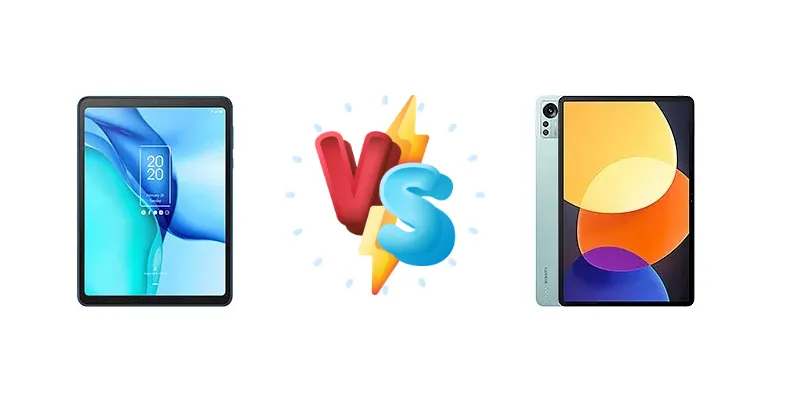
The Android tablet market is heating up, offering options for every user. We pit the TCL NxtPaper, focused on a paper-like reading experience and portability, against the Xiaomi Pad 5 Pro 12.4, a performance-oriented device aimed at power users and creative professionals. This comparison dissects their core strengths and weaknesses to determine which tablet delivers the best value.
🏆 Quick Verdict
For the average user prioritizing performance and versatility, the Xiaomi Pad 5 Pro 12.4 is the clear winner. Its Snapdragon 870 chipset and 67W fast charging significantly outperform the TCL NxtPaper’s Mediatek MT8768E and 18W charging. However, the NxtPaper’s unique display is compelling for dedicated readers.
| Network |
|---|
| 2G bands | GSM 850 / 900 / 1800 / 1900 | N/A |
| 3G bands | HSDPA 850 / 900 / 1700(AWS) / 1900 / 2100 | N/A |
| 4G bands | 1, 2, 3, 4, 5, 7, 8, 17, 18, 19, 20, 26, 28, 34, 38, 39, 40, 41 | N/A |
| EDGE | - | No |
| GPRS | - | No |
| Speed | HSPA, LTE | - |
| Technology | GSM / HSPA / LTE | No cellular connectivity |
| Launch |
|---|
| Announced | 2021, January 12 | 2022, August 11 |
| Status | Cancelled | Available. Released 2022, August 24 |
| Body |
|---|
| Build | - | Glass front (Gorilla Glass 3), aluminum frame, aluminum back |
| Dimensions | 203.8 x 150.8 x 7.5 mm (8.02 x 5.94 x 0.30 in) | 285 x 185.2 x 6.7 mm (11.22 x 7.29 x 0.26 in) |
| SIM | Nano-SIM | No |
| Weight | 316 g (11.15 oz) | 620 g (1.37 lb) |
| | Splash resistant | Stylus support (magnetic) |
| Display |
|---|
| Protection | - | Corning Gorilla Glass 3 |
| Resolution | 1080 x 1440 pixels, 4:3 ratio (~203 ppi density) | 1600 x 2560 pixels, 16:10 ratio (~243 ppi density) |
| Size | 8.88 inches, 244.2 cm2 (~79.5% screen-to-body ratio) | 12.4 inches, 445.8 cm2 (~84.5% screen-to-body ratio) |
| Type | NCVM | IPS LCD, 120Hz, HDR10, Dolby Vision, 500 nits |
| Platform |
|---|
| CPU | Octa-core 2.0 GHz | Octa-core (1x3.2 GHz Kryo 585 & 3x2.42 GHz Kryo 585 & 4x1.80 GHz Kryo 585) |
| Chipset | Mediatek MT8768E | Qualcomm SM8250-AC Snapdragon 870 5G (7 nm) |
| GPU | PowerVR GE8320 | Adreno 650 |
| OS | Android 10 | Android 12, MIUI Pad 13 |
| Memory |
|---|
| Card slot | microSDXC | No |
| Internal | 64GB 4GB RAM | 128GB 6GB RAM, 256GB 8GB RAM, 512GB 12GB RAM |
| | eMMC 5.1 | UFS 3.1 |
| Main Camera |
|---|
| Dual | - | 50 MP, f/1.8, 1/2.76", 0.64µm, PDAF
Auxiliary lens |
| Features | - | Color spectrum sensor, LED flash, panorama, HDR |
| Single | 8 MP | - |
| Video | 1080p@30fps | 4K@30fps, 1080p@30/60fps |
| Selfie camera |
|---|
| Single | 5 MP | 20 MP, f/2.2, 1/3.4", 0.8µm |
| Video | 1080p@30fps | 1080p@30/60fps |
| Sound |
|---|
| 3.5mm jack | Yes | No |
| 35mm jack | Yes | No |
| Loudspeaker | Yes, with dual speakers | Yes, with stereo speakers (4 speakers) |
| Comms |
|---|
| Bluetooth | 5.0, A2DP, LE | 5.2, A2DP, LE |
| NFC | No | No |
| Positioning | GPS | No |
| Radio | FM radio, built-in antenna | No |
| USB | USB Type-C 2.0 | USB Type-C 3.2 video output |
| WLAN | Wi-Fi 802.11 a/b/g/n/ac, dual-band, Wi-Fi Direct | Wi-Fi 802.11 a/b/g/n/ac/6, dual-band, Wi-Fi Direct |
| Features |
|---|
| Sensors | Accelerometer, proximity | Accelerometer, gyro, proximity, compass |
| Battery |
|---|
| Charging | 18W wired | 67W wired, PD3.0, QC4, 60% in 36 min, 100% in 68 min |
| Type | Li-Ion 5500 mAh | Li-Po 10000 mAh |
| Misc |
|---|
| Colors | Ultramarine Green | Black, Silver, Green |
| Price | About 350 EUR | About 400 EUR |
TCL NxtPaper
- Unique paper-like display for comfortable reading
- Highly portable and lightweight design
- More affordable price point
- Significantly slower processor
- Slow 18W charging
- Limited performance for demanding tasks
Xiaomi Pad 5 Pro 12.4
- Powerful Snapdragon 870 processor
- Ultra-fast 67W charging
- Large, vibrant 12.4-inch display
- Higher price tag
- Less focused on reading comfort
- Potentially heavier and less portable
Display Comparison
The TCL NxtPaper distinguishes itself with its unique display technology, aiming to mimic the look and feel of paper. While specific nit brightness isn't provided, the focus is on reducing blue light and glare. Conversely, the Xiaomi Pad 5 Pro 12.4 boasts a larger 12.4-inch display, likely utilizing IPS LCD technology, offering vibrant colors and higher brightness levels. The larger screen real estate on the Xiaomi Pad 5 Pro 12.4 is a significant advantage for productivity tasks and media consumption. Bezels are expected to be slimmer on the Xiaomi, contributing to a more immersive experience. Color accuracy is likely superior on the Xiaomi Pad 5 Pro 12.4, given its target audience of creative professionals.
Camera Comparison
Camera performance isn't a primary focus for either tablet, but the Xiaomi Pad 5 Pro 12.4 likely holds an advantage. While specific camera specs are unavailable, Xiaomi typically equips its tablets with capable camera systems. The TCL NxtPaper’s camera is likely geared towards basic video calls and document scanning. The Xiaomi’s potential for higher resolution sensors and improved image processing will result in better photo and video quality. We anticipate the Xiaomi will have a more versatile camera setup, potentially including ultrawide or macro lenses.
Performance
The performance gap is substantial. The Xiaomi Pad 5 Pro 12.4’s Qualcomm Snapdragon 870 5G (7nm) is a flagship-level chipset, featuring an octa-core CPU clocked up to 3.2 GHz. This is a significant leap over the TCL NxtPaper’s Mediatek MT8768E, an octa-core processor clocked at 2.0 GHz. The Snapdragon 870’s Kryo 585 cores offer superior single-core and multi-core performance, translating to faster app loading times, smoother multitasking, and a more responsive user experience. While both devices likely utilize sufficient RAM for everyday tasks, the Xiaomi’s chipset will handle demanding applications and games with greater ease. Thermal management will also be more effective on the Xiaomi due to the more efficient 7nm manufacturing process.
Battery Life
The TCL NxtPaper’s 18W wired charging is considerably slower than the Xiaomi Pad 5 Pro 12.4’s 67W wired charging, which supports PD3.0 and QC4. The Xiaomi can reach 60% charge in just 36 minutes and 100% in 68 minutes. While battery capacity isn’t specified for either device, the faster charging of the Xiaomi Pad 5 Pro 12.4 mitigates any potential disadvantage from a smaller battery size. The Xiaomi’s charging speed is a significant convenience factor for users who rely on their tablet throughout the day.
Buying Guide
Buy the TCL NxtPaper if you need a highly portable, eye-friendly device primarily for reading ebooks, taking handwritten notes, or light web browsing. Its focus on a paper-like display and lower price point make it ideal for students or those seeking a distraction-free experience. Buy the Xiaomi Pad 5 Pro 12.4 if you prefer a powerful tablet for multitasking, gaming, video editing, or running demanding applications. Its superior processing power, faster charging, and larger display cater to users who demand performance and versatility.
Frequently Asked Questions
❓ Is the Mediatek MT8768E in the TCL NxtPaper sufficient for running multiple apps simultaneously?
The Mediatek MT8768E is a capable processor for basic multitasking, but it will struggle with demanding applications or running numerous apps concurrently. Users primarily focused on reading, note-taking, or light web browsing will find it adequate, but power users will experience slowdowns.
❓ How does the TCL NxtPaper’s display compare to a traditional LCD or OLED screen for extended reading sessions?
The TCL NxtPaper’s display is designed to mimic the look and feel of paper, reducing blue light and glare. This makes it significantly more comfortable for extended reading sessions compared to traditional LCD or OLED screens, which can cause eye strain. It's a key advantage for users who spend hours reading ebooks or articles.
❓ Does the Xiaomi Pad 5 Pro 12.4 support stylus input and keyboard attachments for increased productivity?
Yes, the Xiaomi Pad 5 Pro 12.4 supports stylus input (sold separately) and is compatible with keyboard attachments, transforming it into a powerful productivity tool. This allows users to take handwritten notes, create digital art, and type documents with ease.
❓ What type of video codecs does the Xiaomi Pad 5 Pro 12.4 support for media playback?
The Xiaomi Pad 5 Pro 12.4, powered by the Snapdragon 870, supports a wide range of video codecs including H.265 (HEVC), H.264 (AVC), VP9, and AV1, ensuring compatibility with most video formats and streaming services.