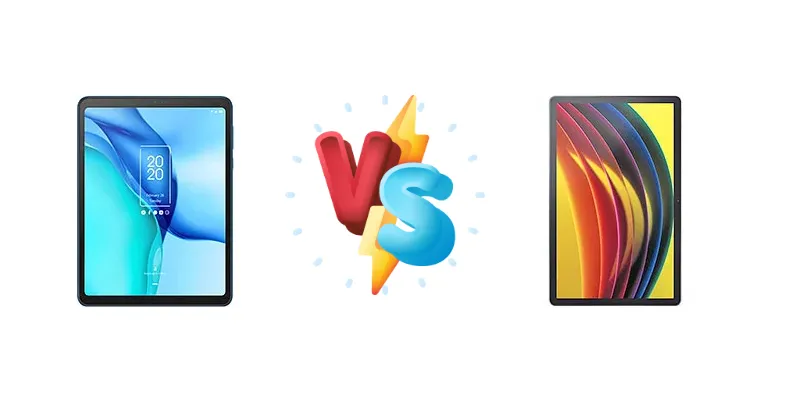
The tablet market offers a diverse range of options, but narrowing down the best choice depends heavily on intended use. The TCL NxtPaper distinguishes itself with a unique paper-like display aimed at reducing eye strain, while the Lenovo Tab P11 Plus targets users seeking a balance of performance and affordability. This comparison dissects their core components to determine which tablet best suits your needs.
🏆 Quick Verdict
For users prioritizing comfortable long-form reading and note-taking, the TCL NxtPaper is the clear winner. However, the Lenovo Tab P11 Plus delivers significantly better performance for gaming and demanding applications, making it the superior choice for power users and those needing more versatility.
| Network |
|---|
| 2G bands | GSM 850 / 900 / 1800 / 1900 | GSM 850 / 900 / 1800 / 1900 |
| 3G bands | HSDPA 850 / 900 / 1700(AWS) / 1900 / 2100 | HSDPA 850 / 900 / 1900 / 2100 |
| 4G bands | 1, 2, 3, 4, 5, 7, 8, 17, 18, 19, 20, 26, 28, 34, 38, 39, 40, 41 | 1, 2, 3, 4, 5, 7, 8, 20, 28, 38, 40, 41 |
| Speed | HSPA, LTE | HSPA, LTE - cellular model only |
| Technology | GSM / HSPA / LTE | GSM / HSPA / LTE |
| Launch |
|---|
| Announced | 2021, January 12 | 2021, June 28 |
| Status | Cancelled | Available. Released 2021, July 29 |
| Body |
|---|
| Dimensions | 203.8 x 150.8 x 7.5 mm (8.02 x 5.94 x 0.30 in) | 258.4 x 163 x 7.5 mm (10.17 x 6.42 x 0.30 in) |
| SIM | Nano-SIM | Nano-SIM (cellular model only) |
| Weight | 316 g (11.15 oz) | 490 g (1.08 lb) |
| | Splash resistant | Stylus support |
| Display |
|---|
| Resolution | 1080 x 1440 pixels, 4:3 ratio (~203 ppi density) | 1200 x 2000 pixels, 5:3 ratio (~212 ppi density) |
| Size | 8.88 inches, 244.2 cm2 (~79.5% screen-to-body ratio) | 11.0 inches, 344.4 cm2 (~81.8% screen-to-body ratio) |
| Type | NCVM | IPS LCD, 400 nits (typ) |
| Platform |
|---|
| CPU | Octa-core 2.0 GHz | Octa-core (2x2.05 GHz Cortex-A76 & 6x2.0 GHz Cortex-A55) |
| Chipset | Mediatek MT8768E | Mediatek MT6785 Helio G90T (12 nm) |
| GPU | PowerVR GE8320 | Mali-G76 MC4 |
| OS | Android 10 | Android 11 |
| Memory |
|---|
| Card slot | microSDXC | microSDXC (dedicated slot) |
| Internal | 64GB 4GB RAM | 64GB 4GB RAM, 128GB 4GB RAM, 128GB 6GB RAM |
| | eMMC 5.1 | - |
| Main Camera |
|---|
| Features | - | LED flash |
| Single | 8 MP | 13 MP, (wide), AF |
| Video | 1080p@30fps | 1080p@30fps |
| Selfie camera |
|---|
| Single | 5 MP | 8 MP, (wide) |
| Video | 1080p@30fps | 1080p@30fps |
| Sound |
|---|
| 3.5mm jack | Yes | No |
| 35mm jack | Yes | No |
| Loudspeaker | Yes, with dual speakers | Yes, with stereo speakers (4 speakers) |
| Comms |
|---|
| Bluetooth | 5.0, A2DP, LE | 5.1, A2DP, LE |
| NFC | No | No |
| Positioning | GPS | GPS, GLONASS, BDS - cellular model only |
| Radio | FM radio, built-in antenna | FM radio |
| USB | USB Type-C 2.0 | USB Type-C 2.0 |
| WLAN | Wi-Fi 802.11 a/b/g/n/ac, dual-band, Wi-Fi Direct | Wi-Fi 802.11 a/b/g/n/ac, dual-band, Wi-Fi Direct |
| Features |
|---|
| Sensors | Accelerometer, proximity | Accelerometer, gyro, proximity |
| Battery |
|---|
| Charging | 18W wired | 20W wired |
| Type | Li-Ion 5500 mAh | Li-Po 7700 mAh |
| Misc |
|---|
| Colors | Ultramarine Green | Slate Grey, Platinum Grey, Modernist teal |
| Models | - | ZA940124SE |
| Price | About 350 EUR | About 300 EUR |
TCL NxtPaper
- Exceptional eye comfort with paper-like display
- Reduced blue light and glare for extended reading
- Potentially longer battery life due to display technology
- Limited performance for gaming and demanding apps
- Less vibrant colors compared to standard LCDs
Lenovo Tab P11 Plus
- Superior performance with MediaTek Helio G90T
- Faster 20W wired charging
- More versatile for gaming, streaming, and multitasking
- Standard LCD display can cause eye strain during prolonged use
- May not offer the same level of battery efficiency as the NxtPaper
Display Comparison
The TCL NxtPaper’s defining feature is its namesake display, designed to mimic the texture of paper. While specific nit brightness isn’t provided, the focus is on reducing glare and blue light, rather than peak brightness. Conversely, the Lenovo Tab P11 Plus lacks this specialized technology, relying on a standard LCD panel. The difference isn’t about resolution (both likely target FHD+), but about the *experience*. The NxtPaper’s matte finish will be far more comfortable for extended reading sessions, while the P11 Plus will offer more vibrant colors for video consumption. Bezels are likely comparable given the price points, and color accuracy will favor the Lenovo due to its standard LCD technology.
Camera Comparison
Camera performance is unlikely to be a deciding factor for either tablet, but the Lenovo Tab P11 Plus likely holds a slight edge. While both likely feature similar basic camera setups, the G90T’s ISP (Image Signal Processor) is more advanced, resulting in better image processing. The TCL NxtPaper’s camera is primarily for basic scanning and video calls, while the P11 Plus can handle slightly more demanding photography tasks. We can expect both to have a front-facing camera for video conferencing.
Performance
The Lenovo Tab P11 Plus boasts a significant performance advantage thanks to its MediaTek Helio G90T chipset, fabricated on a 12nm process. This chip features a combination of 2x 2.05 GHz Cortex-A76 cores and 6x 2.0 GHz Cortex-A55 cores, offering a more robust CPU architecture than the TCL NxtPaper’s MediaTek MT8768E (Octa-core 2.0 GHz). The G90T’s Mali-G76 MC4 GPU is also substantially more powerful, making it suitable for gaming. The MT8768E, while capable for basic tasks, will struggle with graphically intensive games. The P11 Plus’s architecture allows for better sustained performance, minimizing throttling during extended use. RAM configurations are not specified, but the G90T benefits from faster RAM speeds (likely LPDDR4x) compared to the NxtPaper.
Battery Life
Both tablets offer adequate battery life for their intended use cases. The TCL NxtPaper’s e-ink-like display consumes significantly less power than a traditional LCD, potentially offering longer battery life during reading. However, the Lenovo Tab P11 Plus compensates with 20W wired charging, allowing for faster top-ups compared to the NxtPaper’s 18W charging. While battery capacity isn’t specified, the P11 Plus’s faster charging is a practical advantage for users who frequently use their tablet throughout the day.
Buying Guide
Buy the TCL NxtPaper if you need a device primarily for reading ebooks, digital comics, or taking handwritten notes, and eye comfort is paramount. Its unique display technology minimizes blue light and glare. Buy the Lenovo Tab P11 Plus if you prefer a tablet capable of handling mobile games, streaming video, and multitasking without significant lag, and you value a more responsive user experience.
Frequently Asked Questions
❓ Is the TCL NxtPaper display truly like reading on paper? How does it affect text clarity?
The TCL NxtPaper’s display utilizes a unique surface treatment and anti-glare coating to mimic the texture and visual properties of paper. This significantly reduces eye strain and glare, making text appear clearer and more comfortable to read for extended periods. While it doesn’t replicate the exact feel of paper, it’s a substantial improvement over traditional LCDs for reading-intensive tasks.
❓ Can the Lenovo Tab P11 Plus handle demanding games like Genshin Impact or Call of Duty Mobile?
The Lenovo Tab P11 Plus, powered by the MediaTek Helio G90T, can run many popular mobile games, including Genshin Impact and Call of Duty Mobile. However, you’ll likely need to lower the graphics settings to medium or low to achieve a smooth and consistent frame rate. The G90T is a capable mid-range chipset, but it’s not a flagship-level performer.
❓ Does the TCL NxtPaper support color ebooks or comics well, or is it limited to grayscale?
While the TCL NxtPaper excels at displaying black and white content, it *does* support color ebooks and comics. However, the color reproduction won’t be as vibrant or accurate as on a traditional LCD. The display is optimized for contrast and readability, prioritizing text clarity over color fidelity. It's suitable for color content, but not ideal if color accuracy is critical.