
TCL NxtPaper 60 Ultra vs Samsung Galaxy Tab A9+: Which Tablet Reigns Supreme?
| Phones Images | |||||
|---|---|---|---|---|---|
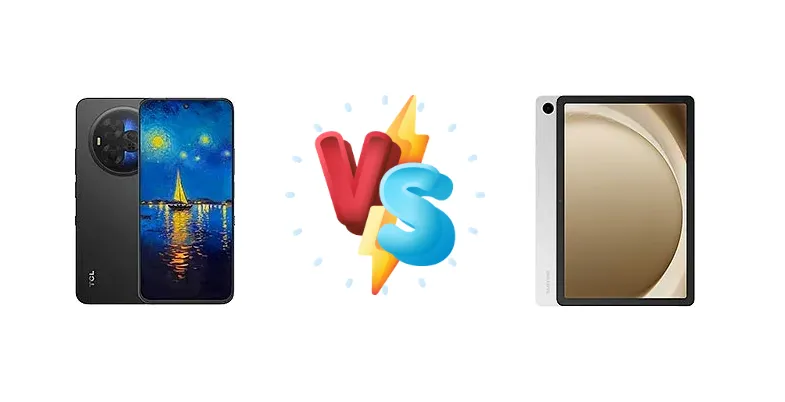
|
🏆 Quick Verdict
For users prioritizing performance and faster charging, the TCL NxtPaper 60 Ultra is the clear winner. Its Dimensity 7400 chipset offers a significant performance uplift over the Snapdragon 695 in the Tab A9+, and the 33W charging is substantially quicker. However, Samsung’s software and brand recognition remain strong contenders.
| PHONES | ||
|---|---|---|
| Phone Names | TCL NxtPaper 60 Ultra | Samsung Galaxy Tab A9+ |
| Network | ||
|---|---|---|
| 2G bands | GSM 850 / 900 / 1800 / 1900 | GSM 850 / 900 / 1800 / 1900 |
| 3G bands | HSDPA 850 / 1700(AWS) / 1900 / 2100 | HSDPA 850 / 900 / 1700(AWS) / 1900 / 2100 |
| 4G bands | 1, 2, 3, 4, 5, 7, 8, 12, 13, 17, 18, 19, 20, 26, 28, 32, 38, 39, 40, 41, 42, 66 | 1, 2, 3, 4, 5, 7, 8, 12, 13, 17, 20, 26, 28, 38, 40, 41, 66 |
| 5G bands | 1, 3, 5, 7, 8, 20, 26, 28, 38, 40, 41, 66, 75, 77, 78 SA/NSA | 1, 3, 5, 7, 8, 20, 28, 38, 40, 41, 66, 77, 78 SA/NSA/Sub6 |
| Speed | HSPA, LTE, 5G | HSPA, LTE, 5G - cellular model only |
| Technology | GSM / HSPA / LTE / 5G | GSM / HSPA / LTE / 5G |
| Launch | ||
|---|---|---|
| Announced | 2025, September 04 | 2023, October 05 |
| Status | Available. Released 2025, September 18 | Available. Released 2023, October 17 |
| Body | ||
|---|---|---|
| Build | Glass front, plastic back, plastic frame | - |
| Dimensions | 174.5 x 81.2 x 7.6 mm (6.87 x 3.20 x 0.30 in) | 257.1 x 168.7 x 6.9 mm (10.12 x 6.64 x 0.27 in) |
| SIM | Nano-SIM + Nano-SIM + eSIM (max 2 at a time) | Nano-SIM + eSIM (cellular model only) |
| Weight | 227 g (8.01 oz) | 480 g or 492 g (1.06 lb) |
| Display | ||
|---|---|---|
| Protection | Mohs level 7 | - |
| Resolution | 1080 x 2340 pixels, 19.5:9 ratio (~358 ppi density) | 1200 x 1920 pixels, 16:10 ratio (~206 ppi density) |
| Size | 7.2 inches, 127.3 cm2 (~89.8% screen-to-body ratio) | 11.0 inches, 350.9 cm2 (~80.9% screen-to-body ratio) |
| Type | IPS LCD, 120Hz, 850 (HBM) | TFT LCD, 90Hz |
| Platform | ||
|---|---|---|
| CPU | Octa-core (4x2.6 GHz Cortex-A78 & 4x2.0 GHz Cortex-A55) | Octa-core (2x2.2 GHz Kryo 660 Gold & 6x1.8 GHz Kryo 660 Silver) |
| Chipset | Mediatek Dimensity 7400 (4 nm) | Qualcomm SM6375 Snapdragon 695 5G (6 nm) |
| GPU | Mali-G615 MC2 | Adreno 619 |
| OS | Android 15, up to 3 major Android upgrades | Android 13, upgradable to Android 15, One UI 7 |
| Memory | ||
|---|---|---|
| Card slot | No | microSDXC (dedicated slot) |
| Internal | 256GB 12GB RAM, 512GB 12GB RAM | 64GB 4GB RAM, 128GB 4GB RAM, 128GB 8GB RAM, 256GB 8GB RAM |
| Main Camera | ||
|---|---|---|
| Features | LED flash, HDR, panorama | - |
| Single | - | 8 MP, AF |
| Triple | 50 MP, f/1.8, 24mm (wide), 1/1.55", 1.0µm, PDAF, OIS 50 MP, f/2.4, 71mm (periscope telephoto), 1/2.8", 0.64µm, PDAF, OIS, 3x optical zoom 8 MP, f/2.2, 112˚ (ultrawide), 1/4.0", 1.12µm | - |
| Video | 4K@30fps, 1080p@60fps | 1080p@30fps |
| Selfie camera | ||
|---|---|---|
| Features | HDR | - |
| Single | 32 MP, f/2.0, 28mm (wide), 1/3.1", 0.7µm | 5 MP |
| Video | 1440p@30fps | 1080p@30fps |
| Sound | ||
|---|---|---|
| 35mm jack | No | Yes |
| Loudspeaker | Yes, with stereo speakers | Yes, with stereo speakers (4 speakers) |
| Comms | ||
|---|---|---|
| Bluetooth | 5.4, A2DP, LE | 5.1, A2DP, LE |
| Infrared port | Yes | - |
| NFC | Yes (market/region dependent) | No |
| Positioning | GPS (L1+L5), GLONASS, GALILEO, BDS | GPS, GLONASS, GALILEO, BDS, QZSS - cellular model only |
| Radio | Unspecified | No |
| USB | USB Type-C 2.0, OTG | USB Type-C 2.0 |
| WLAN | Wi-Fi 802.11 a/b/g/n/ac/6, dual-band, Wi-Fi Direct | Wi-Fi 802.11 a/b/g/n/ac, dual-band, Wi-Fi Direct |
| Features | ||
|---|---|---|
| Sensors | Fingerprint (side-mounted), accelerometer, gyro, proximity, compass, barometer | Accelerometer, gyro, proximity (accessories only), compass |
| Battery | ||
|---|---|---|
| Charging | 33W wired, 50% in 30 min 10W reverse wired | 15W wired |
| Type | 5200 mAh | Li-Po 7040 mAh |
| Misc | ||
|---|---|---|
| Colors | Lunar White, Nebula Black | Graphite, Silver, Navy |
| Models | T951K, T951P, T951P1 | SM-X210, SM-X215, SM-X216B |
| Price | £ 339.99 / € 397.84 | $ 199.99 |
| SAR | - | 0.42 W/kg (body) |
| SAR EU | - | 1.19 W/kg (body) |
| EU LABEL | ||
|---|---|---|
| Battery | 50:48h endurance, 1000 cycles | - |
| Energy | Class B | - |
| Free fall | Class B (180 falls) | - |
| Repairability | Class B | - |
TCL NxtPaper 60 Ultra
- Significantly faster processor (Dimensity 7400)
- Much faster charging (33W vs 15W)
- Reverse wired charging capability
- Brand recognition is lower than Samsung
- Software update support may be less consistent
Samsung Galaxy Tab A9+
- Established brand and ecosystem
- Reliable software support
- Generally smooth user experience
- Slower processor (Snapdragon 695)
- Slower charging (15W)
- Lacks reverse charging
Display Comparison
While both tablets likely feature LCD panels (data not provided), the focus here is on performance. The absence of display specs like resolution or refresh rate makes a direct comparison impossible. However, the TCL’s emphasis on the ‘NxtPaper’ branding suggests a focus on eye comfort, potentially utilizing a different panel technology or software optimizations to reduce blue light. Samsung’s display quality is generally reliable, but without specific details, it’s difficult to assess a clear advantage.
Camera Comparison
Neither tablet is positioned as a photography powerhouse, and the provided data doesn’t offer much insight. We can assume both will feature basic camera setups suitable for casual snapshots and video calls. Without sensor size or aperture information, it’s impossible to determine a clear winner. The focus should be on the processor’s image signal processing (ISP) capabilities; the Dimensity 7400’s more advanced ISP likely provides better image quality, particularly in low-light conditions, but this is speculative without testing.
Performance
The TCL NxtPaper 60 Ultra’s Mediatek Dimensity 7400 (4nm) represents a significant leap in processing power compared to the Samsung Galaxy Tab A9+'s Qualcomm Snapdragon 695 5G (6nm). The Dimensity 7400’s architecture – octa-core with 4x2.6 GHz Cortex-A78 and 4x2.0 GHz Cortex-A55 – is demonstrably more efficient and powerful than the Snapdragon 695’s 2x2.2 GHz Kryo 660 Gold & 6x1.8 GHz Kryo 660 Silver configuration. The 4nm process node further enhances the Dimensity 7400’s efficiency, leading to better thermal management and sustained performance under load. This translates to smoother multitasking, faster app loading times, and a more responsive user experience on the TCL.
Battery Life
The TCL NxtPaper 60 Ultra boasts a 50:48h endurance rating, suggesting excellent battery life. While the Samsung Galaxy Tab A9+’s battery capacity is unknown, the TCL’s 33W wired charging significantly outperforms the Samsung’s 15W charging. The TCL can reach 50% charge in just 30 minutes, a substantial advantage for users who need a quick power boost. The TCL also offers 10W reverse wired charging, a feature absent on the Samsung, allowing it to top up other devices.
Buying Guide
Buy the TCL NxtPaper 60 Ultra if you need a tablet for demanding tasks like gaming, video editing, or multitasking, and value fast charging. Its more powerful processor and quicker replenishment will keep you productive. Buy the Samsung Galaxy Tab A9+ if you prioritize a well-established ecosystem, reliable software updates, and a generally smoother, if less powerful, experience for everyday tasks like browsing and streaming.