
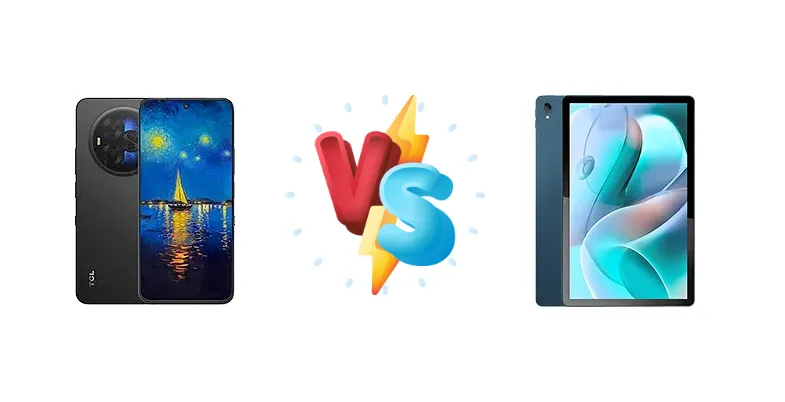
TCL NxtPaper 60 Ultra vs Motorola Moto Tab G70: A Deep Dive Comparison
| Phones Images | |||||
|---|---|---|---|---|---|
|
🏆 Quick Verdict
For most users, the TCL NxtPaper 60 Ultra is the superior choice. Its Mediatek Dimensity 7400 chipset, built on a 4nm process, delivers significantly better performance and efficiency than the Moto Tab G70’s Helio G90T. While the G70 offers a compelling value proposition, the NxtPaper’s faster charging and potentially longer lifespan make it a worthwhile investment.
| PHONES | ||
|---|---|---|
| Phone Names | TCL NxtPaper 60 Ultra | Motorola Moto Tab G70 |
| Network | ||
|---|---|---|
| 2G bands | GSM 850 / 900 / 1800 / 1900 | GSM 850 / 900 / 1800 / 1900 |
| 3G bands | HSDPA 850 / 1700(AWS) / 1900 / 2100 | HSDPA 850 / 900 / 1900 / 2100 |
| 4G bands | 1, 2, 3, 4, 5, 7, 8, 12, 13, 17, 18, 19, 20, 26, 28, 32, 38, 39, 40, 41, 42, 66 | 1, 2, 4, 7, 8, 20, 28, 38, 40, 41 |
| 5G bands | 1, 3, 5, 7, 8, 20, 26, 28, 38, 40, 41, 66, 75, 77, 78 SA/NSA | - |
| Speed | HSPA, LTE, 5G | HSPA 42.2/5.76 Mbps, LTE Cat4 150/50 Mbps - cellular model only |
| Technology | GSM / HSPA / LTE / 5G | GSM / HSPA / LTE |
| Launch | ||
|---|---|---|
| Announced | 2025, September 04 | 2022, January 12 |
| Status | Available. Released 2025, September 18 | Available. Released 2022, January 13 |
| Body | ||
|---|---|---|
| Build | Glass front, plastic back, plastic frame | Glass front, aluminum back, aluminum frame |
| Dimensions | 174.5 x 81.2 x 7.6 mm (6.87 x 3.20 x 0.30 in) | 258.4 x 163 x 7.5 mm (10.17 x 6.42 x 0.30 in) |
| SIM | Nano-SIM + Nano-SIM + eSIM (max 2 at a time) | Nano-SIM (cellular model only) |
| Weight | 227 g (8.01 oz) | 500 g (1.10 lb) |
| - | Water repellent design | |
| Display | ||
|---|---|---|
| Protection | Mohs level 7 | - |
| Resolution | 1080 x 2340 pixels, 19.5:9 ratio (~358 ppi density) | 1200 x 2000 pixels, 5:3 ratio (~212 ppi density) |
| Size | 7.2 inches, 127.3 cm2 (~89.8% screen-to-body ratio) | 11.0 inches, 344.4 cm2 (~81.8% screen-to-body ratio) |
| Type | IPS LCD, 120Hz, 850 (HBM) | IPS LCD, 400 nits (typ) |
| Platform | ||
|---|---|---|
| CPU | Octa-core (4x2.6 GHz Cortex-A78 & 4x2.0 GHz Cortex-A55) | Octa-core (2x2.05 GHz Cortex-A76 & 6x2.0 GHz Cortex-A55) |
| Chipset | Mediatek Dimensity 7400 (4 nm) | Mediatek MT6785 Helio G90T (12 nm) |
| GPU | Mali-G615 MC2 | Mali-G76 MC4 |
| OS | Android 15, up to 3 major Android upgrades | Android 11 |
| Memory | ||
|---|---|---|
| Card slot | No | microSDXC (dedicated slot) |
| Internal | 256GB 12GB RAM, 512GB 12GB RAM | 64GB 4GB RAM, 128GB 6GB RAM |
| - | eMMC 5.1 | |
| Main Camera | ||
|---|---|---|
| Features | LED flash, HDR, panorama | LED flash |
| Single | - | 13 MP, f/2.2, 26mm (wide), AF |
| Triple | 50 MP, f/1.8, 24mm (wide), 1/1.55", 1.0µm, PDAF, OIS 50 MP, f/2.4, 71mm (periscope telephoto), 1/2.8", 0.64µm, PDAF, OIS, 3x optical zoom 8 MP, f/2.2, 112˚ (ultrawide), 1/4.0", 1.12µm | - |
| Video | 4K@30fps, 1080p@60fps | 1080p@30fps |
| Selfie camera | ||
|---|---|---|
| Features | HDR | - |
| Single | 32 MP, f/2.0, 28mm (wide), 1/3.1", 0.7µm | 8 MP, f/2.0, 26mm (wide) |
| Video | 1440p@30fps | 1080p@30fps |
| Sound | ||
|---|---|---|
| 3.5mm jack | - | Yes |
| 35mm jack | No | Yes |
| Loudspeaker | Yes, with stereo speakers | Yes, with stereo speakers (4 speakers) |
| Comms | ||
|---|---|---|
| Bluetooth | 5.4, A2DP, LE | 5.2, A2DP, LE |
| Infrared port | Yes | - |
| NFC | Yes (market/region dependent) | No |
| Positioning | GPS (L1+L5), GLONASS, GALILEO, BDS | GPS, GLONASS - cellular model only |
| Radio | Unspecified | No |
| USB | USB Type-C 2.0, OTG | USB Type-C 2.0, OTG |
| WLAN | Wi-Fi 802.11 a/b/g/n/ac/6, dual-band, Wi-Fi Direct | Wi-Fi 802.11 a/b/g/n/ac, dual-band, Wi-Fi Direct |
| Features | ||
|---|---|---|
| Sensors | Fingerprint (side-mounted), accelerometer, gyro, proximity, compass, barometer | Accelerometer, gyro, proximity |
| Battery | ||
|---|---|---|
| Charging | 33W wired, 50% in 30 min 10W reverse wired | 20W wired |
| Type | 5200 mAh | Li-Po 7700 mAh |
| Misc | ||
|---|---|---|
| Colors | Lunar White, Nebula Black | Modernist Teal, Blue |
| Models | T951K, T951P, T951P1 | - |
| Price | £ 339.99 / € 397.84 | About 380 EUR |
| EU LABEL | ||
|---|---|---|
| Battery | 50:48h endurance, 1000 cycles | - |
| Energy | Class B | - |
| Free fall | Class B (180 falls) | - |
| Repairability | Class B | - |
TCL NxtPaper 60 Ultra
- Superior performance with the Dimensity 7400 chipset
- Faster 33W charging with 50% in 30 minutes
- Potentially longer battery lifespan with 1000 charge cycles
- Likely higher price point
- Specific display details (resolution, brightness) are unknown
Motorola Moto Tab G70
- More affordable price point
- Decent performance for everyday tasks
- Established brand reputation
- Older and less efficient Helio G90T chipset
- Slower 20W charging
- Potentially shorter battery lifespan
Display Comparison
While both tablets likely feature IPS LCD panels (data not provided), the core difference lies in the processing power driving them. Display quality details like resolution and peak brightness are missing, but the chipset’s ability to efficiently render graphics will impact perceived smoothness. The NxtPaper’s Dimensity 7400 will handle graphically intensive tasks with greater ease, potentially resulting in a more responsive user experience even with similar display specs.
Camera Comparison
Camera specifications are not provided for either device. Given the tablet segment, camera quality is typically secondary to other features. However, the chipset’s image signal processor (ISP) plays a crucial role in image processing. The Dimensity 7400’s more advanced ISP will likely deliver better image quality, particularly in low-light conditions, compared to the Helio G90T. Without specific sensor details, it’s difficult to make a definitive judgment.
Performance
The TCL NxtPaper 60 Ultra’s Mediatek Dimensity 7400 (4nm) represents a significant leap forward compared to the Motorola Moto Tab G70’s Helio G90T (12nm). The 4nm fabrication process allows for higher transistor density and improved power efficiency, translating to better sustained performance and reduced thermal throttling. The Dimensity 7400’s CPU configuration – 4x2.6 GHz Cortex-A78 & 4x2.0 GHz Cortex-A55 – is also more modern and efficient than the G90T’s 2x2.05 GHz Cortex-A76 & 6x2.0 GHz Cortex-A55. This means the NxtPaper 60 Ultra will excel in multitasking, gaming, and demanding applications.
Battery Life
The TCL NxtPaper 60 Ultra boasts a reported 50:48h endurance, suggesting a well-optimized power consumption profile. While the Moto Tab G70’s battery capacity is unknown, the NxtPaper’s 4nm chipset contributes to significantly improved efficiency. The NxtPaper also features 33W wired charging, reaching 50% charge in 30 minutes, and 10W reverse wired charging. The Moto Tab G70 is limited to 20W wired charging, meaning a slower recharge time. The NxtPaper’s 1000 charge cycles also suggest a longer overall battery lifespan.
Buying Guide
Buy the TCL NxtPaper 60 Ultra if you prioritize performance for demanding tasks like video editing or gaming, and value faster charging speeds and potentially longer battery health due to the 1000 cycle rating. Buy the Motorola Moto Tab G70 if you’re on a tighter budget and primarily need a tablet for casual media consumption, web browsing, and light productivity – accepting a trade-off in processing power and charging speed.