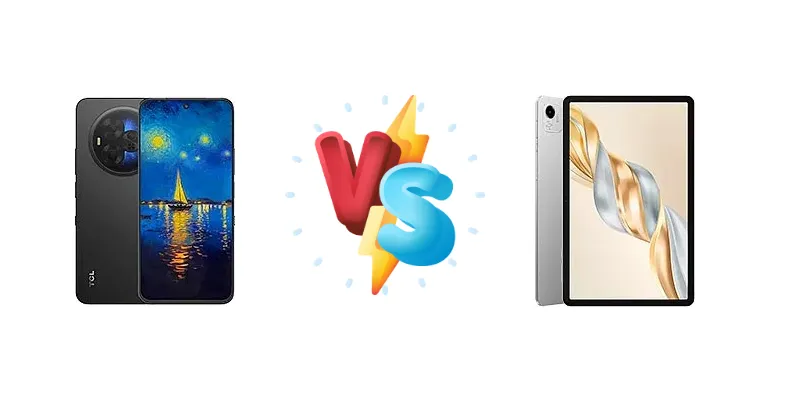
The tablet market is heating up with compelling options at various price points. We're pitting the TCL NxtPaper 60 Ultra, boasting a newer chipset and focus on endurance, against the Honor Pad X9a, which prioritizes extended battery life and a more established brand presence. This comparison will dissect their strengths and weaknesses to determine which tablet delivers the best overall experience.
🏆 Quick Verdict
For the average user prioritizing all-day usability and a modern processor, the TCL NxtPaper 60 Ultra emerges as the winner. Its Dimensity 7400 chipset offers a noticeable performance edge, and the 33W charging mitigates the slightly lower battery endurance compared to the Honor Pad X9a.
| Network |
|---|
| 2G bands | GSM 850 / 900 / 1800 / 1900 | N/A |
| 3G bands | HSDPA 850 / 1700(AWS) / 1900 / 2100 | N/A |
| 4G bands | 1, 2, 3, 4, 5, 7, 8, 12, 13, 17, 18, 19, 20, 26, 28, 32, 38, 39, 40, 41, 42, 66 | N/A |
| 5G bands | 1, 3, 5, 7, 8, 20, 26, 28, 38, 40, 41, 66, 75, 77, 78 SA/NSA | - |
| EDGE | - | No |
| GPRS | - | No |
| Speed | HSPA, LTE, 5G | - |
| Technology | GSM / HSPA / LTE / 5G | No cellular connectivity |
| Launch |
|---|
| Announced | 2025, September 04 | 2025, March 21 |
| Status | Available. Released 2025, September 18 | Available. Released 2025, March 26 |
| Body |
|---|
| Build | Glass front, plastic back, plastic frame | Glass front, aluminum frame, aluminum back |
| Dimensions | 174.5 x 81.2 x 7.6 mm (6.87 x 3.20 x 0.30 in) | 267.3 x 167.4 x 6.8 mm (10.52 x 6.59 x 0.27 in) |
| SIM | Nano-SIM + Nano-SIM + eSIM (max 2 at a time) | No |
| Weight | 227 g (8.01 oz) | 475 g (1.05 lb) |
| Display |
|---|
| Protection | Mohs level 7 | Mohs level 4 |
| Resolution | 1080 x 2340 pixels, 19.5:9 ratio (~358 ppi density) | 1504 x 2508 pixels, 5:3 ratio (~254 ppi density) |
| Size | 7.2 inches, 127.3 cm2 (~89.8% screen-to-body ratio) | 11.5 inches, 376.3 cm2 (~84.1% screen-to-body ratio) |
| Type | IPS LCD, 120Hz, 850 (HBM) | TFT LCD, 120Hz, 400 nits (peak) |
| Platform |
|---|
| CPU | Octa-core (4x2.6 GHz Cortex-A78 & 4x2.0 GHz Cortex-A55) | Octa-core (4x2.8 GHz Cortex-A73 & 4x1.9 GHz Cortex-A53) |
| Chipset | Mediatek Dimensity 7400 (4 nm) | Qualcomm SM6225 Snapdragon 685 (6 nm) |
| GPU | Mali-G615 MC2 | Adreno 610 |
| OS | Android 15, up to 3 major Android upgrades | Android 15, MagicOS 9 |
| Memory |
|---|
| Card slot | No | No |
| Internal | 256GB 12GB RAM, 512GB 12GB RAM | 128GB 6GB RAM, 128GB 8GB RAM |
| Main Camera |
|---|
| Features | LED flash, HDR, panorama | - |
| Single | - | 8 MP, f/2.0, (wide), 1/5.0" |
| Triple | 50 MP, f/1.8, 24mm (wide), 1/1.55", 1.0µm, PDAF, OIS
50 MP, f/2.4, 71mm (periscope telephoto), 1/2.8", 0.64µm, PDAF, OIS, 3x optical zoom
8 MP, f/2.2, 112˚ (ultrawide), 1/4.0", 1.12µm | - |
| Video | 4K@30fps, 1080p@60fps | 1080p@30fps |
| Selfie camera |
|---|
| Features | HDR | - |
| Single | 32 MP, f/2.0, 28mm (wide), 1/3.1", 0.7µm | 5 MP, f/2.2 |
| Video | 1440p@30fps | 1080p@30fps |
| Sound |
|---|
| 35mm jack | No | No |
| Loudspeaker | Yes, with stereo speakers | Yes, with stereo speakers (4 speakers) |
| Comms |
|---|
| Bluetooth | 5.4, A2DP, LE | 5.1, A2DP, LE |
| Infrared port | Yes | - |
| NFC | Yes (market/region dependent) | No |
| Positioning | GPS (L1+L5), GLONASS, GALILEO, BDS | No |
| Radio | Unspecified | No |
| USB | USB Type-C 2.0, OTG | USB Type-C |
| WLAN | Wi-Fi 802.11 a/b/g/n/ac/6, dual-band, Wi-Fi Direct | Wi-Fi 802.11 a/b/g/n/ac, dual-band |
| Features |
|---|
| Sensors | Fingerprint (side-mounted), accelerometer, gyro, proximity, compass, barometer | Accelerometer |
| Battery |
|---|
| Charging | 33W wired, 50% in 30 min
10W reverse wired | 35W wired |
| Type | 5200 mAh | Li-Ion 8300 mAh |
| Misc |
|---|
| Colors | Lunar White, Nebula Black | Gray |
| Models | T951K, T951P, T951P1 | ELN2-W29 |
| Price | £ 339.99 / € 397.84 | About 210 EUR |
| EU LABEL |
|---|
| Battery | 50:48h endurance, 1000 cycles | 92:29h endurance, 1200 cycles |
| Energy | Class B | Class F |
| Free fall | Class B (180 falls) | Class E (10 falls) |
| Repairability | Class B | Class C |
TCL NxtPaper 60 Ultra
- More powerful processor (Dimensity 7400)
- Faster charging (33W)
- Reverse wired charging capability
- Significantly lower battery endurance
- Fewer battery charge cycles
Honor Pad X9a
- Exceptional battery life (92:29h endurance)
- Higher battery cycle count (1200)
- Slightly faster charging wattage (35W)
- Less powerful processor (Snapdragon 685)
- No reverse charging
Display Comparison
Neither device's display specifications are provided, so a direct comparison is limited. However, given the NxtPaper branding, TCL likely emphasizes a paper-like reading experience, potentially with a matte finish. The Honor Pad X9a, positioned as a value-oriented device, likely features a standard IPS LCD. The absence of details like resolution, refresh rate, and peak brightness makes it difficult to definitively declare a winner, but TCL's focus on eye comfort could appeal to readers.
Camera Comparison
Without specific camera details beyond the chipsets, a detailed comparison is impossible. However, given the market positioning, it’s reasonable to assume both tablets feature modest camera setups geared towards casual use. The TCL NxtPaper 60 Ultra, being a newer device, *may* benefit from improved image processing capabilities within the Dimensity 7400’s ISP, but this is speculative. We can expect both to struggle in low-light conditions.
Performance
The TCL NxtPaper 60 Ultra’s Mediatek Dimensity 7400 (4nm) represents a significant architectural leap over the Honor Pad X9a’s Qualcomm Snapdragon 685 (6nm). The Dimensity 7400 utilizes Cortex-A78 cores clocked at 2.6 GHz, offering substantially higher single-core performance than the X9a’s 2.8 GHz Cortex-A73 cores. While the X9a’s clock speed is higher, the A78 architecture is more efficient and powerful. The 4nm process node of the Dimensity 7400 further enhances efficiency, leading to better thermal management and sustained performance during intensive tasks. This translates to smoother multitasking, faster app loading times, and a more responsive user experience on the TCL.
Battery Life
The Honor Pad X9a boasts a remarkable 92:29h endurance rating, significantly exceeding the TCL NxtPaper 60 Ultra’s 50:48h. This suggests the X9a can last nearly two full days on a single charge with typical usage. However, the TCL compensates with 33W wired charging, achieving 50% charge in 30 minutes, while the X9a’s 35W charging is only slightly faster. The X9a also offers 1200 battery cycles compared to the TCL’s 1000, indicating potentially longer-term battery health. The TCL’s reverse wired charging (10W) is a useful addition for topping up accessories, a feature absent on the X9a.
Buying Guide
Buy the TCL NxtPaper 60 Ultra if you need a tablet capable of handling demanding apps, multitasking, and occasional gaming with a more responsive experience. Buy the Honor Pad X9a if you prioritize maximizing battery life above all else, and your usage primarily revolves around media consumption, light browsing, and basic productivity tasks. The X9a is ideal for users who frequently find themselves away from a power source.
Frequently Asked Questions
❓ Will the Dimensity 7400 in the TCL NxtPaper 60 Ultra struggle with graphically intensive games?
While the Dimensity 7400 isn't a flagship gaming chip, its Cortex-A78 cores and modern architecture provide a significant performance boost over the Snapdragon 685. It should handle most mobile games at medium settings without significant issues, though demanding titles may require lower graphics settings for optimal frame rates.
❓ How does the 6nm vs 4nm process node affect the real-world experience on the Honor Pad X9a and TCL NxtPaper 60 Ultra?
A smaller process node (4nm vs 6nm) generally translates to improved power efficiency and thermal performance. The TCL NxtPaper 60 Ultra’s 4nm Dimensity 7400 will likely run cooler and consume less power under load compared to the Honor Pad X9a’s 6nm Snapdragon 685, potentially leading to less throttling during prolonged use.
❓ Is the difference in battery cycle count (1200 vs 1000) between the Honor Pad X9a and TCL NxtPaper 60 Ultra significant?
Yes, a difference of 200 battery cycles is noticeable. It suggests the Honor Pad X9a’s battery may retain a higher percentage of its original capacity after a similar number of charge/discharge cycles, potentially extending its usable lifespan.