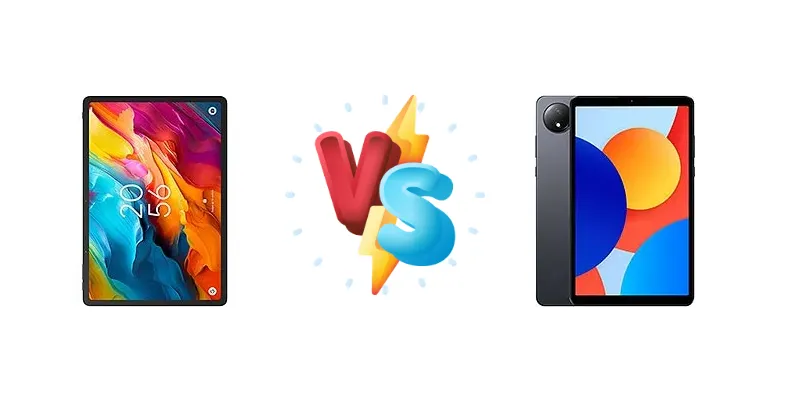
The tablet market is heating up with compelling options at every price point. We’re pitting the TCL NxtPaper 14, a larger-screened device focused on paper-like readability, against the more compact and affordable Xiaomi Redmi Pad SE 8.7. This comparison dives deep into their core components – from chipsets to charging – to determine which tablet best suits your needs.
🏆 Quick Verdict
For users prioritizing sustained performance and a larger display for productivity, the TCL NxtPaper 14 emerges as the winner. Its Helio G99 chipset, built on a more efficient 6nm process, offers a noticeable advantage over the Redmi Pad SE 8.7’s Helio G85. However, the Redmi Pad SE 8.7 remains a strong contender for budget-conscious buyers valuing portability.
| Network |
|---|
| 2G bands | N/A | GSM 850 / 900 / 1800 / 1900 |
| 3G bands | N/A | HSDPA 800 / 850 / 900 / 1700(AWS) / 1900 / 2100 |
| 4G bands | N/A | 1, 2, 3, 4, 5, 7, 8, 13, 18, 19, 20, 26, 28, 38, 40, 41, 66 |
| EDGE | No | - |
| GPRS | No | - |
| Speed | - | HSPA, LTE - cellular model only |
| Technology | No cellular connectivity | GSM / HSPA / LTE |
| Launch |
|---|
| Announced | 2024, February | 2024, July 29 |
| Status | Available. Released 2024, July | Available. Released 2024, August 08 |
| Body |
|---|
| Build | - | Glass front (Gorilla Glass 3) |
| Dimensions | 322.4 x 222 x 7 mm (12.69 x 8.74 x 0.28 in) | 211.6 x 125.5 x 8.8 mm (8.33 x 4.94 x 0.35 in) |
| SIM | No | Nano-SIM + Nano-SIM (cellular model only) |
| Weight | 760 g (1.68 lb) | 370 / 373 / 375 g (13.05 oz) |
| Display |
|---|
| Protection | - | Corning Gorilla Glass 3 |
| Resolution | 1600 x 2400 pixels, 3:2 ratio (~202 ppi density) | 800 x 1340 pixels, 5:3 ratio (~179 ppi density) |
| Size | 14.3 inches, 608.9 cm2 (~85.1% screen-to-body ratio) | 8.7 inches, 214.9 cm2 (~80.9% screen-to-body ratio) |
| Type | IPS, 400 nits | IPS LCD, 1B colors, 90Hz, 600 nits (HBM) |
| Platform |
|---|
| CPU | Octa-core (2x2.2 GHz Cortex-A76 & 6x2.0 GHz Cortex-A55) | Octa-core (2x2.0 GHz Cortex-A75 & 6x1.8 GHz Cortex-A55) |
| Chipset | Mediatek Helio G99 (6 nm) | Mediatek Helio G85 (12 nm) |
| GPU | Mali-G57 MC2 | Mali-G52 MC2 |
| OS | Android 14 | Android 14, HyperOS |
| Memory |
|---|
| Card slot | microSDXC (dedicated slot) | microSDXC (dedicated slot) |
| Internal | 256GB 8GB RAM | 64GB 4GB RAM, 128GB 4GB RAM, 128GB 6GB RAM |
| Main Camera |
|---|
| Features | LED flash | LED flash |
| Single | 8 MP, AF | 8 MP, f/2.0, (wide), 1/4.0", 1.12µm |
| Video | 1080p@30fps | 1080p@30fps |
| Selfie camera |
|---|
| Dual | 13 MP
5 MP | - |
| Single | - | 5 MP, f/2.2, (wide), 1/5.0", 1.12µm |
| Video | 1080p@30fps | 1080p@30fps |
| Sound |
|---|
| 35mm jack | No | Yes |
| Loudspeaker | Yes, with stereo speakers (4 speakers) | Yes, with stereo speakers |
| Comms |
|---|
| Bluetooth | 5.0, A2DP, LE | 5.3, A2DP, LE |
| Infrared port | - | Yes |
| NFC | No | No |
| Positioning | GPS | GPS, GALILEO, GLONASS, BDS - cellular model only |
| Radio | No | FM radio |
| USB | USB Type-C 2.0, OTG | USB Type-C 2.0 |
| WLAN | Wi-Fi 802.11 a/b/g/n/ac, dual-band | Wi-Fi 802.11 a/b/g/n/ac, dual-band |
| Features |
|---|
| Sensors | Accelerometer, proximity, compass | Accelerometer, proximity (accessories only), compass |
| Battery |
|---|
| Charging | 33W wired | 18W wired (Int'l)
10W wired (India) |
| Type | 10000 mAh | 6650 mAh |
| Misc |
|---|
| Colors | Navy Blue | Aurora Green (Forest Green), Sky Blue (Ocean Blue), Graphite Gray (Urban Grey) |
| Models | 9491G | 220233L2G |
| Price | $ 299.99 | About 120 EUR |
| SAR | - | 0.90 W/kg (head) 0.65 W/kg (body) |
| SAR EU | - | 0.40 W/kg (head) 0.99 W/kg (body) |
TCL NxtPaper 14
- Faster 33W Charging
- More Powerful Helio G99 Chipset
- Larger 14-inch Display for Productivity
- Likely Lower Portability due to Size
- Potentially Higher Price
Xiaomi Redmi Pad SE 8.7
- More Affordable Price Point
- Highly Portable 8.7-inch Form Factor
- Sufficient for Basic Tasks
- Slower 10W/18W Charging
- Less Powerful Helio G85 Chipset
- Smaller Screen Size
Display Comparison
The TCL NxtPaper 14’s 14-inch display is its defining feature, offering significantly more screen real estate than the Redmi Pad SE 8.7’s 8.7-inch panel. While specific brightness nits aren’t provided, TCL’s NxtPaper technology aims to mimic the look of paper, reducing eye strain. The Redmi Pad SE 8.7, lacking this specialized tech, will likely offer a more conventional LCD experience. Bezels are expected to be larger on the TCL due to its size, while the Redmi Pad SE 8.7 benefits from a more compact form factor. Color accuracy data is unavailable for both, but given the price points, neither is expected to cover 100% of the DCI-P3 color gamut.
Camera Comparison
Camera performance is unlikely to be a deciding factor for most tablet buyers. Neither device is positioned as a photography powerhouse. Details on camera sensors are limited, but focusing on the main sensors is crucial. The TCL NxtPaper 14 likely features a more capable main sensor given its positioning as a more premium device, but without specific megapixel counts or aperture information, it’s difficult to quantify. The Redmi Pad SE 8.7 will likely prioritize cost savings in this area. Any secondary cameras (ultrawide, macro) on either device should be considered supplemental at best.
Performance
The core performance difference lies in the chipsets. The TCL NxtPaper 14 utilizes the MediaTek Helio G99, fabricated on a 6nm process. This translates to improved power efficiency and potentially higher sustained performance compared to the Xiaomi Redmi Pad SE 8.7’s Helio G85, which is built on a less efficient 12nm process. The G99’s CPU configuration – 2x2.2 GHz Cortex-A76 and 6x2.0 GHz Cortex-A55 – provides a clock speed advantage over the G85’s 2x2.0 GHz Cortex-A75 and 6x1.8 GHz Cortex-A55. While both use similar core architectures, the G99’s higher clock speeds and more efficient node will result in snappier app launches and smoother multitasking. RAM speed isn't specified, but LPDDR4X is likely on both devices, limiting the performance gains from the chipset difference.
Battery Life
Battery capacity isn’t specified for either device, making a direct comparison challenging. However, the TCL NxtPaper 14’s 33W wired charging significantly outpaces the Redmi Pad SE 8.7’s 18W (International) or 10W (India) charging. This means the NxtPaper 14 will replenish its battery much faster, a crucial advantage for users who rely on their tablet throughout the day. The Redmi Pad SE 8.7’s slower charging could be a significant inconvenience, especially for those who frequently use the device on the go. The larger screen of the NxtPaper 14 will likely draw more power, but the faster charging mitigates this concern.
Buying Guide
Buy the TCL NxtPaper 14 if you need a larger screen for multitasking, document editing, or media consumption, and value a more responsive experience for demanding apps. Buy the Xiaomi Redmi Pad SE 8.7 if you prioritize extreme portability, a lower price point, and primarily use your tablet for casual browsing, video streaming, and light tasks. The Redmi Pad SE 8.7 is ideal for students or travelers.
Frequently Asked Questions
❓ Does the Helio G99 in the TCL NxtPaper 14 offer a noticeable gaming improvement over the Helio G85 in the Redmi Pad SE 8.7?
Yes, the Helio G99’s 6nm process and higher clock speeds provide a tangible performance boost in gaming. While neither tablet is a dedicated gaming device, the NxtPaper 14 will handle graphically demanding titles with smoother frame rates and less thermal throttling compared to the Redmi Pad SE 8.7.
❓ The Redmi Pad SE 8.7 has different charging speeds depending on the region (10W in India, 18W internationally). Which one should I expect?
The charging speed depends entirely on your region of purchase. If you're buying in India, you'll receive the 10W charger. If purchasing elsewhere, you'll get the 18W charger. This is a significant difference, and the 10W charging is considerably slower, impacting the overall user experience.
❓ Is the TCL NxtPaper display truly easier on the eyes for extended reading sessions?
TCL’s NxtPaper technology aims to reduce eye strain by mimicking the texture of paper. While subjective, many users report a more comfortable reading experience compared to traditional LCD screens, particularly in bright environments. It’s a key differentiator for the NxtPaper 14.