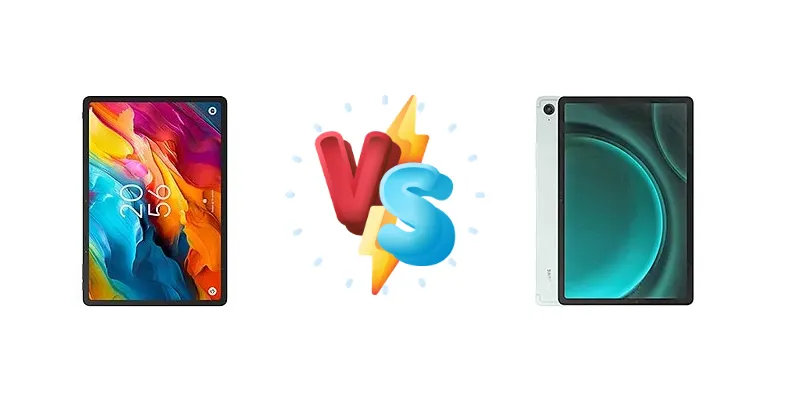
The Android tablet market is heating up, with options ranging from budget-friendly to premium. The TCL NxtPaper 14 distinguishes itself with its unique paper-like display, aiming to replicate the reading experience of physical books. Conversely, the Samsung Galaxy Tab S9 FE offers a more traditional tablet experience, prioritizing all-around performance and features at a competitive price point. This comparison dissects these two devices to determine which best suits your needs.
🏆 Quick Verdict
For users prioritizing a distraction-free reading experience and extended battery life, the TCL NxtPaper 14 is the clear winner. However, the Samsung Galaxy Tab S9 FE takes the crown for those needing a more versatile tablet capable of handling demanding tasks and offering faster charging, thanks to its superior chipset and broader feature set.
| Network |
|---|
| 2G bands | N/A | GSM 850 / 900 / 1800 / 1900 |
| 3G bands | N/A | HSDPA 850 / 900 / 1700(AWS) / 1900 / 2100 |
| 4G bands | N/A | 1, 2, 3, 4, 5, 7, 8, 12, 13, 17, 20, 26, 28, 32, 38, 40, 41, 66 |
| 5G bands | - | 1, 3, 5, 7, 8, 20, 28, 38, 40, 41, 66, 77, 78 SA/NSA/Sub6 |
| EDGE | No | - |
| GPRS | No | - |
| Speed | - | HSPA, LTE, 5G - cellular model only |
| Technology | No cellular connectivity | GSM / HSPA / LTE / 5G |
| Launch |
|---|
| Announced | 2024, February | 2023, October 04 |
| Status | Available. Released 2024, July | Available. Released 2023, October 16 |
| Body |
|---|
| Build | - | Glass front, aluminum back, aluminum frame |
| Dimensions | 322.4 x 222 x 7 mm (12.69 x 8.74 x 0.28 in) | 254.3 x 165.8 x 6.5 mm (10.01 x 6.53 x 0.26 in) |
| SIM | No | Nano-SIM + eSIM (cellular model only) |
| Weight | 760 g (1.68 lb) | 523 g or 524 g (1.15 lb) |
| Display |
|---|
| Resolution | 1600 x 2400 pixels, 3:2 ratio (~202 ppi density) | 1440 x 2304 pixels, 16:10 ratio (~249 ppi density) |
| Size | 14.3 inches, 608.9 cm2 (~85.1% screen-to-body ratio) | 10.9 inches, 344.5 cm2 (~81.7% screen-to-body ratio) |
| Type | IPS, 400 nits | IPS LCD, 90Hz |
| Platform |
|---|
| CPU | Octa-core (2x2.2 GHz Cortex-A76 & 6x2.0 GHz Cortex-A55) | Octa-core (4x2.4 GHz Cortex-A78 & 4x2.0 GHz Cortex-A55) |
| Chipset | Mediatek Helio G99 (6 nm) | Exynos 1380 (5 nm) |
| GPU | Mali-G57 MC2 | Mali-G68 MP5 |
| OS | Android 14 | Android 13, up to 4 major Android upgrades, One UI 6 |
| Memory |
|---|
| Card slot | microSDXC (dedicated slot) | microSDXC (dedicated slot) |
| Internal | 256GB 8GB RAM | 128GB 6GB RAM, 128GB 8GB RAM, 256GB 8GB RAM |
| Main Camera |
|---|
| Features | LED flash | - |
| Single | 8 MP, AF | 8 MP, (wide) |
| Video | 1080p@30fps | 4K@30fps, 1080p@30fps |
| Selfie camera |
|---|
| Dual | 13 MP
5 MP | - |
| Single | - | 12 MP, (ultrawide) |
| Video | 1080p@30fps | Yes |
| Sound |
|---|
| 35mm jack | No | No |
| Loudspeaker | Yes, with stereo speakers (4 speakers) | Yes, with stereo speakers |
| Comms |
|---|
| Bluetooth | 5.0, A2DP, LE | 5.3, A2DP, LE |
| NFC | No | No |
| Positioning | GPS | GPS, GALILEO, GLONASS, BDS, QZSS - cellular model only |
| Radio | No | No |
| USB | USB Type-C 2.0, OTG | USB Type-C 2.0, magnetic connector |
| WLAN | Wi-Fi 802.11 a/b/g/n/ac, dual-band | Wi-Fi 802.11 a/b/g/n/ac/6, dual-band, Wi-Fi Direct |
| Features |
|---|
| Sensors | Accelerometer, proximity, compass | Fingerprint (side-mounted), accelerometer, gyro, compass, proximity (accessories only) |
| Battery |
|---|
| Charging | 33W wired | 45W wired, QC2.0 |
| Type | 10000 mAh | Li-Po 8000 mAh |
| Misc |
|---|
| Colors | Navy Blue | Mint, Silver, Gray, Lavender |
| Models | 9491G | SM-X510, SM-X516B |
| Price | $ 299.99 | About 300 EUR |
| SAR | - | 1.55 W/kg (body) |
| SAR EU | - | 0.59 W/kg (body) |
TCL NxtPaper 14
- Unique paper-like display reduces eye strain
- Excellent battery life for reading and note-taking
- Lightweight and portable design
- Limited performance for demanding tasks
- Slower charging speeds
Samsung Galaxy Tab S9 FE
- Faster and more responsive performance
- 45W fast charging with QC2.0
- Versatile for a wider range of applications
- LCD display lacks the eye comfort of the NxtPaper
- Battery life is shorter than the NxtPaper 14
Display Comparison
The TCL NxtPaper 14’s defining feature is its namesake display, designed to mimic the texture of paper. While specific nit brightness isn’t provided, the focus is on minimizing blue light and glare, making it ideal for extended reading sessions. The Samsung Galaxy Tab S9 FE features a more conventional LCD panel. The Exynos 1380 likely drives a higher peak brightness, beneficial for outdoor visibility, but lacks the NxtPaper’s anti-glare properties. Bezels appear comparable based on available imagery, but the NxtPaper’s display technology is fundamentally different, prioritizing eye comfort over vibrant colors.
Camera Comparison
Camera performance is unlikely to be a deciding factor for most buyers in this segment. However, the Samsung Galaxy Tab S9 FE likely has a more capable camera system. While specific sensor details are missing for both, Samsung typically equips its FE series with decent main sensors. The TCL NxtPaper 14’s camera is likely a basic module for occasional snapshots. The presence of a 2MP macro camera on either device is largely inconsequential, offering limited practical benefit due to its low resolution and fixed focus.
Performance
The Samsung Galaxy Tab S9 FE’s Exynos 1380 (5nm) significantly outperforms the TCL NxtPaper 14’s MediaTek Helio G99 (6nm). The 5nm fabrication process allows for greater transistor density and improved power efficiency, translating to faster processing speeds and better thermal management. The Tab S9 FE’s CPU configuration – 4x2.4 GHz Cortex-A78 & 4x2.0 GHz Cortex-A55 – is more powerful than the NxtPaper’s 2x2.2 GHz Cortex-A76 & 6x2.0 GHz Cortex-A55. This difference will be noticeable in multitasking, app loading times, and demanding applications. While both use LPDDR4X RAM (assumed for NxtPaper based on market segment), the Exynos 1380’s superior architecture will provide a smoother overall experience.
Battery Life
The TCL NxtPaper 14 prioritizes battery life, likely leveraging the power efficiency of the Helio G99 and its paper-like display which consumes less power than a traditional LCD. While specific battery capacities aren’t provided, the NxtPaper’s focus on reading and note-taking suggests a larger battery optimized for longevity. The Samsung Galaxy Tab S9 FE offers 45W wired charging with QC2.0 support, enabling significantly faster charging times compared to the NxtPaper 14’s 33W charging. This means less downtime and quicker top-ups, even if the Tab S9 FE’s battery drains faster during intensive use.
Buying Guide
Buy the TCL NxtPaper 14 if you primarily need a device for reading ebooks, taking handwritten notes, or working on documents in a distraction-free environment, and battery life is paramount. Buy the Samsung Galaxy Tab S9 FE if you want a tablet for a wider range of tasks – streaming video, light gaming, multitasking – and value faster performance and the S Pen ecosystem.
Frequently Asked Questions
❓ Does the Exynos 1380 in the Galaxy Tab S9 FE overheat during prolonged gaming sessions?
The Exynos 1380 is a relatively efficient chip, and the Tab S9 FE’s larger chassis provides ample space for heat dissipation. While some throttling may occur during extended, graphically intensive gaming, it’s unlikely to cause significant overheating or performance degradation. The 5nm process node contributes to better thermal efficiency compared to the 6nm Helio G99.
❓ Is the paper-like display on the TCL NxtPaper 14 suitable for viewing color content like photos and videos?
The NxtPaper display prioritizes readability and eye comfort over vibrant colors. While it can display color content, it won’t offer the same level of saturation or accuracy as a traditional LCD or AMOLED panel. It’s best suited for text-based content, ebooks, and note-taking, rather than immersive multimedia experiences.
❓ Can the Samsung Galaxy Tab S9 FE handle multitasking with several apps open simultaneously?
Yes, the Exynos 1380 and ample RAM (likely 6GB or 8GB) in the Galaxy Tab S9 FE allow for smooth multitasking with multiple apps open. The processor’s architecture is designed to handle demanding workloads efficiently, ensuring a responsive user experience even when switching between applications.
❓ How does the 33W charging on the TCL NxtPaper 14 compare to the 45W charging on the Samsung Tab S9 FE in terms of real-world charging time?
The Samsung Galaxy Tab S9 FE’s 45W charging with Quick Charge 2.0 will significantly reduce charging times compared to the TCL NxtPaper 14’s 33W charging. Expect the Tab S9 FE to reach a full charge much faster, potentially cutting charging time by 30-50% depending on battery capacity.