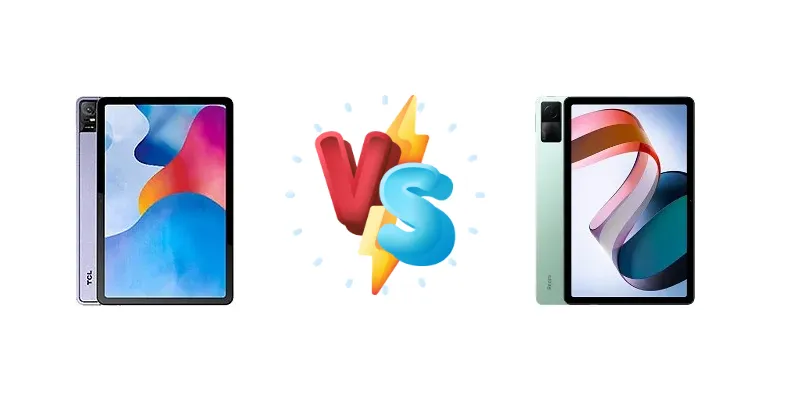
The tablet market is heating up, and two contenders are vying for your attention: the TCL NxtPaper 11, known for its e-ink-like display, and the Xiaomi Redmi Pad, a budget-friendly all-rounder. But which one deserves a spot in your bag? Let's dive into a detailed comparison to help you decide.
🏆 Quick Verdict
The Xiaomi Redmi Pad offers a more well-rounded experience with a brighter display and slightly better performance. However, the TCL NxtPaper 11’s unique display is a game-changer for reading and content consumption, making it ideal for students and avid readers. It's a close call, depending on your priorities.
| Network |
|---|
| 2G bands | GSM 850 / 900 / 1800 / 1900 | N/A |
| 3G bands | HSDPA 850 / 900 / 1900 / 2100 | N/A |
| 4G bands | LTE | N/A |
| EDGE | - | N/A |
| GPRS | - | N/A |
| Speed | HSPA, LTE - cellular model only | - |
| Technology | GSM / HSPA / LTE | No cellular connectivity |
| Launch |
|---|
| Announced | 2023, February 26 | 2022, October 04 |
| Status | Available. Released 2023, May | Available. Released 2022, October 05 |
| Body |
|---|
| Build | - | Glass front, aluminum frame |
| Dimensions | 259 x 163.6 x 6.9 mm (10.20 x 6.44 x 0.27 in) | 250.5 x 158.1 x 7.1 mm (9.86 x 6.22 x 0.28 in) |
| SIM | Nano-SIM (cellular model only) | No |
| Weight | 462 g (1.02 lb) | 465 g (1.03 lb) |
| Display |
|---|
| Resolution | 1200 x 2000 pixels, 5:3 ratio (~213 ppi density) | 1200 x 2000 pixels, 5:3 ratio (~220 ppi density) |
| Size | 10.95 inches, 341.3 cm2 (~80.5% screen-to-body ratio) | 10.61 inches, 320.4 cm2 (~80.9% screen-to-body ratio) |
| Type | NCVM IPS | IPS LCD, 1B colors, 90Hz, 400 nits (typ) |
| Platform |
|---|
| CPU | Octa-core (4x2.0 GHz Cortex-A73 & 4x Cortex-A53) | Octa-core (2x2.2 GHz Cortex-A76 & 6x2.0 GHz Cortex-A55) |
| Chipset | Mediatek MT8183 Helio P60T (12 nm) | Mediatek Helio G99 (6 nm) |
| GPU | PowerVR GE8320 | Mali-G57 MC2 |
| OS | Android 13 | Android 12, upgradable to Android 13, MIUI 14 |
| Memory |
|---|
| Card slot | microSDXC | microSDXC |
| Internal | - | 64GB 3GB RAM, 128GB 4GB RAM, 128GB 6GB RAM |
| | - | UFS 2.2 |
| Main Camera |
|---|
| Features | LED flash | - |
| Single | 8 MP, f/2.0, (wide), 1/4.0", 1.12µm, AF | 8 MP, f/2.0, (wide), AF |
| Video | 1080p@30fps | 1080p@30fps |
| Selfie camera |
|---|
| Single | 8 MP, 100˚, (ultrawide), 1/4.0", 1.12µm | 8 MP, f/2.3, 105° (ultrawide) |
| Video | 1080p@30fps | 1080p@30fps |
| Sound |
|---|
| 3.5mm jack | Unspecified | No |
| 35mm jack | No | No |
| Loudspeaker | Yes, with dual speakers (4 speakers) | Yes, with stereo speakers (4 speakers) |
| | - | 24-bit/192kHz audio |
| Comms |
|---|
| Bluetooth | 5.0, A2DP, LE | 5.2, A2DP, LE |
| NFC | No | No |
| Positioning | No | No |
| Radio | Unspecified | No |
| USB | USB Type-C 2.0 | USB Type-C, OTG |
| WLAN | Wi-Fi 802.11 a/b/g/n/ac, dual-band, Wi-Fi Direct | Wi-Fi 802.11 a/b/g/n/ac, dual-band, Wi-Fi Direct |
| Features |
|---|
| Sensors | Accelerometer, proximity (accessories only) | Accelerometer |
| Battery |
|---|
| Charging | 18W wired | 18W wired |
| Type | Li-Po 8000 mAh | Li-Po 8000 mAh |
| Misc |
|---|
| Colors | Digital Lavender, Dark Gray | Graphite Gray, Moonlight Silver, Mint Green |
| Models | 9466X | 22081283G |
| Price | About 240 EUR | About 250 EUR |
| SAR EU | - | 0.36 W/kg (body) |
| Tests |
|---|
| Display | - |
Contrast ratio: 1529:1 (nominal) |
| Loudspeaker | - |
-23.9 LUFS (Very good)
|
| Performance | - |
AnTuTu: 319077 (v9)
GeekBench: 1852 (v5.1)
GFXBench: 13fps (ES 3.1 onscreen) |
TCL NxtPaper 11
- Eye-friendly display reduces strain
- Excellent for reading and writing
- Decent battery life
- Lightweight and portable
- Performance is not top-tier
- Color reproduction could be better
- Camera quality is average
Xiaomi Redmi Pad
- Brighter display for outdoor use
- Better overall performance
- More vibrant colors
- Affordable price
- Display isn't as eye-friendly as NxtPaper
- Camera quality is average
- Design is fairly basic
Display Comparison
The TCL NxtPaper 11 boasts a unique LCD panel designed to mimic the look of e-ink, reducing eye strain. While the Redmi Pad has a standard LCD with a 1529:1 contrast ratio, its 402 nits brightness gives it an edge in brighter environments. The NxtPaper's color reproduction is decent, but the Redmi Pad offers a more vibrant and colorful experience.
Camera Comparison
Neither tablet excels in the camera department. Both feature basic rear and front-facing cameras suitable for video calls and casual snapshots. Image quality is average in both cases, with limited low-light performance. Don't expect to use these tablets as your primary camera.
Performance
The Xiaomi Redmi Pad's Mediatek Helio G99 chipset, built on a 6nm process, generally outperforms the TCL NxtPaper 11's Helio P60T (12nm). The G99's Cortex-A76 cores provide a noticeable boost in responsiveness and gaming performance. While both handle everyday tasks well, the Redmi Pad feels snappier overall.
Battery Life
Battery life is comparable between the two. Both offer all-day battery life with moderate usage. The TCL NxtPaper 11's e-ink-like display contributes to slightly better battery efficiency during reading, but the Redmi Pad's larger battery capacity helps it keep up.
Buying Guide
Who should buy the TCL NxtPaper 11? Students, bookworms, and anyone who spends a lot of time reading or working with documents will appreciate the eye-friendly display. Who should buy the Xiaomi Redmi Pad? Those seeking a versatile tablet for entertainment, browsing, and light gaming at an affordable price will find the Redmi Pad a great choice.
Frequently Asked Questions
❓ Is the TCL NxtPaper 11 good for gaming?
While it can handle some casual games, the NxtPaper 11's processor isn't ideal for demanding titles. The Redmi Pad offers a better gaming experience.
❓ Which tablet has better speakers?
The Xiaomi Redmi Pad generally has slightly better speakers with a more balanced sound profile.
❓ Does the NxtPaper 11 support a stylus?
Yes, the TCL NxtPaper 11 supports a stylus, making it great for note-taking and drawing.