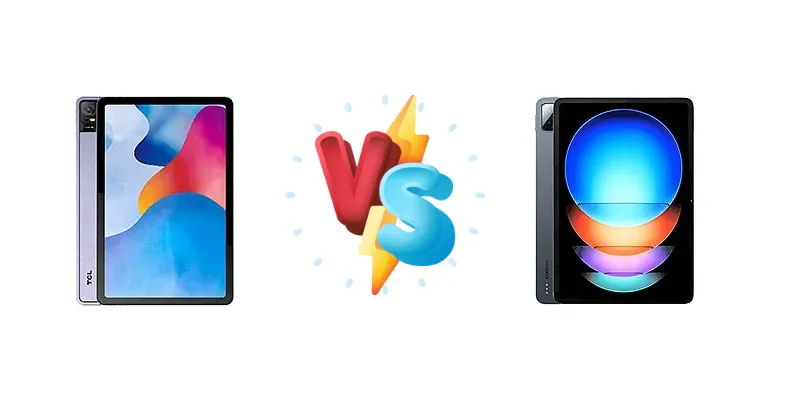
The tablet market offers a wide spectrum of choices, from budget-friendly options focused on portability and reading to high-performance devices aiming to replace laptops. The TCL NxtPaper 11 prioritizes a unique paper-like display and affordability, while the Xiaomi Pad 6S Pro 12.4 aims for flagship performance and a premium experience. This comparison dissects their key differences to help you determine which tablet best suits your needs.
🏆 Quick Verdict
For the average user prioritizing performance and future-proofing, the Xiaomi Pad 6S Pro 12.4 is the clear winner. Its Snapdragon 8 Gen 2 chipset and 120W charging offer a vastly superior experience compared to the TCL NxtPaper 11’s Helio P60T. However, the NxtPaper 11 remains a compelling option for those seeking a dedicated reading device with a unique display.
| Network |
|---|
| 2G bands | GSM 850 / 900 / 1800 / 1900 | N/A |
| 3G bands | HSDPA 850 / 900 / 1900 / 2100 | N/A |
| 4G bands | LTE | - |
| EDGE | - | N/A |
| GPRS | - | N/A |
| Speed | HSPA, LTE - cellular model only | - |
| Technology | GSM / HSPA / LTE | No cellular connectivity |
| Launch |
|---|
| Announced | 2023, February 26 | 2024, February 22 |
| Status | Available. Released 2023, May | Available. Released 2024, February 22 |
| Body |
|---|
| Build | - | Glass front (Gorilla Glass 5), aluminum frame, aluminum back |
| Dimensions | 259 x 163.6 x 6.9 mm (10.20 x 6.44 x 0.27 in) | 278.7 x 191.6 x 6.3 mm (10.97 x 7.54 x 0.25 in) |
| SIM | Nano-SIM (cellular model only) | No |
| Weight | 462 g (1.02 lb) | 590 g (1.30 lb) |
| Display |
|---|
| Protection | - | Corning Gorilla Glass 5 |
| Resolution | 1200 x 2000 pixels, 5:3 ratio (~213 ppi density) | 2032 x 3048 pixels, 3:2 ratio (~295 ppi density) |
| Size | 10.95 inches, 341.3 cm2 (~80.5% screen-to-body ratio) | 12.4 inches, 457.8 cm2 (~85.7% screen-to-body ratio) |
| Type | NCVM IPS | IPS LCD, 68B colors, 144Hz, HDR10, Dolby Vision, 900 nits (peak) |
| Platform |
|---|
| CPU | Octa-core (4x2.0 GHz Cortex-A73 & 4x Cortex-A53) | Octa-core (1x3.2 GHz Cortex-X3 & 2x2.8 GHz Cortex-A715 & 2x2.8 GHz Cortex-A710 & 3x2.0 GHz Cortex-A510) |
| Chipset | Mediatek MT8183 Helio P60T (12 nm) | Qualcomm SM8550-AB Snapdragon 8 Gen 2 (4 nm) |
| GPU | PowerVR GE8320 | Adreno 740 |
| OS | Android 13 | Android 14, up to 3 major Android upgrades, HyperOS |
| Memory |
|---|
| Card slot | microSDXC | No |
| Internal | - | 256GB 8GB RAM, 256GB 12GB RAM, 512GB 12GB RAM, 1TB 16GB RAM |
| Main Camera |
|---|
| Dual | - | 50 MP, f/1.8, (wide), 1/2.76", 0.64µm, PDAF
Auxiliary lens |
| Features | LED flash | LED flash, HDR, panorama |
| Single | 8 MP, f/2.0, (wide), 1/4.0", 1.12µm, AF | - |
| Video | 1080p@30fps | 4K@30/60fps, 1080p@30/60fps |
| Selfie camera |
|---|
| Single | 8 MP, 100˚, (ultrawide), 1/4.0", 1.12µm | 32 MP, f/2.2, (wide), 1/3.6", 0.61µm |
| Video | 1080p@30fps | 1080p@30fps |
| Sound |
|---|
| 3.5mm jack | Unspecified | - |
| 35mm jack | No | No |
| Loudspeaker | Yes, with dual speakers (4 speakers) | Yes, with stereo speakers (6 speakers) |
| Comms |
|---|
| Bluetooth | 5.0, A2DP, LE | 5.3, A2DP, LE, LHDC |
| NFC | No | Yes (file transfer only) |
| Positioning | No | No |
| Radio | Unspecified | No |
| USB | USB Type-C 2.0 | USB Type-C 3.2, accessory connector |
| WLAN | Wi-Fi 802.11 a/b/g/n/ac, dual-band, Wi-Fi Direct | Wi-Fi 802.11 a/b/g/n/a/6/7, dual-band, Wi-Fi Direct |
| Features |
|---|
| Sensors | Accelerometer, proximity (accessories only) | Fingerprint (side-mounted), accelerometer, gyro, proximity (accessories only), compass |
| Battery |
|---|
| Charging | 18W wired | 120W wired, PD3.0, QC4, 45% in 10 min, 100% in 35 min |
| Type | Li-Po 8000 mAh | 10000 mAh |
| Misc |
|---|
| Colors | Digital Lavender, Dark Gray | Black, Blue, Green |
| Models | 9466X | 24018RPACG |
| Price | About 240 EUR | About 700 EUR |
| SAR EU | - | 0.99 W/kg (body) |
TCL NxtPaper 11
- Unique paper-like display for comfortable reading
- Highly portable and lightweight design
- More affordable price point
- Significantly weaker processor performance
- Slow 18W charging
- Lower display brightness and contrast
Xiaomi Pad 6S Pro 12.4
- Flagship Snapdragon 8 Gen 2 performance
- Ultra-fast 120W charging
- Bright and vibrant 12.4-inch display
- Higher price tag
- Larger size and weight
- May be overkill for basic tasks
Display Comparison
The Xiaomi Pad 6S Pro 12.4 boasts a significantly brighter display, reaching a measured 848 nits, compared to the TCL NxtPaper 11’s unspecified brightness. This makes the Xiaomi tablet far more usable outdoors. While the NxtPaper 11’s display is designed to mimic the texture of paper, reducing eye strain, the Xiaomi Pad 6S Pro’s higher contrast ratio of 1378:1 delivers richer, more vibrant visuals. The larger 12.4-inch screen on the Xiaomi also provides more screen real estate for productivity tasks. The NxtPaper 11’s focus on a matte finish is a trade-off; it reduces glare but also impacts color vibrancy.
Camera Comparison
Given the tablet form factor, camera quality isn't a primary concern for most users. However, the Xiaomi Pad 6S Pro is likely to offer a more capable camera system due to its flagship positioning, though specific details are unavailable. The TCL NxtPaper 11’s camera specifications are not provided, suggesting a basic implementation. It’s safe to assume the Xiaomi will deliver better image quality and more features.
Performance
The performance gap between these tablets is substantial. The Xiaomi Pad 6S Pro 12.4 is powered by the Qualcomm Snapdragon 8 Gen 2 (4nm), featuring a core configuration of 1x3.2 GHz Cortex-X3, 2x2.8 GHz Cortex-A715, 2x2.8 GHz Cortex-A710, and 3x2.0 GHz Cortex-A510. This is a flagship-level chipset designed for demanding applications. In contrast, the TCL NxtPaper 11 utilizes the Mediatek MT8183 Helio P60T (12nm) with an older core arrangement of 4x2.0 GHz Cortex-A73 & 4x Cortex-A53. The 4nm process node of the Snapdragon 8 Gen 2 offers significantly better power efficiency and thermal performance, resulting in less throttling during sustained workloads. The Xiaomi’s superior GPU will also deliver a much smoother gaming experience.
Battery Life
The Xiaomi Pad 6S Pro 12.4 excels in charging speed with its 120W wired charging, achieving 45% charge in just 10 minutes and a full charge in 35 minutes, supporting PD3.0 and QC4 standards. The TCL NxtPaper 11’s 18W charging is considerably slower. While the NxtPaper 11’s battery capacity isn’t specified, the Xiaomi Pad 6S Pro achieves an impressive 11:14h of active use, suggesting efficient power management alongside its larger battery. The faster charging of the Xiaomi mitigates any potential concerns about battery life, allowing for quick top-ups throughout the day.
Buying Guide
Buy the TCL NxtPaper 11 if you need a highly portable, affordable tablet primarily for reading, note-taking, and light tasks where battery life is paramount. Buy the Xiaomi Pad 6S Pro 12.4 if you prefer a powerful tablet capable of demanding games, video editing, and multitasking, and value fast charging and a premium display experience.
Frequently Asked Questions
❓ Is the TCL NxtPaper 11’s display truly better for reading long-form content compared to a standard LCD or OLED?
The NxtPaper 11’s matte, paper-like display reduces glare and blue light emission, which can minimize eye strain during extended reading sessions. However, this comes at the cost of color accuracy and vibrancy. Users sensitive to screen flicker or who read extensively in bright environments may find it more comfortable than traditional displays.
❓ Will the Snapdragon 8 Gen 2 in the Xiaomi Pad 6S Pro 12.4 handle demanding games like Genshin Impact or Call of Duty Mobile at high settings?
Absolutely. The Snapdragon 8 Gen 2 is a flagship-level chipset capable of running virtually any Android game at maximum settings. The larger display of the Xiaomi Pad 6S Pro 12.4 also enhances the gaming experience, providing more immersive visuals. Expect consistently high frame rates and minimal thermal throttling.
❓ How does the 120W charging on the Xiaomi Pad 6S Pro 12.4 compare to typical tablet charging speeds?
120W charging is exceptionally fast for a tablet. Most tablets charge at 20-30W. The Xiaomi Pad 6S Pro can go from 0 to 100% in just 35 minutes, a significant time saver compared to the TCL NxtPaper 11’s 18W charging, which will take considerably longer.