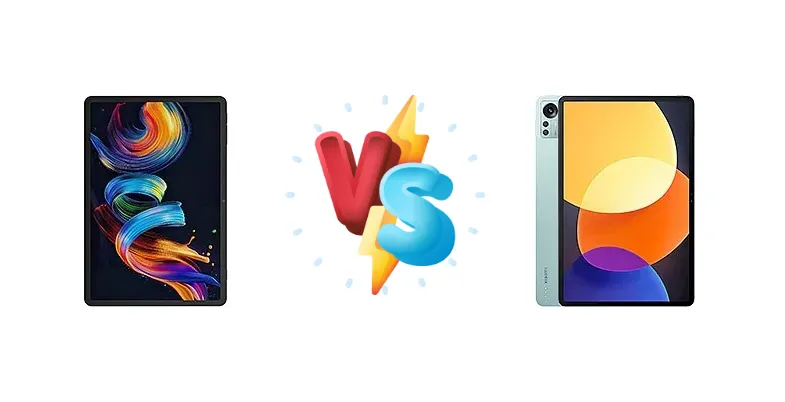
The Android tablet market is heating up, with options ranging from budget-friendly productivity tools to high-performance media centers. The TCL NxtPaper 11 Plus and Xiaomi Pad 5 Pro 12.4 represent distinct approaches: the TCL prioritizing long-lasting battery and a unique paper-like display, while the Xiaomi focuses on raw processing power and rapid charging. This comparison dissects their key differences to help you choose the right tablet for your workflow.
🏆 Quick Verdict
For the average user prioritizing sustained performance and quick turnaround times, the Xiaomi Pad 5 Pro 12.4 is the stronger choice. Its Snapdragon 870 chipset delivers significantly more processing power, and the 67W charging drastically reduces downtime. However, the TCL NxtPaper 11 Plus remains a compelling option for those valuing extended battery life and a unique reading experience.
| Network |
|---|
| 2G bands | N/A | N/A |
| 3G bands | N/A | N/A |
| 4G bands | N/A | N/A |
| EDGE | No | No |
| GPRS | No | No |
| Technology | No cellular connectivity | No cellular connectivity |
| Launch |
|---|
| Announced | 2025, March 03 | 2022, August 11 |
| Status | Available. Released 2025, May | Available. Released 2022, August 24 |
| Body |
|---|
| Build | - | Glass front (Gorilla Glass 3), aluminum frame, aluminum back |
| Dimensions | 260.5 x 176.8 x 6.5 mm (10.26 x 6.96 x 0.26 in) | 285 x 185.2 x 6.7 mm (11.22 x 7.29 x 0.26 in) |
| SIM | No | No |
| Weight | 490 g (1.08 lb) | 620 g (1.37 lb) |
| | - | Stylus support (magnetic) |
| Display |
|---|
| Protection | Mohs level 7 | Corning Gorilla Glass 3 |
| Resolution | 1440 x 2200 pixels, 3:2 ratio (~229 ppi density) | 1600 x 2560 pixels, 16:10 ratio (~243 ppi density) |
| Size | 11.5 inches, 391.0 cm2 (~84.9% screen-to-body ratio) | 12.4 inches, 445.8 cm2 (~84.5% screen-to-body ratio) |
| Type | IPS LCD, 120Hz, 450 nits (typ), 550 nits (HBM) | IPS LCD, 120Hz, HDR10, Dolby Vision, 500 nits |
| Platform |
|---|
| CPU | Octa-core (2x2.2 GHz Cortex-A76 & 6x2.0 GHz Cortex-A55) | Octa-core (1x3.2 GHz Kryo 585 & 3x2.42 GHz Kryo 585 & 4x1.80 GHz Kryo 585) |
| Chipset | Mediatek Helio G100 (6 nm) | Qualcomm SM8250-AC Snapdragon 870 5G (7 nm) |
| GPU | Mali-G57 MC2 | Adreno 650 |
| OS | Android 15, up to 1 major Android upgrades | Android 12, MIUI Pad 13 |
| Memory |
|---|
| Card slot | Unspecified | No |
| Internal | 256GB 8GB RAM, 256GB 12GB RAM | 128GB 6GB RAM, 256GB 8GB RAM, 512GB 12GB RAM |
| | - | UFS 3.1 |
| Main Camera |
|---|
| Dual | - | 50 MP, f/1.8, 1/2.76", 0.64µm, PDAF
Auxiliary lens |
| Features | LED flash | Color spectrum sensor, LED flash, panorama, HDR |
| Single | 8 MP, f/2.0, (wide), AF | - |
| Video | 1080p@30fps | 4K@30fps, 1080p@30/60fps |
| Selfie camera |
|---|
| Single | 8 MP | 20 MP, f/2.2, 1/3.4", 0.8µm |
| Video | 1080p@30fps | 1080p@30/60fps |
| Sound |
|---|
| 3.5mm jack | - | No |
| 35mm jack | No | No |
| Loudspeaker | Yes, with dual speakers (4 speakers) | Yes, with stereo speakers (4 speakers) |
| Comms |
|---|
| Bluetooth | 5.3, A2DP, LE | 5.2, A2DP, LE |
| NFC | No | No |
| Positioning | GPS | No |
| Radio | Unspecified | No |
| USB | USB Type-C 2.0 | USB Type-C 3.2 video output |
| WLAN | Wi-Fi 802.11 a/b/g/n/ac, dual-band | Wi-Fi 802.11 a/b/g/n/ac/6, dual-band, Wi-Fi Direct |
| Features |
|---|
| Sensors | Accelerometer, proximity (accessories only) | Accelerometer, gyro, proximity, compass |
| Battery |
|---|
| Charging | 33W wired, 33W PD | 67W wired, PD3.0, QC4, 60% in 36 min, 100% in 68 min |
| Type | Li-Po 8000 mAh | Li-Po 10000 mAh |
| Misc |
|---|
| Colors | Dark Gray | Black, Silver, Green |
| Models | 9469X | - |
| Price | $ 201.55 | About 400 EUR |
| EU LABEL |
|---|
| Battery | 82:11h endurance, 1000 cycles | - |
| Energy | Class F | - |
| Free fall | Class E (14 falls) | - |
| Repairability | Class C | - |
TCL NxtPaper 11 Plus
- Exceptional 82-hour battery life
- Unique paper-like display for comfortable reading
- 1000 charge cycles promise long-term durability
- Less powerful Mediatek Helio G100 chipset
- Slower 33W charging
- Display may lack the vibrancy of higher-end panels
Xiaomi Pad 5 Pro 12.4
- Powerful Qualcomm Snapdragon 870 5G processor
- Ultra-fast 67W charging (60% in 36 min)
- Likely superior display quality and brightness
- Potentially shorter battery life compared to TCL
- Higher price point
- May run warmer under sustained load
Display Comparison
While both tablets offer large displays, their approaches differ. The Xiaomi Pad 5 Pro 12.4’s size isn’t specified, but its ‘Pro’ designation suggests a higher-quality panel, potentially with features like LTPO for variable refresh rates, absent in the TCL. The TCL NxtPaper 11 Plus’s key feature is its paper-like display, designed to reduce eye strain, but this comes at the cost of potentially lower peak brightness and color accuracy compared to a traditional LCD or OLED. Bezels are not specified for either device, but the Xiaomi’s premium positioning suggests a more refined design.
Camera Comparison
Camera performance is unlikely to be a primary concern for most tablet users, but the Xiaomi Pad 5 Pro 12.4 likely holds an advantage. While specific sensor details are missing, Xiaomi typically equips its ‘Pro’ tablets with higher-resolution sensors and more advanced image processing. The TCL NxtPaper 11 Plus’s camera specifications are not provided, suggesting a more basic implementation. Focusing on the primary sensor is key, as the inclusion of low-resolution auxiliary lenses (like a 2MP macro) adds little value.
Performance
The performance gap is significant. The Xiaomi Pad 5 Pro 12.4’s Qualcomm Snapdragon 870 5G (7nm) is a flagship-level chipset, boasting a prime core clocked at 3.2 GHz, designed for sustained high performance. In contrast, the TCL NxtPaper 11 Plus utilizes the Mediatek Helio G100 (6nm). While the G100 is a capable processor, its Cortex-A76 cores at 2.2 GHz are less powerful than the Snapdragon’s Kryo 585 cores. The Xiaomi’s likely use of faster LPDDR5x RAM further enhances its multitasking capabilities. The 7nm process node of the Snapdragon 870 also contributes to better thermal efficiency, minimizing throttling during extended use.
Battery Life
Battery life is a key differentiator. The TCL NxtPaper 11 Plus boasts an impressive 82-hour endurance, suggesting a large battery capacity optimized for efficiency. However, the Xiaomi Pad 5 Pro 12.4 compensates for potentially lower endurance with its blazing-fast 67W charging. Reaching 60% charge in just 36 minutes and 100% in 68 minutes significantly reduces downtime. The TCL’s 33W charging, while supporting PD, is considerably slower. The Xiaomi’s support for PD3.0 and QC4 further enhances charging compatibility.
Buying Guide
Buy the TCL NxtPaper 11 Plus if you need a tablet primarily for reading, note-taking, and light productivity tasks, and value exceptional battery life above all else. Its 82-hour endurance is ideal for travelers or students. Buy the Xiaomi Pad 5 Pro 12.4 if you prefer a tablet capable of demanding tasks like video editing, gaming, and multitasking, and appreciate the convenience of incredibly fast charging and a more powerful processor.
Frequently Asked Questions
❓ Does the Mediatek Helio G100 in the TCL NxtPaper 11 Plus struggle with demanding games like Genshin Impact?
The Helio G100 is a capable processor, but it's not designed for high-end gaming. While it can run Genshin Impact, you'll likely need to lower the graphics settings to achieve a playable frame rate. The Xiaomi Pad 5 Pro 12.4’s Snapdragon 870 will provide a significantly smoother gaming experience at higher settings.
❓ How much faster is the 67W charging on the Xiaomi Pad 5 Pro 12.4 compared to the 33W charging on the TCL NxtPaper 11 Plus in real-world use?
The difference is substantial. The Xiaomi can go from 0% to 60% in just 36 minutes, and fully charge in 68 minutes. The TCL’s 33W charging will take considerably longer – likely over two hours for a full charge. This makes the Xiaomi ideal for users who need to quickly top up their battery before heading out.
❓ Is the paper-like display on the TCL NxtPaper 11 Plus suitable for viewing photos and videos?
While excellent for reading, the paper-like display may not be ideal for viewing photos and videos. It prioritizes eye comfort over color vibrancy and contrast, so images may appear less saturated and dynamic compared to a traditional LCD or OLED panel.