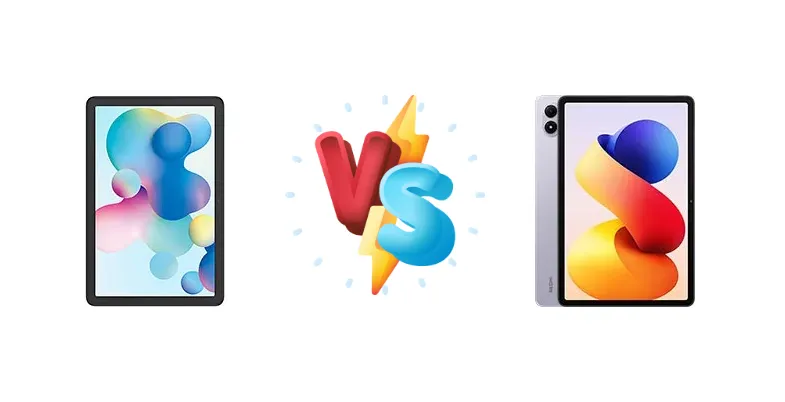
The tablet market is heating up, with options ranging from basic media consumption devices to surprisingly capable productivity tools. The TCL NxtPaper 10s aims for affordability and a unique paper-like display, while the Xiaomi Redmi Pad 2 Pro targets a more mainstream user with a focus on performance and fast charging. This comparison dissects the key differences to help you choose the right tablet for your needs.
🏆 Quick Verdict
For the average user, the Xiaomi Redmi Pad 2 Pro is the superior choice. Its Snapdragon 7s Gen 4 chipset delivers significantly faster performance than the TCL NxtPaper 10s’ Mediatek MT8768, and the 33W charging is a game-changer compared to the 18W charging on the TCL. While the NxtPaper 10s has a unique display, the Redmi Pad 2 Pro offers a more well-rounded experience.
| Network |
|---|
| 2G bands | N/A | N/A |
| 3G bands | N/A | N/A |
| EDGE | No | N/A |
| GPRS | No | N/A |
| Technology | No cellular connectivity | No cellular connectivity |
| Launch |
|---|
| Announced | 2022, January 04 | 2025, September 24 |
| Status | Available. Released 2022, Q3 | Available. Released 2025, September 24 |
| Body |
|---|
| Build | - | Glass front, aluminum frame, aluminum back |
| Dimensions | 241 x 158.6 x 8.3 mm (9.49 x 6.24 x 0.33 in) | 279.8 x 181.7 x 7.5 mm (11.02 x 7.15 x 0.30 in) |
| SIM | No | No |
| Weight | 490 g (1.08 lb) | 610 g (1.34 lb) |
| Display |
|---|
| Protection | - | Mohs level 6 |
| Resolution | 1200 x 1920 pixels, 16:10 ratio (~224 ppi density) | 1600 x 2560 pixels, 16:10 ratio (~249 ppi density) |
| Size | 10.1 inches, 295.8 cm2 (~77.4% screen-to-body ratio) | 12.1 inches, 424.5 cm2 (~83.5% screen-to-body ratio) |
| Type | NCVM IPS | IPS LCD, 1B colors, 120Hz, Dolby Vision, 600 nits (HBM) |
| Platform |
|---|
| CPU | Octa-core (4x2.0 GHz Cortex-A53 & 4x1.5 GHz Cortex-A53) | Octa-core (1x2.7 GHz Cortex-A720 & 3x2.4 GHz Cortex-A720 & 4x1.8 GHz Cortex-A520) |
| Chipset | Mediatek MT8768 | Qualcomm SM7635-AC Snapdragon 7s Gen 4 (4 nm) |
| GPU | PowerVR GE8320 | Adreno 810 |
| OS | Android 11 | Android 15, HyperOS 2 |
| Memory |
|---|
| Card slot | microSDXC | microSDXC (dedicated slot) |
| Internal | 64GB 4GB RAM | 128GB 6GB RAM, 256GB 8GB RAM |
| Main Camera |
|---|
| Features | LED flash | Color spectrum sensor, LED flash, HDR |
| Single | 8 MP, f/2.0, (wide), 1/4.0", 1.12µm, AF | 8 MP, f/2.0, (wide), 1/4.0", 1.12µm |
| Video | 1080p@30fps | 1080p@30fps |
| Selfie camera |
|---|
| Single | 5 MP, f/2.2, (wide), 1/5.0", 1.12µm | 8 MP, f/2.3, (wide), 1/4.0", 1.12µm |
| Video | 1080p@30fps | 1080p@30fps |
| Sound |
|---|
| 35mm jack | Yes | Yes |
| Loudspeaker | Yes, with dual speakers | Yes, with stereo speakers, Dolby Atmos (4 speakers) |
| Comms |
|---|
| Bluetooth | 5.0, A2DP, LE | 5.4, A2DP, LE, aptX HD, aptX Adaptive |
| NFC | No | No |
| Positioning | GPS | No |
| Radio | FM radio, RDS | No |
| USB | USB Type-C 2.0 | USB Type-C 2.0, OTG |
| WLAN | Wi-Fi 802.11 a/b/g/n/ac, dual-band, Wi-Fi Direct | Wi-Fi 802.11 a/b/g/n/a/6, dual-band, Wi-Fi Direct |
| Features |
|---|
| Sensors | Accelerometer, proximity | Accelerometer, gyro, proximity (accessories only), compass |
| Battery |
|---|
| Charging | 18W wired | 33W wired, PD3.0, QC3+
27W reverse wired |
| Type | Li-Po 8000 mAh | 12000 mAh |
| Misc |
|---|
| Colors | Dark Gray, Ethereal Green | Graphite Gray, Silver, Lavender Purple, Matte Glass Version |
| Models | 9081X, 9081X2 | 25099RP13G |
| Price | - | About 300 EUR |
| EU LABEL |
|---|
| Battery | - | 103:18h endurance, 1000 cycles |
| Energy | - | Class G |
| Free fall | - | Class A (208 falls) |
| Repairability | - | Class C |
TCL NxtPaper 10s
- Unique paper-like display for comfortable reading
- Potentially lower price point
- Lightweight design (assumed based on market positioning)
- Significantly weaker performance
- Slower charging speed
- Likely limited software updates
Xiaomi Redmi Pad 2 Pro
- Faster and more efficient Snapdragon 7s Gen 4 chipset
- Significantly faster 33W charging
- Longer battery life in active use
- May be more expensive
- Lacks the unique paper-like display of the NxtPaper 10s
- Potentially larger and heavier
Display Comparison
While both tablets feature 10-inch displays, the specifics are absent in the provided data. However, the TCL NxtPaper 10s’ namesake suggests a focus on a matte, paper-like texture designed to reduce eye strain, potentially at the cost of peak brightness and color vibrancy. The Redmi Pad 2 Pro, lacking this specific feature, likely prioritizes standard LCD or IPS panel characteristics. Without nit brightness data, it's difficult to assess which display is superior for outdoor visibility.
Camera Comparison
Neither device is positioned as a photography powerhouse, and the provided data doesn’t offer detailed camera specs. It’s safe to assume both tablets feature basic camera setups suitable for video calls and casual snapshots. Without sensor size or aperture information, a meaningful comparison is impossible. We can expect image quality to be similar, leaning towards acceptable rather than exceptional.
Performance
The performance gap is substantial. The Xiaomi Redmi Pad 2 Pro’s Qualcomm SM7635-AC Snapdragon 7s Gen 4 (4nm) is built on a more advanced manufacturing process than the TCL NxtPaper 10s’ Mediatek MT8768. The 4nm process node translates to improved power efficiency and thermal management, allowing the Snapdragon 7s Gen 4 to sustain higher clock speeds for longer periods. The CPU architecture also favors the Redmi Pad 2 Pro; its Cortex-A720 cores are significantly more powerful than the Cortex-A53 cores found in the NxtPaper 10s. This difference will be most noticeable in demanding tasks like gaming and video editing.
Battery Life
The Xiaomi Redmi Pad 2 Pro boasts a significant advantage in battery endurance, with a reported 103:18h endurance and 12:55h of active use. While the TCL NxtPaper 10s’ battery capacity is unknown, the Redmi Pad 2 Pro’s superior chipset efficiency and larger battery (implied by the endurance score) contribute to its longer runtime. Furthermore, the Redmi Pad 2 Pro’s 33W wired charging, supporting PD3.0 and QC3+, is a major benefit, allowing for much faster top-ups compared to the NxtPaper 10s’ 18W charging. The 27W reverse wired charging on the Redmi Pad 2 Pro is also a unique feature, allowing it to charge other devices.
Buying Guide
Buy the TCL NxtPaper 10s if you prioritize a unique, paper-like reading experience and are on a very tight budget, accepting compromises in performance. Buy the Xiaomi Redmi Pad 2 Pro if you value faster performance for multitasking, gaming, and content creation, alongside significantly quicker charging speeds and a longer-lasting battery in active use.
Frequently Asked Questions
❓ Will the Mediatek MT8768 in the TCL NxtPaper 10s struggle with demanding games like Genshin Impact?
Yes, the Mediatek MT8768 is a relatively low-powered chipset. While it can handle basic games and streaming, demanding titles like Genshin Impact will likely experience significant frame rate drops and stuttering, even on low settings. The Snapdragon 7s Gen 4 in the Redmi Pad 2 Pro is far better equipped for gaming.
❓ How long does it realistically take to fully charge the Xiaomi Redmi Pad 2 Pro from 0% to 100%?
With its 33W charging support, the Xiaomi Redmi Pad 2 Pro can realistically charge from 0% to 100% in approximately 1 hour and 45 minutes to 2 hours, depending on usage during charging. This is significantly faster than the TCL NxtPaper 10s, which will likely take over 3 hours with its 18W charging.
❓ Is the paper-like display on the TCL NxtPaper 10s suitable for watching videos or viewing photos?
The paper-like display prioritizes readability and reduces eye strain, but it may not be ideal for viewing photos or videos. The matte texture can wash out colors and reduce contrast, resulting in a less vibrant viewing experience compared to a standard LCD or IPS display.