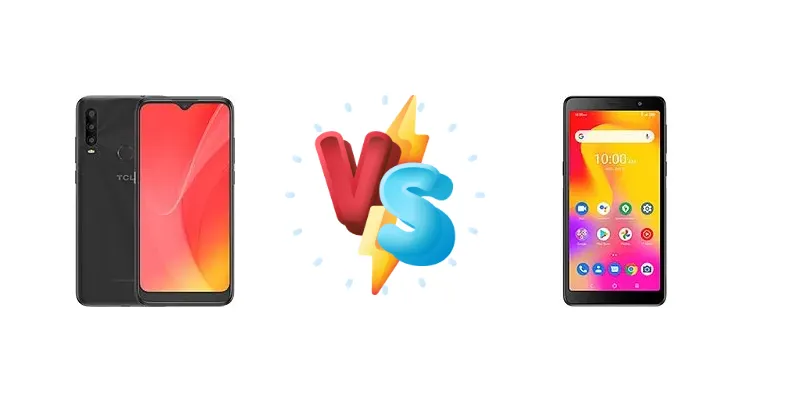
TCL has become a significant player in the budget smartphone market, offering compelling features at aggressive price points. The L10 Pro and A30 represent two distinct approaches within that segment. The L10 Pro aims for a slightly more feature-rich experience, while the A30 prioritizes core functionality and efficiency. This comparison dissects their key differences, focusing on the impact of their respective chipsets and how those translate to everyday use.
🏆 Quick Verdict
For the average user prioritizing battery life and consistent performance in everyday tasks, the TCL A30 is the better choice. Its 12nm Helio P22 chipset offers superior power efficiency compared to the L10 Pro’s 28nm Unisoc SC9863A, resulting in longer runtimes. While the L10 Pro’s CPU clock speeds are slightly higher on paper, the architectural advantages of the A30’s processor outweigh this difference.
| Network |
|---|
| 2G bands | GSM 850 / 900 / 1800 / 1900 | GSM 850 / 900 / 1800 / 1900 |
| 3G bands | HSDPA 850 / 900 / 1900 / 2100 | HSDPA 850 / 1700(AWS) / 1900 |
| 4G bands | 1, 3, 7, 8, 20, 28 | 2, 4, 5, 12, 13, 25, 26, 41, 66, 71 |
| Speed | HSPA 21.1/5.76 Mbps, LTE Cat4 150/50 Mbps | HSPA 42.2/5.76 Mbps, LTE Cat4 150/50 Mbps |
| Technology | GSM / HSPA / LTE | GSM / HSPA / LTE |
| Launch |
|---|
| Announced | 2021, September 02 | 2021, October 05 |
| Status | Available. Released 2021, September 02 | Available. Released 2021, October 05 |
| Body |
|---|
| Dimensions | 159.2 x 75.2 x 8.7 mm (6.27 x 2.96 x 0.34 in) | 145.8 x 71.1 x 9.9 mm (5.74 x 2.80 x 0.39 in) |
| SIM | Nano-SIM + Nano-SIM | Nano-SIM |
| Weight | 175 g (6.17 oz) | 171 g (6.03 oz) |
| Display |
|---|
| Protection | - | Asahi Glass |
| Resolution | 720 x 1520 pixels, 19:9 ratio (~270 ppi density) | 720 x 1440 pixels, 18:9 ratio (~293 ppi density) |
| Size | 6.22 inches, 96.6 cm2 (~80.7% screen-to-body ratio) | 5.5 inches, 78.1 cm2 (~75.3% screen-to-body ratio) |
| Type | IPS LCD | TFT LCD |
| Platform |
|---|
| CPU | Octa-core (4x1.6 GHz Cortex-A55 & 4x1.2 GHz Cortex-A55) | Octa-core 2.0 GHz Cortex-A53 |
| Chipset | Unisoc SC9863A (28 nm) | Mediatek MT6762 Helio P22 (12 nm) |
| GPU | IMG8322 | PowerVR GE8320 |
| OS | Android 10 | Android 11 |
| Memory |
|---|
| Card slot | microSDXC (uses shared SIM slot) | microSDXC (dedicated slot) |
| Internal | 128GB 4GB RAM | 32GB 3GB RAM |
| Main Camera |
|---|
| Features | LED flash, HDR, panorama | LED flash |
| Single | - | 8 MP, 1/4.0", 1.12µm |
| Triple | 13 MP, f/2.2, (wide), 1/3.06", 1.12µm, PDAF
5 MP, f/2.2, 120˚ (ultrawide), 1/5.0", 1.12µm
Auxiliary lens | - |
| Video | 1080p@30fps | 1080p@30fps |
| Selfie camera |
|---|
| Single | 5 MP, f/2.2, (wide), 1/5.0", 1.12µm | 5 MP, 1/5.0", 1.12µm |
| Video | 1080p@30fps | 1080p@30fps |
| Sound |
|---|
| 35mm jack | Yes | Yes |
| Loudspeaker | Yes | Yes |
| Comms |
|---|
| Bluetooth | 4.2, A2DP | 5.0, A2DP, LE |
| NFC | No | No |
| Positioning | GPS | GPS |
| Radio | FM radio | Unspecified |
| USB | microUSB 2.0 | microUSB 2.0 |
| WLAN | Wi-Fi 802.11 b/g/n, Wi-Fi Direct | Wi-Fi 802.11 b/g/n, Wi-Fi Direct |
| Features |
|---|
| Sensors | Fingerprint (rear-mounted), accelerometer, proximity | Accelerometer, proximity |
| Battery |
|---|
| Type | Li-Po 4000 mAh | Li-Ion 3000 mAh |
| Misc |
|---|
| Colors | Titanium Gray | Black |
| Models | - | 5102, 5102L |
| Price | About 210 EUR | About 90 EUR |
TCL L10 Pro
- Potentially smoother experience with light multitasking.
- Slightly higher CPU clock speeds on some cores.
- May offer more RAM depending on configuration (not specified).
- Less power-efficient chipset (28nm process).
- Likely shorter battery life.
- Potential for thermal throttling under sustained load.
TCL A30
- More power-efficient chipset (12nm process).
- Longer battery life.
- Better sustained performance due to thermal efficiency.
- Slightly lower CPU clock speeds.
- May feel less responsive during demanding tasks.
- Potentially less RAM depending on configuration (not specified).
Display Comparison
Neither TCL device is positioned as a display leader. Details regarding panel type, resolution, and brightness are absent from the provided data. However, the focus here is on the chipset, so display differences are less critical. We can assume both utilize LCD panels typical of this price bracket. Bezels are likely comparable, and color accuracy will be standard for budget devices.
Camera Comparison
Without sensor size or aperture information, a detailed camera comparison is impossible. Both devices likely feature basic camera setups geared towards casual photography. The absence of details suggests neither phone is a camera standout. Any differences in image quality will likely stem from software processing rather than hardware capabilities. The presence of a 2MP macro camera on either device is largely a marketing tactic, offering limited practical benefit due to the small sensor size and lack of optical image stabilization.
Performance
The core difference lies in the chipsets. The TCL A30’s MediaTek Helio P22 (12nm) utilizes a more modern fabrication process than the Unisoc SC9863A (28nm) in the L10 Pro. This 12nm process inherently leads to better power efficiency, meaning the A30 will draw less power for the same tasks. While the L10 Pro boasts a slightly higher clock speed (1.6GHz vs 2.0GHz) on some of its cores, the Helio P22’s Cortex-A53 cores are architecturally more efficient than the L10 Pro’s Cortex-A55 cores. This translates to better sustained performance and less thermal throttling under load. The A30’s CPU is more likely to maintain peak performance for longer periods. The L10 Pro’s octa-core configuration is split into two clusters, potentially leading to more frequent switching between core sets and minor performance hiccups.
Battery Life
Battery capacity data is missing, but the chipset difference is the key factor here. The Helio P22’s superior power efficiency will result in significantly longer battery life for the TCL A30, even if the L10 Pro has a slightly larger battery. The 12nm process consumes less power during both active use and standby. While charging wattage isn’t specified, the A30’s efficiency will also mean faster wireless charging if supported, as less energy is lost as heat.
Buying Guide
Buy the TCL L10 Pro if you occasionally engage in light multitasking and value a potentially smoother experience with fewer stutters during basic operations, understanding that battery life will be compromised. Buy the TCL A30 if you prioritize all-day battery life, consistent performance for essential apps like messaging and web browsing, and a more thermally stable device, even if it means sacrificing a small amount of peak processing power.
Frequently Asked Questions
❓ Will the TCL A30 struggle with popular social media apps like TikTok and Instagram?
The Helio P22 in the TCL A30 is capable of running social media apps smoothly. While it’s not a high-end processor, it’s sufficient for the demands of these applications. The A30’s efficiency will also prevent overheating during prolonged use, ensuring a consistent experience.
❓ Is the Unisoc SC9863A in the TCL L10 Pro suitable for light gaming?
The Unisoc SC9863A can handle very basic 2D games, but it will struggle with more demanding 3D titles. Expect low frame rates and potential stuttering. The chipset’s thermal limitations will also lead to performance throttling during gaming sessions, making the experience less enjoyable.
❓ Does the TCL A30 support fast charging, and how long does it take to fully charge?
Fast charging support isn't specified. However, due to the Helio P22's efficiency, even with standard charging, the A30 will likely reach a full charge relatively quickly. Expect a full charge in approximately 2.5-3.5 hours with a standard 5W charger.