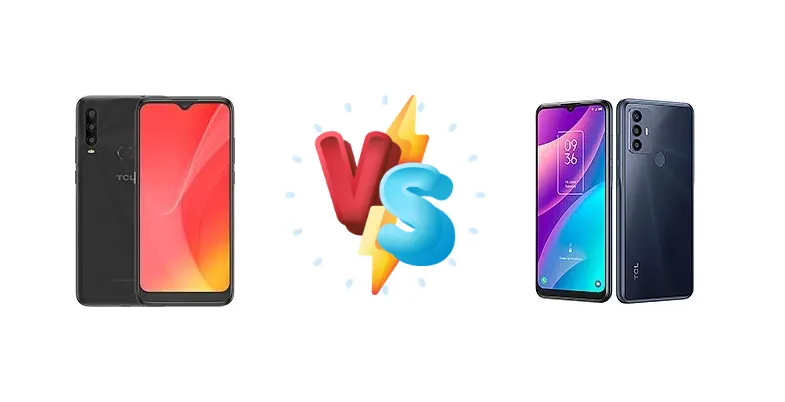
TCL has become a significant player in the budget smartphone space, offering compelling features at aggressive price points. The L10 Pro and 30 SE represent two distinct approaches within that segment. The L10 Pro aims for a slightly broader feature set, while the 30 SE focuses on core functionality and efficiency. This comparison dissects their key differences to determine which device delivers the best value.
🏆 Quick Verdict
For the average user prioritizing efficiency and a slightly smoother experience, the TCL 30 SE is the better choice. Its Mediatek Helio G25, built on a 12nm process, offers a performance advantage over the L10 Pro’s older 28nm Unisoc SC9863A, despite similar core counts. While neither phone is a performance powerhouse, the 30 SE’s charging capability adds a practical benefit.
| Network |
|---|
| 2G bands | GSM 850 / 900 / 1800 / 1900 | GSM 850 / 900 / 1800 / 1900 |
| 3G bands | HSDPA 850 / 900 / 1900 / 2100 | HSDPA 850 / 900 / 1900 / 2100 - EMEA/APAC |
| 4G bands | 1, 3, 7, 8, 20, 28 | 1, 3, 5, 7, 8, 20, 28, 38, 40, 41 - EMEA |
| Speed | HSPA 21.1/5.76 Mbps, LTE Cat4 150/50 Mbps | HSPA 42.2/11.5 Mbps, LTE Cat4 150/50 Mbps |
| Technology | GSM / HSPA / LTE | GSM / HSPA / LTE |
| | - | 2, 3, 4, 5, 7, 8, 12, 13, 17, 26, 28, 66 - LATAM |
| Launch |
|---|
| Announced | 2021, September 02 | 2022, February 27 |
| Status | Available. Released 2021, September 02 | Available. Released 2022, April 20 |
| Body |
|---|
| Build | - | Glass front, plastic frame, plastic back |
| Dimensions | 159.2 x 75.2 x 8.7 mm (6.27 x 2.96 x 0.34 in) | 165.2 x 75.5 x 8.9 mm (6.50 x 2.97 x 0.35 in) |
| SIM | Nano-SIM + Nano-SIM | · Nano-SIM· Nano-SIM + Nano-SIM |
| Weight | 175 g (6.17 oz) | 190 g (6.70 oz) |
| Display |
|---|
| Resolution | 720 x 1520 pixels, 19:9 ratio (~270 ppi density) | 720 x 1600 pixels, 20:9 ratio (~269 ppi density) |
| Size | 6.22 inches, 96.6 cm2 (~80.7% screen-to-body ratio) | 6.52 inches, 102.6 cm2 (~82.3% screen-to-body ratio) |
| Type | IPS LCD | IPS LCD, 450 nits (typ) |
| Platform |
|---|
| CPU | Octa-core (4x1.6 GHz Cortex-A55 & 4x1.2 GHz Cortex-A55) | Octa-core (4x2.0 GHz Cortex-A53 & 4x1.5 GHz Cortex-A53) |
| Chipset | Unisoc SC9863A (28 nm) | Mediatek MT6762G Helio G25 (12 nm) |
| GPU | IMG8322 | PowerVR GE8320 |
| OS | Android 10 | Android 12, TCL UI 4.0 |
| Memory |
|---|
| Card slot | microSDXC (uses shared SIM slot) | microSDXC (dedicated slot) |
| Internal | 128GB 4GB RAM | 64GB 4GB RAM, 128GB 4GB RAM |
| | - | eMMC 5.1 |
| Main Camera |
|---|
| Features | LED flash, HDR, panorama | LED flash, HDR, panorama |
| Single | - | 8 MP, f/2.0, 26mm (wide), 1/4", 1.12µm |
| Triple | 13 MP, f/2.2, (wide), 1/3.06", 1.12µm, PDAF
5 MP, f/2.2, 120˚ (ultrawide), 1/5.0", 1.12µm
Auxiliary lens | 50 MP, f/1.9, 28mm (wide), 1/2.76", 0.64µm, PDAF
2 MP (macro)
Auxiliary lens |
| Video | 1080p@30fps | 1080p@30fps |
| Selfie camera |
|---|
| Features | - | HDR |
| Single | 5 MP, f/2.2, (wide), 1/5.0", 1.12µm | 8 MP, f/2.0, 26mm (wide), 1/4.0", 1.12µm |
| Video | 1080p@30fps | 1080p@30fps |
| Sound |
|---|
| 3.5mm jack | - | Yes |
| 35mm jack | Yes | Yes |
| Loudspeaker | Yes | Yes |
| Comms |
|---|
| Bluetooth | 4.2, A2DP | 5.0, A2DP, LE |
| NFC | No | Yes (6165H/6165H1 only) |
| Positioning | GPS | GPS, GLONASS, GALILEO, BDS |
| Radio | FM radio | Unspecified |
| USB | microUSB 2.0 | USB Type-C 2.0 |
| WLAN | Wi-Fi 802.11 b/g/n, Wi-Fi Direct | Wi-Fi 802.11 b/g/n, Wi-Fi Direct |
| Features |
|---|
| Sensors | Fingerprint (rear-mounted), accelerometer, proximity | Fingerprint (rear-mounted), accelerometer, proximity, compass |
| Battery |
|---|
| Charging | - | 15W wired |
| Type | Li-Po 4000 mAh | Li-Po 5000 mAh |
| Misc |
|---|
| Colors | Titanium Gray | Atlantic Blue, Space Gray, Glacial Blue |
| Models | - | 6165H, 6156H1, 6165A, 6165A1, 6165S |
| Price | About 210 EUR | - |
TCL L10 Pro
- Potentially lower price point
- Basic functionality for essential tasks
- May include features not found on the 30 SE (dependent on regional variations)
- Older, less efficient chipset
- Likely slower performance and more throttling
- Slower charging speeds
TCL 30 SE
- More efficient Mediatek Helio G25 chipset
- 15W wired charging for faster top-ups
- Slightly smoother user experience
- May be slightly more expensive than the L10 Pro
- Still a budget device with limitations
- Camera performance likely similar to the L10 Pro
Display Comparison
Neither TCL device boasts a standout display. Specifications are not provided, so we must assume both utilize LCD panels typical of this price bracket. The absence of details like peak brightness or color gamut suggests neither is geared towards media consumption. Bezels are likely to be substantial on both, and color accuracy will be standard for budget phones. The focus here is clearly on cost reduction, not visual fidelity.
Camera Comparison
Without detailed sensor information, a direct camera comparison is difficult. However, it’s safe to assume both phones feature basic camera setups geared towards casual photography. The absence of OIS on either device suggests image stabilization will rely solely on software processing. Given the price point, image quality will likely be acceptable in good lighting conditions but suffer in low light. The inclusion of a 2MP macro camera on either device is largely a marketing tactic, offering limited practical benefit due to the low resolution and lack of optical image stabilization.
Performance
The core difference lies in the chipsets. The TCL 30 SE’s Mediatek Helio G25 (12nm) is a more modern design than the Unisoc SC9863A (28nm) in the L10 Pro. While both are octa-core CPUs, the Helio G25 utilizes Cortex-A53 cores clocked at 2.0 GHz, compared to the L10 Pro’s Cortex-A55 cores at 1.6 GHz and 1.2 GHz. The 12nm process node of the Helio G25 is significantly more efficient, leading to better thermal management and sustained performance. The L10 Pro’s older 28nm process will likely result in more throttling under load. This translates to a snappier experience on the 30 SE for tasks like app switching and web browsing.
Battery Life
Battery capacity is not specified for either device. However, the TCL 30 SE’s inclusion of 15W wired charging is a significant advantage. The L10 Pro likely relies on slower charging speeds, extending the time required to reach a full charge. The more efficient Helio G25 in the 30 SE will also contribute to better battery life, even if the battery capacity is similar. The 15W charging on the 30 SE provides a tangible benefit for users who need to quickly top up their device.
Buying Guide
Buy the TCL L10 Pro if you need a device for extremely basic tasks like calls, texts, and light social media, and are on the absolute tightest budget. Its older chipset will struggle with multitasking. Buy the TCL 30 SE if you prefer a more responsive experience for everyday use, including browsing, video streaming, and casual gaming, and appreciate the convenience of 15W wired charging.
Frequently Asked Questions
❓ Will the Helio G25 in the TCL 30 SE handle popular games like PUBG Mobile?
The Helio G25 is capable of running PUBG Mobile, but you'll need to lower the graphics settings to medium or low to achieve a playable frame rate. Don't expect a high-end gaming experience, but it's sufficient for casual gaming sessions.
❓ Is the Unisoc SC9863A in the TCL L10 Pro known for overheating during prolonged use?
The Unisoc SC9863A, being built on a 28nm process, is prone to thermal throttling. Extended gaming or demanding tasks will likely cause the phone to heat up and performance to decrease to prevent overheating.
❓ Does the TCL 30 SE support fast charging protocols beyond the standard 15W?
While the TCL 30 SE supports 15W wired charging, it's unlikely to support proprietary fast charging protocols like Qualcomm Quick Charge or USB Power Delivery. It will charge at the standard 15W rate with a compatible charger.