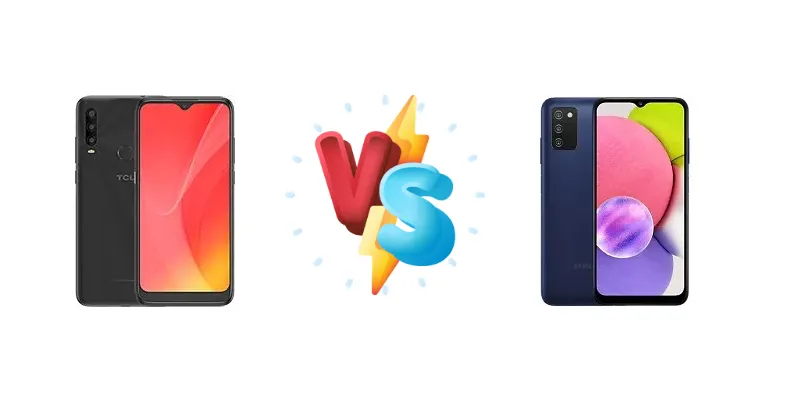
The TCL L10 Pro and Samsung Galaxy A03s represent the extreme end of the smartphone price spectrum. Both aim to deliver essential functionality at a minimal cost, but they take different approaches. This comparison dissects their core components to determine which device offers the best value for users prioritizing affordability.
🏆 Quick Verdict
For most users, the Samsung Galaxy A03s emerges as the slightly better choice. While the TCL L10 Pro's Unisoc chipset is newer, the Galaxy A03s' Mediatek Helio P35, coupled with its measured 488 nits of brightness, provides a more consistently usable experience, especially outdoors.
| Network |
|---|
| 2G bands | GSM 850 / 900 / 1800 / 1900 | GSM 850 / 900 / 1800 / 1900 |
| 3G bands | HSDPA 850 / 900 / 1900 / 2100 | HSDPA 850 / 900 / 2100 |
| 4G bands | 1, 3, 7, 8, 20, 28 | 1, 3, 5, 7, 8, 20, 28, 38, 40, 41 |
| Speed | HSPA 21.1/5.76 Mbps, LTE Cat4 150/50 Mbps | HSPA 42.2/5.76 Mbps, LTE Cat4 150/50 Mbps |
| Technology | GSM / HSPA / LTE | GSM / HSPA / LTE |
| | - | 2, 4, 5, 7, 12, 13, 14, 25, 26, 41, 66, 71 - SM-A037U |
| Launch |
|---|
| Announced | 2021, September 02 | 2021, August 18 |
| Status | Available. Released 2021, September 02 | Available. Released 2021, August 18 |
| Body |
|---|
| Build | - | Glass front, plastic frame, plastic back |
| Dimensions | 159.2 x 75.2 x 8.7 mm (6.27 x 2.96 x 0.34 in) | 164.2 x 75.9 x 9.1 mm (6.46 x 2.99 x 0.36 in) |
| SIM | Nano-SIM + Nano-SIM | Nano-SIM + Nano-SIM |
| Weight | 175 g (6.17 oz) | 196 g (6.91 oz) |
| Display |
|---|
| Resolution | 720 x 1520 pixels, 19:9 ratio (~270 ppi density) | 720 x 1600 pixels, 20:9 ratio (~270 ppi density) |
| Size | 6.22 inches, 96.6 cm2 (~80.7% screen-to-body ratio) | 6.5 inches, 102.0 cm2 (~81.8% screen-to-body ratio) |
| Type | IPS LCD | PLS LCD |
| Platform |
|---|
| CPU | Octa-core (4x1.6 GHz Cortex-A55 & 4x1.2 GHz Cortex-A55) | Octa-core (4x2.35 GHz Cortex-A53 & 4x1.8 GHz Cortex-A53) |
| Chipset | Unisoc SC9863A (28 nm) | Mediatek MT6765 Helio P35 (12 nm) |
| GPU | IMG8322 | PowerVR GE8320 |
| OS | Android 10 | Android 11, upgradable to Android 13, One UI 5.1 Core |
| Memory |
|---|
| Card slot | microSDXC (uses shared SIM slot) | microSDXC (dedicated slot) |
| Internal | 128GB 4GB RAM | 32GB 2GB RAM, 32GB 3GB RAM, 32GB 4GB RAM, 64GB 3GB RAM, 64GB 4GB RAM |
| | - | eMMC 5.1 |
| Main Camera |
|---|
| Features | LED flash, HDR, panorama | LED flash |
| Single | - | 5 MP, f/2.2 |
| Triple | 13 MP, f/2.2, (wide), 1/3.06", 1.12µm, PDAF
5 MP, f/2.2, 120˚ (ultrawide), 1/5.0", 1.12µm
Auxiliary lens | 13 MP, f/2.2, (wide), AF
2 MP (macro)
Auxiliary lens |
| Video | 1080p@30fps | 1080p@30fps |
| Selfie camera |
|---|
| Single | 5 MP, f/2.2, (wide), 1/5.0", 1.12µm | 5 MP, f/2.2 |
| Video | 1080p@30fps | 1080p@30fps |
| Sound |
|---|
| 3.5mm jack | - | Yes |
| 35mm jack | Yes | Yes |
| Loudspeaker | Yes | Yes |
| Comms |
|---|
| Bluetooth | 4.2, A2DP | 5.0, A2DP |
| NFC | No | Yes (market/region dependent) |
| Positioning | GPS | GPS, GLONASS, GALILEO, BDS |
| Radio | FM radio | No |
| USB | microUSB 2.0 | USB Type-C 2.0 |
| WLAN | Wi-Fi 802.11 b/g/n, Wi-Fi Direct | Wi-Fi 802.11 b/g/n, Wi-Fi Direct |
| Features |
|---|
| Sensors | Fingerprint (rear-mounted), accelerometer, proximity | Fingerprint (side-mounted), accelerometer, proximity |
| Battery |
|---|
| Charging | - | 15W wired |
| Type | Li-Po 4000 mAh | Li-Po 5000 mAh |
| Misc |
|---|
| Colors | Titanium Gray | Black, Blue, White |
| Models | - | SM-A037F, SM-A037F/DS, SM-A037M, SM-A037G, SM-A037U, SM-S134DL, SM-A037W, SM-A037U1, SM-S135DL |
| Price | About 210 EUR | $ 65.65 / £ 82.99 / ₹ 10,800 |
| SAR EU | - | 0.36 W/kg (head) 1.09 W/kg (body) |
| Tests |
|---|
| Battery life | - |
Endurance rating 122h
|
| Camera | - |
Photo / Video |
| Display | - |
Contrast ratio: 1718:1 (nominal) |
| Loudspeaker | - |
-27.4 LUFS (Good)
|
| Performance | - |
AnTuTu: 103465 (v8), 101299 (v9)
GeekBench: 889 (v5.1)
GFXBench: 5.5fps (ES 3.1 onscreen) |
TCL L10 Pro
- Newer Unisoc SC9863A chipset architecture
- Octa-core CPU configuration
- Potentially lower price point
- Less efficient 28nm manufacturing process
- Lack of published display brightness data
- Uncertain software support and optimization
Samsung Galaxy A03s
- Brighter display (488 nits measured)
- More efficient Mediatek Helio P35 chipset
- Established Samsung software and support
- Older chipset design
- Lower clock speeds on some cores
- 2MP macro camera is largely ineffective
Display Comparison
The Samsung Galaxy A03s boasts a measured peak brightness of 488 nits, a significant advantage over the TCL L10 Pro, which lacks published brightness data. Both share a 1718:1 contrast ratio, suggesting similar dynamic range. However, the A03s’ higher brightness translates to better visibility in direct sunlight, a crucial factor for outdoor use. The TCL L10 Pro’s display specifications are less defined, making it difficult to assess its color accuracy or viewing angles relative to the A03s.
Camera Comparison
Both devices offer 'Photo / Video' capabilities, but lack detailed camera specifications. Without sensor size or aperture information, a direct comparison is challenging. The presence of a 2MP macro camera on the A03s is unlikely to significantly impact image quality, serving primarily as a marketing feature. The A03s benefits from Samsung’s established image processing algorithms, potentially delivering more consistent and pleasing results than the TCL L10 Pro, which relies on less refined software.
Performance
The Samsung Galaxy A03s utilizes the Mediatek Helio P35 (12nm), featuring four Cortex-A53 cores clocked at 2.35 GHz and another four at 1.8 GHz. The TCL L10 Pro employs the Unisoc SC9863A (28nm) with an octa-core configuration of 4x1.6 GHz Cortex-A55 and 4x1.2 GHz Cortex-A55 cores. Despite the TCL’s core count advantage, the Helio P35’s more efficient 12nm process and higher clock speeds on its primary cores likely result in superior real-world performance, particularly in demanding applications. The older 28nm process of the Unisoc chip will likely lead to higher power consumption and potentially more thermal throttling.
Battery Life
Both the TCL L10 Pro and Samsung Galaxy A03s achieve an endurance rating of 122 hours, indicating comparable battery life under similar usage conditions. The A03s supports 15W wired charging, providing a faster recharge rate than the TCL L10 Pro, which lacks published charging specifications. While both offer similar longevity, the A03s’ faster charging is a practical advantage for users who need to quickly top up their battery.
Buying Guide
Buy the TCL L10 Pro if you prioritize a newer chipset architecture and are comfortable potentially troubleshooting software optimizations. It's a good option for tech enthusiasts willing to tinker. Buy the Samsung Galaxy A03s if you value a proven, reliable experience with a brighter display and a longer track record of software support, making it ideal for first-time smartphone users or those seeking a dependable secondary device.
Frequently Asked Questions
❓ Is the Unisoc SC9863A chipset in the TCL L10 Pro prone to overheating during extended gaming sessions?
Given the 28nm manufacturing process of the Unisoc SC9863A, it's more likely to generate heat under sustained load compared to the 12nm Helio P35 in the A03s. While not necessarily a deal-breaker, users should expect potential thermal throttling during prolonged gaming or demanding tasks.
❓ Does the Samsung Galaxy A03s support fast charging beyond the 15W wired charging?
No, the Samsung Galaxy A03s officially supports only 15W wired charging. While it may be compatible with chargers offering higher wattage, it will not charge at a faster rate than 15W. The TCL L10 Pro's charging capabilities are not specified, making it difficult to compare.
❓ How does the software experience differ between the TCL L10 Pro and the Samsung Galaxy A03s?
Samsung's One UI is a well-established and refined Android skin, offering a consistent and user-friendly experience. TCL's software is less known and may contain more pre-installed bloatware or receive fewer software updates compared to Samsung. This is a key consideration for long-term usability.