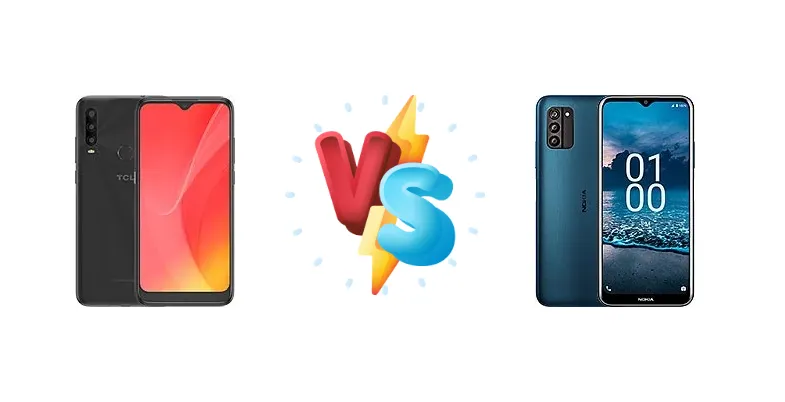
The TCL L10 Pro and Nokia G100 represent two distinct approaches to the budget smartphone market. The TCL leverages a Unisoc chipset aiming for cost optimization, while the Nokia opts for Qualcomm's Snapdragon 662, a more established platform. This comparison dissects their core components to determine which device delivers the best user experience for the price.
🏆 Quick Verdict
For the average user prioritizing consistent performance and a smoother experience, the Nokia G100 is the better choice. Its Snapdragon 662, built on an 11nm process, offers a noticeable performance advantage over the TCL L10 Pro’s 28nm Unisoc SC9863A, despite the TCL's potentially lower price point.
| Network |
|---|
| 2G bands | GSM 850 / 900 / 1800 / 1900 | GSM 850 / 900 / 1800 / 1900 |
| 3G bands | HSDPA 850 / 900 / 1900 / 2100 | HSDPA 850 / 1700(AWS) / 1900 |
| 4G bands | 1, 3, 7, 8, 20, 28 | 2, 4, 5, 7, 12, 13, 17, 44, 66, 71 |
| Speed | HSPA 21.1/5.76 Mbps, LTE Cat4 150/50 Mbps | HSPA, LTE |
| Technology | GSM / HSPA / LTE | GSM / HSPA / LTE |
| Launch |
|---|
| Announced | 2021, September 02 | 2022, September 22 |
| Status | Available. Released 2021, September 02 | Available. Released 2022, October |
| Body |
|---|
| Build | - | Glass front, plastic frame, plastic back |
| Dimensions | 159.2 x 75.2 x 8.7 mm (6.27 x 2.96 x 0.34 in) | 166.6 x 76.7 x 8.9 mm (6.56 x 3.02 x 0.35 in) |
| SIM | Nano-SIM + Nano-SIM | Nano-SIM |
| Weight | 175 g (6.17 oz) | 195.1 g (6.88 oz) |
| Display |
|---|
| Resolution | 720 x 1520 pixels, 19:9 ratio (~270 ppi density) | 720 x 1600 pixels, 20:9 ratio (~269 ppi density) |
| Size | 6.22 inches, 96.6 cm2 (~80.7% screen-to-body ratio) | 6.52 inches, 102.6 cm2 (~80.3% screen-to-body ratio) |
| Type | IPS LCD | IPS LCD |
| Platform |
|---|
| CPU | Octa-core (4x1.6 GHz Cortex-A55 & 4x1.2 GHz Cortex-A55) | Octa-core (4x2.0 GHz Kryo 260 Gold & 4x1.8 GHz Kryo 260 Silver) |
| Chipset | Unisoc SC9863A (28 nm) | Qualcomm SM6115 Snapdragon 662 (11 nm) |
| GPU | IMG8322 | Adreno 610 |
| OS | Android 10 | Android 12 |
| Memory |
|---|
| Card slot | microSDXC (uses shared SIM slot) | microSDXC |
| Internal | 128GB 4GB RAM | 32GB 3GB RAM, 128GB 4GB RAM |
| Main Camera |
|---|
| Features | LED flash, HDR, panorama | LED flash, HDR, panorama |
| Triple | 13 MP, f/2.2, (wide), 1/3.06", 1.12µm, PDAF
5 MP, f/2.2, 120˚ (ultrawide), 1/5.0", 1.12µm
Auxiliary lens | 13 MP, f/1.8, (wide), AF
5 MP, f/2.2, 115˚ (ultrawide), 1/5.0"
Auxiliary lens |
| Video | 1080p@30fps | 1080p@30fps |
| Selfie camera |
|---|
| Single | 5 MP, f/2.2, (wide), 1/5.0", 1.12µm | 8 MP, f/2.0, (wide), 1/4.0", 1.12µm |
| Video | 1080p@30fps | 1080p@30fps |
| Sound |
|---|
| 35mm jack | Yes | Yes |
| Loudspeaker | Yes | Yes |
| Comms |
|---|
| Bluetooth | 4.2, A2DP | 5.0, A2DP, LE |
| NFC | No | No |
| Positioning | GPS | GPS |
| Radio | FM radio | FM radio |
| USB | microUSB 2.0 | USB Type-C 2.0, OTG |
| WLAN | Wi-Fi 802.11 b/g/n, Wi-Fi Direct | Wi-Fi 802.11 b/g/n/ac, dual-band |
| Features |
|---|
| Sensors | Fingerprint (rear-mounted), accelerometer, proximity | Fingerprint (side-mounted), accelerometer, gyro, proximity, barometer |
| Battery |
|---|
| Charging | - | 15W wired |
| Type | Li-Po 4000 mAh | Li-Po 5000 mAh |
| Misc |
|---|
| Colors | Titanium Gray | Nordic Blue |
| Price | About 210 EUR | About 60 EUR |
TCL L10 Pro
- Potentially lower price point
- May offer larger storage options
- Functional for basic smartphone tasks
- Less powerful Unisoc SC9863A chipset
- Less efficient 28nm process
- Likely slower performance and more lag
Nokia G100
- More powerful Snapdragon 662 chipset
- More efficient 11nm process
- Smoother user experience and better multitasking
- Slightly higher price point
- 15W charging is relatively slow
- May have limited storage options
Display Comparison
Neither TCL nor Nokia provided display specs. Given the price bracket, both likely utilize LCD panels with 720p+ resolution. However, the lack of information makes a direct comparison impossible. Expect both to offer adequate, but not exceptional, viewing experiences. Bezels are likely to be substantial on both devices to maintain affordability.
Camera Comparison
Without detailed camera specifications, a direct comparison is limited. However, it’s reasonable to assume both phones feature basic camera setups geared towards casual photography. The Nokia G100’s Snapdragon ISP (Image Signal Processor) is generally more refined than Unisoc’s, potentially leading to better image processing, particularly in challenging lighting conditions. Expect both to struggle with low-light photography and offer limited dynamic range. The presence or absence of features like phase detection autofocus (PDAF) would be a key differentiator, but this information is unavailable.
Performance
The core difference lies in the chipsets. The Nokia G100’s Qualcomm Snapdragon 662 (11nm) boasts a significant architectural advantage over the TCL L10 Pro’s Unisoc SC9863A (28nm). The 11nm process allows for greater transistor density and improved power efficiency, translating to better sustained performance and less heat generation. The Snapdragon 662’s CPU configuration – 4x2.0 GHz Kryo 260 Gold & 4x1.8 GHz Kryo 260 Silver – is also more powerful than the TCL’s 4x1.6 GHz Cortex-A55 & 4x1.2 GHz Cortex-A55. This means the Nokia G100 will handle multitasking, app loading, and light gaming with greater ease. The Unisoc chip, while functional, will likely exhibit more noticeable lag and slowdowns under load.
Battery Life
Battery capacity is not specified for the TCL L10 Pro. The Nokia G100 features 15W wired charging. While not fast charging by modern standards, it’s adequate for a budget device. The Unisoc SC9863A’s less efficient 28nm process likely means the TCL L10 Pro will consume more power, potentially requiring more frequent charging, even if it has a larger battery capacity. The Snapdragon 662’s 11nm process contributes to better power management, potentially extending the Nokia G100’s battery life.
Buying Guide
Buy the TCL L10 Pro if your primary need is a basic smartphone for essential tasks like calls, texts, and light social media, and you are extremely price-sensitive. Buy the Nokia G100 if you value a more responsive user interface, smoother multitasking, and a more reliable experience with demanding apps, even if it means spending slightly more.
Frequently Asked Questions
❓ Will the Nokia G100 struggle with graphically intensive games like PUBG Mobile?
While the Snapdragon 662 isn't a gaming powerhouse, it can handle PUBG Mobile at medium settings with reasonable frame rates. Expect some occasional stuttering, but it's a playable experience. The TCL L10 Pro's Unisoc chip will likely struggle significantly more with the same game.
❓ Is the difference in performance between the Unisoc and Snapdragon chipsets noticeable in everyday use?
Yes, the difference is quite noticeable. The Snapdragon 662 provides a smoother and more responsive experience when navigating the user interface, opening apps, and multitasking. The Unisoc SC9863A will exhibit more lag and slowdowns, especially when running multiple apps simultaneously.
❓ Does the Nokia G100 support software updates for security patches and Android version upgrades?
Nokia is known for providing relatively good software support for its budget devices. The G100 is likely to receive at least one major Android version upgrade and regular security patches, offering a longer lifespan and improved security compared to many other phones in this price range.