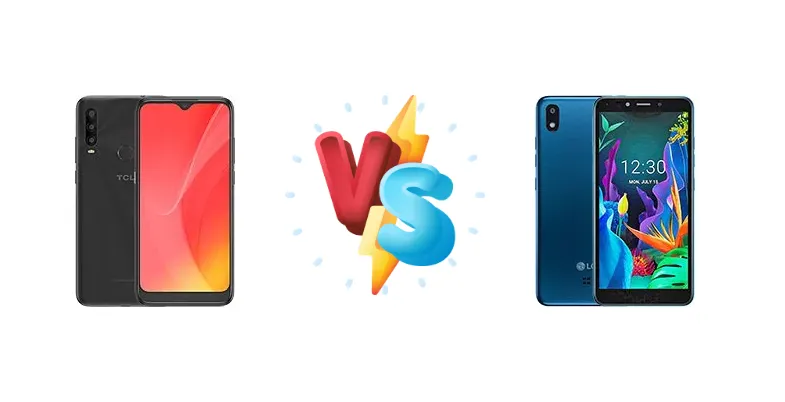
Both the TCL L10 Pro and the LG K20 (2019) represent the entry-level segment of the smartphone market, targeting users prioritizing affordability. However, a closer look at their internal components reveals a notable difference in processing power, potentially impacting everyday usability and app performance. This comparison dissects these differences to determine which device offers the best value.
🏆 Quick Verdict
For the average user, the TCL L10 Pro emerges as the better choice. Its Unisoc SC9863A chipset, featuring an octa-core CPU, provides a significant performance advantage over the LG K20 (2019)'s quad-core Mediatek MT6739, translating to smoother multitasking and a more responsive user experience.
| Network |
|---|
| 2G bands | GSM 850 / 900 / 1800 / 1900 | GSM 850 / 900 / 1800 / 1900 |
| 3G bands | HSDPA 850 / 900 / 1900 / 2100 | HSDPA 850 / 900 / 1900 / 2100 |
| 4G bands | 1, 3, 7, 8, 20, 28 | 1, 3, 7, 8, 20, 38 |
| Speed | HSPA 21.1/5.76 Mbps, LTE Cat4 150/50 Mbps | HSPA 42.2/5.76 Mbps, LTE Cat4 150/50 Mbps |
| Technology | GSM / HSPA / LTE | GSM / HSPA / LTE |
| Launch |
|---|
| Announced | 2021, September 02 | 2019, August. Released 2019, September |
| Status | Available. Released 2021, September 02 | Discontinued |
| Body |
|---|
| Build | - | Glass front, plastic back, plastic frame |
| Dimensions | 159.2 x 75.2 x 8.7 mm (6.27 x 2.96 x 0.34 in) | 148.6 x 71.9 x 8.3 mm (5.85 x 2.83 x 0.33 in) |
| SIM | Nano-SIM + Nano-SIM | Nano-SIM + Nano-SIM |
| Weight | 175 g (6.17 oz) | 152 g (5.36 oz) |
| | - | MIL-STD-810G compliant*
*does not guarantee ruggedness or use in extreme conditions |
| Display |
|---|
| Resolution | 720 x 1520 pixels, 19:9 ratio (~270 ppi density) | 480 x 960 pixels, 18:9 ratio (~197 ppi density) |
| Size | 6.22 inches, 96.6 cm2 (~80.7% screen-to-body ratio) | 5.45 inches, 76.7 cm2 (~71.7% screen-to-body ratio) |
| Type | IPS LCD | IPS LCD |
| Platform |
|---|
| CPU | Octa-core (4x1.6 GHz Cortex-A55 & 4x1.2 GHz Cortex-A55) | Quad-core 1.5 GHz Cortex-A53 |
| Chipset | Unisoc SC9863A (28 nm) | Mediatek MT6739 (28 nm) |
| GPU | IMG8322 | PowerVR GE8100 |
| OS | Android 10 | Android 9.0 Pie (Go edition) |
| Memory |
|---|
| Card slot | microSDXC (uses shared SIM slot) | microSDHC (dedicated slot) |
| Internal | 128GB 4GB RAM | 16GB 1GB RAM |
| | - | eMMC 5.1 |
| Main Camera |
|---|
| Features | LED flash, HDR, panorama | LED flash, panorama, HDR |
| Single | - | 8 MP, f/2.0, 27mm (wide), 1/4.0", 1.12µm, AF |
| Triple | 13 MP, f/2.2, (wide), 1/3.06", 1.12µm, PDAF
5 MP, f/2.2, 120˚ (ultrawide), 1/5.0", 1.12µm
Auxiliary lens | - |
| Video | 1080p@30fps | 1080p@30fps |
| Selfie camera |
|---|
| Features | - | LED flash |
| Single | 5 MP, f/2.2, (wide), 1/5.0", 1.12µm | 5 MP, f/2.2, 24mm (wide), 1/5.0", 1.12µm |
| Video | 1080p@30fps | - |
| Sound |
|---|
| 3.5mm jack | - | Yes |
| 35mm jack | Yes | Yes |
| Loudspeaker | Yes | Yes |
| Comms |
|---|
| Bluetooth | 4.2, A2DP | 5.0, A2DP, LE |
| NFC | No | No |
| Positioning | GPS | GPS |
| Radio | FM radio | No |
| USB | microUSB 2.0 | microUSB 2.0 |
| WLAN | Wi-Fi 802.11 b/g/n, Wi-Fi Direct | Wi-Fi 802.11 b/g/n |
| Features |
|---|
| Sensors | Fingerprint (rear-mounted), accelerometer, proximity | Accelerometer, proximity |
| Battery |
|---|
| Type | Li-Po 4000 mAh | Li-Ion 3000 mAh, non-removable |
| Misc |
|---|
| Colors | Titanium Gray | New Aurora Black, New Moroccan Blue |
| Models | - | LM-X120EMW, LMX120EMW, LM-X120, LMX120BMW |
| Price | About 210 EUR | About 100 EUR |
TCL L10 Pro
- Significantly faster octa-core processor
- More efficient chipset for potentially better battery life
- Likely smoother user experience and multitasking
- Brand recognition is lower than LG
- Software update support may be limited
LG K20 (2019)
- Established brand with potential for longer software support (though limited)
- Simpler user experience for basic tasks
- Potentially lower price point (depending on retailer)
- Slow quad-core processor struggles with multitasking
- Less efficient chipset leads to potentially shorter battery life
- Laggy performance with demanding apps
Display Comparison
Neither TCL nor LG provide display specifications beyond basic resolution in the provided data. However, given their market positioning, both likely utilize IPS LCD panels. The real difference lies under the hood; the chipset's ability to efficiently drive the display. A more powerful chipset like the Unisoc SC9863A in the TCL L10 Pro will likely result in smoother animations and faster response times when navigating the UI, even if the panels themselves are similar.
Camera Comparison
Without detailed camera specifications, a direct comparison is difficult. However, both phones likely feature basic camera setups geared towards casual photography. The TCL L10 Pro’s more powerful chipset *could* enable slightly better image processing, potentially resulting in sharper images and faster capture times. The LG K20 (2019) may suffer from slower processing, leading to more noticeable shutter lag and potentially less effective noise reduction. It's reasonable to assume both phones will struggle in low-light conditions.
Performance
The TCL L10 Pro’s Unisoc SC9863A is the clear winner in this category. Its octa-core configuration (4x1.6 GHz Cortex-A55 & 4x1.2 GHz Cortex-A55) significantly outperforms the LG K20 (2019)’s quad-core 1.5 GHz Cortex-A53. The Cortex-A55 architecture is more efficient than the A53, and having eight cores versus four allows for better parallel processing. This translates to faster app launch times, smoother multitasking, and a more responsive overall experience. The LG K20 (2019) will likely struggle with more than a few apps open simultaneously.
Battery Life
Battery capacity isn't provided for either device. However, given the more efficient chipset in the TCL L10 Pro, it's likely to achieve comparable or better battery life despite potentially having a similar capacity to the LG K20 (2019). The Unisoc SC9863A’s lower power consumption will reduce the strain on the battery, extending usage time between charges. Charging wattage is also unknown, making a direct comparison of charge times impossible.
Buying Guide
Buy the TCL L10 Pro if you need a phone capable of handling more demanding apps and multitasking without significant slowdowns. It's ideal for users who occasionally play mobile games or frequently switch between applications. Buy the LG K20 (2019) if your primary needs are basic communication – calls, texts, and light web browsing – and you prioritize simplicity and potentially longer software support from LG (though updates are limited).
Frequently Asked Questions
❓ Will the TCL L10 Pro handle popular social media apps like Facebook and Instagram smoothly?
Yes, the TCL L10 Pro’s octa-core processor and more efficient architecture are well-suited for running social media apps without significant lag. The LG K20 (2019) may experience noticeable slowdowns when scrolling through feeds or loading images within these apps.
❓ Is the LG K20 (2019) a good choice for someone who primarily uses their phone for calls and texts?
Absolutely. The LG K20 (2019) excels at basic communication tasks. Its quad-core processor is sufficient for making calls, sending texts, and checking email. However, if you anticipate using your phone for anything beyond these core functions, the TCL L10 Pro is a better investment.
❓ Can either of these phones run modern mobile games like PUBG Mobile or Call of Duty Mobile?
While both phones *can* technically run these games, the experience will be vastly different. The TCL L10 Pro will offer playable frame rates at lower settings, while the LG K20 (2019) will likely struggle to maintain a stable frame rate even at the lowest settings, resulting in a frustrating gaming experience.