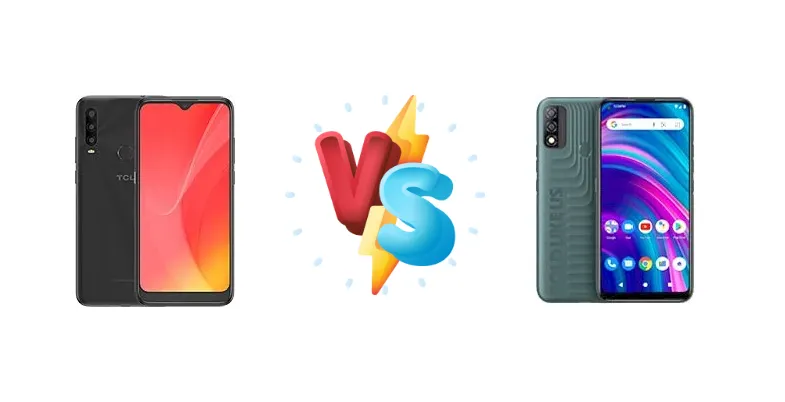
The TCL L10 Pro and BLU G51S represent the fiercely competitive sub-$200 smartphone market. While both aim to deliver essential smartphone functionality at an accessible price, they differ significantly in their underlying hardware. This comparison dissects those differences, focusing on the impact of the TCL's Unisoc SC9863A chipset versus the BLU's octa-core Cortex-A55 processor.
🏆 Quick Verdict
For the average user prioritizing consistent performance and a slightly more refined chipset architecture, the TCL L10 Pro emerges as the better choice. The Unisoc SC9863A, despite its 28nm process, offers a more complex core configuration than the BLU G51S's simpler octa-core setup, potentially leading to smoother multitasking.
| Network |
|---|
| 2G bands | GSM 850 / 900 / 1800 / 1900 | GSM 850 / 900 / 1800 / 1900 |
| 3G bands | HSDPA 850 / 900 / 1900 / 2100 | HSDPA 850 / 900 / 1700(AWS) / 1900 / 2100 |
| 4G bands | 1, 3, 7, 8, 20, 28 | 1, 2, 3, 4, 5, 7, 12, 17, 28 |
| Speed | HSPA 21.1/5.76 Mbps, LTE Cat4 150/50 Mbps | HSPA, LTE |
| Technology | GSM / HSPA / LTE | GSM / HSPA / LTE |
| Launch |
|---|
| Announced | 2021, September 02 | 2022, January |
| Status | Available. Released 2021, September 02 | Available. Released 2022, January |
| Body |
|---|
| Dimensions | 159.2 x 75.2 x 8.7 mm (6.27 x 2.96 x 0.34 in) | 162.4 x 77.5 x 9 mm (6.39 x 3.05 x 0.35 in) |
| SIM | Nano-SIM + Nano-SIM | Dual SIM (Nano-SIM, dual stand-by) |
| Weight | 175 g (6.17 oz) | 185 g (6.53 oz) |
| Display |
|---|
| Resolution | 720 x 1520 pixels, 19:9 ratio (~270 ppi density) | 720 x 1560 pixels, 19.5:9 ratio (~268 ppi density) |
| Size | 6.22 inches, 96.6 cm2 (~80.7% screen-to-body ratio) | 6.4 inches, 100.5 cm2 (~79.9% screen-to-body ratio) |
| Type | IPS LCD | IPS LCD |
| Platform |
|---|
| CPU | Octa-core (4x1.6 GHz Cortex-A55 & 4x1.2 GHz Cortex-A55) | Octa-core 1.6 GHz Cortex-A55 |
| Chipset | Unisoc SC9863A (28 nm) | - |
| GPU | IMG8322 | - |
| OS | Android 10 | Android 11 (Go edition) |
| Memory |
|---|
| Card slot | microSDXC (uses shared SIM slot) | microSDXC |
| Internal | 128GB 4GB RAM | 32GB 2GB RAM |
| Main Camera |
|---|
| Dual | - | 13 MP
Auxiliary lens |
| Features | LED flash, HDR, panorama | LED flash |
| Triple | 13 MP, f/2.2, (wide), 1/3.06", 1.12µm, PDAF
5 MP, f/2.2, 120˚ (ultrawide), 1/5.0", 1.12µm
Auxiliary lens | - |
| Video | 1080p@30fps | 1080p@30fps |
| Selfie camera |
|---|
| Single | 5 MP, f/2.2, (wide), 1/5.0", 1.12µm | 8 MP |
| Video | 1080p@30fps | 720p@30fps |
| Sound |
|---|
| 3.5mm jack | - | Yes |
| 35mm jack | Yes | Yes |
| Loudspeaker | Yes | Yes |
| Comms |
|---|
| Bluetooth | 4.2, A2DP | 4.2, A2DP, LE |
| NFC | No | No |
| Positioning | GPS | GPS |
| Radio | FM radio | FM radio |
| USB | microUSB 2.0 | USB Type-C 2.0 |
| WLAN | Wi-Fi 802.11 b/g/n, Wi-Fi Direct | Wi-Fi 802.11 b/g/n, Wi-Fi Direct |
| Features |
|---|
| Sensors | Fingerprint (rear-mounted), accelerometer, proximity | Fingerprint (rear-mounted), accelerometer, proximity |
| Battery |
|---|
| Type | Li-Po 4000 mAh | Li-Po 4000 mAh |
| Misc |
|---|
| Colors | Titanium Gray | Bronze, Gradient Blue, Green, Red |
| Price | About 210 EUR | About 80 EUR |
TCL L10 Pro
- More complex CPU architecture (big.LITTLE)
- Potentially smoother multitasking
- May offer slightly better display processing
- 28nm process node may lead to higher power consumption
- Limited information on display and camera specs
BLU G51S
- Simpler, potentially more stable performance profile
- Likely lower price point
- Straightforward octa-core CPU
- Less sophisticated CPU architecture
- May struggle with demanding multitasking
- Limited information on display and camera specs
Display Comparison
Neither TCL nor BLU provide display specifications beyond resolution in their marketing materials. However, given the price point, both likely utilize IPS LCD panels. The TCL L10 Pro's Unisoc SC9863A chipset *may* offer slightly better display processing capabilities, potentially resulting in more accurate color reproduction. Bezels are expected to be substantial on both devices, reflecting their budget nature. Without specific brightness or color gamut data, a definitive display comparison is impossible.
Camera Comparison
Detailed camera specifications are unavailable for either device. Given the market segment, both likely feature basic camera setups with a primary sensor and potentially a depth or macro lens. Without knowing sensor sizes, apertures, or image processing algorithms, a meaningful camera comparison is impossible. It's reasonable to assume image quality will be adequate for casual snapshots but not competitive with higher-end smartphones.
Performance
The TCL L10 Pro's Unisoc SC9863A is the key differentiator. It features an octa-core configuration split into two clusters: four Cortex-A55 cores clocked at 1.6 GHz and four at 1.2 GHz. This 'big.LITTLE' architecture allows for dynamic power management, assigning tasks to the appropriate cores for efficiency. The BLU G51S, conversely, utilizes a homogenous octa-core setup of Cortex-A55 cores clocked at 1.6 GHz. While both are based on the ARM Cortex-A55 architecture, the TCL's split design *could* offer better performance in mixed workloads. The 28nm process node of the Unisoc chip is less efficient than newer nodes, potentially impacting thermal performance under sustained load, but the architectural advantage may offset this.
Battery Life
Battery capacity and charging wattage are not specified for either device. However, given the chipsets' power efficiency, both phones should offer at least a full day of moderate use. The TCL L10 Pro's more complex chipset *might* consume slightly more power under heavy load, but the potential for dynamic power management could mitigate this. Without concrete charging data, it's impossible to determine 0-100% charging times.
Buying Guide
Buy the TCL L10 Pro if you need a device capable of handling moderate multitasking and appreciate the potential benefits of a more architecturally diverse CPU. This phone is ideal for users who stream videos, browse social media, and occasionally play less demanding games. Buy the BLU G51S if you prioritize simplicity and a potentially lower price point, and your usage is primarily focused on basic communication – calls, texts, and light web browsing. It's a good option for first-time smartphone users or those needing a reliable backup device.
Frequently Asked Questions
❓ Will the TCL L10 Pro handle popular social media apps like TikTok and Instagram without significant lag?
The TCL L10 Pro's Unisoc SC9863A chipset, with its octa-core configuration, should be capable of running social media apps like TikTok and Instagram smoothly. However, performance may be limited when multitasking or using the apps for extended periods. The split core design of the chipset could help manage background processes while you're scrolling through feeds.
❓ Is the BLU G51S a good option for someone upgrading from a feature phone?
The BLU G51S is a reasonable choice for someone upgrading from a feature phone. Its simple octa-core processor and Android operating system provide a basic smartphone experience without overwhelming complexity. It's ideal for essential tasks like making calls, sending texts, and browsing the web, making it a good entry point into the world of smartphones.
❓ Can either of these phones play modern mobile games like PUBG Mobile or Call of Duty Mobile?
While both phones *can* technically run PUBG Mobile or Call of Duty Mobile, the experience will likely be limited to the lowest graphics settings and frame rates. The Cortex-A55 cores are not designed for demanding gaming workloads. Expect significant frame drops and lag, especially during intense action sequences. These phones are better suited for less graphically intensive games.