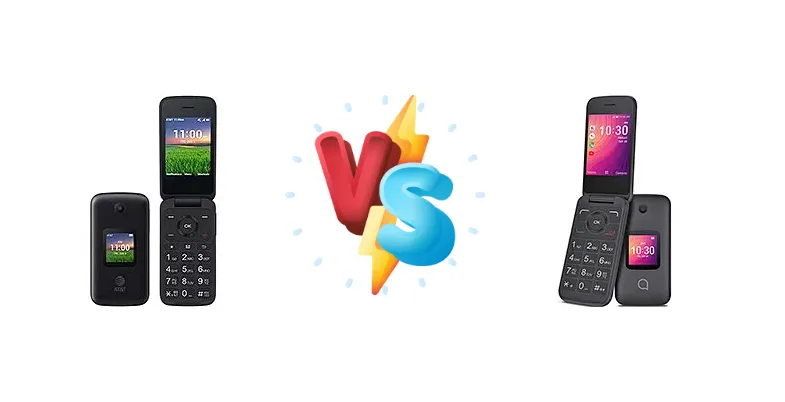
The TCL Classic and Alcatel Go Flip 3 represent a resurgence in basic flip phones, catering to users seeking simplicity, affordability, and long battery life. However, beneath the familiar form factor lie key differences in processing power and efficiency. This comparison dissects the hardware to determine which device delivers the best experience for its target audience.
🏆 Quick Verdict
For most users prioritizing basic functionality like calls and texts, the TCL Classic offers a slight edge due to its more powerful Mediatek MT6739 chipset. While the Alcatel Go Flip 3’s Snapdragon 210 is efficient, the TCL’s CPU clock speed and architecture provide a smoother, more responsive experience, justifying its position as the overall winner.
| Network |
|---|
| 2G bands | GSM 850 / 900 / 1800 / 1900 | GSM 850 / 900 / 1800 / 1900 |
| 3G bands | HSDPA 850 / 1700(AWS) / 1900 | HSDPA 850 / 1700(AWS) / 1900 |
| 4G bands | 2, 4, 5, 12, 14 | 2, 4, 5, 12, 25, 26, 41, 66, 71 |
| Speed | HSPA, LTE | HSPA, LTE |
| Technology | GSM / HSPA / LTE | GSM / CDMA / HSPA / LTE |
| | - | CDMA 800 / 1900 |
| Launch |
|---|
| Announced | 2024 | 2019, September 19. Released 2019, September 19 |
| Status | Available. Released 2024 | Discontinued |
| Body |
|---|
| Dimensions | 107.3 x 55.6 x 19.8 mm (4.22 x 2.19 x 0.78 in) | 104.9 x 53.1 x 20.1 mm (4.13 x 2.09 x 0.79 in) |
| SIM | Nano-SIM | Nano-SIM |
| Weight | 139.8 g (4.94 oz) | 118 g (4.16 oz) |
| Display |
|---|
| Resolution | 240 x 320 pixels, 4:3 ratio (~143 ppi density) | 240 x 320 pixels, 4:3 ratio (~143 ppi density) |
| Size | 2.8 inches, 24.3 cm2 (~40.7% screen-to-body ratio) | 2.8 inches, 24.3 cm2 (~43.6% screen-to-body ratio) |
| Type | TFT LCD | TN TFT LCD |
| | - | Second external TN TFT display, 1.44 inches, 128 x 128 pixels |
| Platform |
|---|
| CPU | Quad-core 1.5 GHz Cortex-A53 | Quad-core 1.1 GHz Cortex-A7 |
| Chipset | Mediatek MT6739 (28 nm) | Qualcomm MSM8909 Snapdragon 210 (28 nm) |
| GPU | PowerVR GE8100 | Adreno 304 |
| OS | - | KaiOS 2.5.2 |
| Memory |
|---|
| Call records | Yes | - |
| Card slot | microSDHC (dedicated slot) | microSDHC (dedicated slot) |
| Internal | 4GB 512MB RAM | 4GB 512MB RAM |
| Phonebook | Yes | - |
| Main Camera |
|---|
| Features | LED flash | - |
| Single | 2 MP | 2 MP |
| Video | 480p@30fps | 720p@30fps |
| Sound |
|---|
| 3.5mm jack | - | Yes |
| 35mm jack | Yes | Yes |
| Loudspeaker | Yes | Yes |
| Comms |
|---|
| Bluetooth | 4.2, A2DP | 4.2, A2DP |
| NFC | No | No |
| Positioning | GPS | No |
| Radio | No | FM radio |
| USB | USB Type-C | microUSB 2.0 |
| WLAN | Wi-Fi 802.11 b/g/n | Wi-Fi 802.11 b/g/n, hotspot |
| Features |
|---|
| Games | Yes | - |
| Java | No | - |
| Messaging | SMS, MMS | - |
| Sensors | Barometer | - |
| Battery |
|---|
| Charging | 5W wired | - |
| Type | 1850 mAh | Li-Ion 1350 mAh, removable |
| Misc |
|---|
| Colors | Black | Prime Black |
| Models | 4058C | - |
| Price | About 70 EUR | About 80 EUR |
| SAR | 0.86 W/kg (head) 1.29 W/kg (body) | 1.28 W/kg (head) 1.16 W/kg (body) |
TCL Classic
- More powerful processor (Mediatek MT6739)
- Faster CPU clock speed (1.5 GHz)
- Potentially smoother user experience
- Likely shorter battery life compared to Alcatel
- May experience slightly more heat under load
alcatel Go Flip 3
- Greater power efficiency (Snapdragon 210)
- Potentially longer battery life
- Simpler, more streamlined experience
- Slower processor
- Less responsive user interface
- Limited app compatibility
Display Comparison
Neither device boasts a particularly impressive display. Both likely utilize basic LCD panels, and detailed specifications like brightness and resolution are unavailable. The focus here isn't on visual fidelity, but on readability and power efficiency. Bezels are expected to be substantial on both models, consistent with the flip phone design language. Color accuracy is likely standard for this price point, prioritizing visibility over color science.
Camera Comparison
Camera performance is unlikely to be a deciding factor for either device. Both are equipped with basic cameras intended for occasional snapshots. Detailed sensor information is unavailable, but given the market segment, expectations should be tempered. Image quality will likely be acceptable in well-lit conditions, but struggle in low light. The focus is on functionality, not photographic excellence.
Performance
The core difference lies in the chipsets. The TCL Classic’s Mediatek MT6739, built on a 28nm process, features a quad-core 1.5 GHz Cortex-A53 CPU. This is a demonstrably more powerful configuration than the Alcatel Go Flip 3’s Qualcomm MSM8909 Snapdragon 210, which utilizes a quad-core 1.1 GHz Cortex-A7 CPU, also on a 28nm node. While both are entry-level processors, the Cortex-A53 architecture is more efficient and offers better performance per clock cycle than the older Cortex-A7. This translates to snappier menu navigation and faster app loading times on the TCL Classic. The lower clock speed of the Snapdragon 210 in the Alcatel Go Flip 3 prioritizes power savings over raw processing power.
Battery Life
Both phones likely feature batteries optimized for extended standby time, a key selling point for flip phones. While specific mAh ratings are unavailable, the Alcatel Go Flip 3’s less demanding Snapdragon 210 chipset will likely result in longer battery life between charges. The TCL Classic’s 5W wired charging is standard for this class of device, and charge times will be relatively slow. The Alcatel Go Flip 3’s charging specifications are unknown, but are likely similar.
Buying Guide
Buy the TCL Classic if you need a flip phone capable of handling occasional light app usage beyond calls and texts, such as basic web browsing or simple messaging apps. The Mediatek MT6739 provides a more robust platform for these tasks. Buy the Alcatel Go Flip 3 if you prioritize maximum battery life and are strictly focused on voice calls and SMS messaging. The Qualcomm Snapdragon 210’s lower clock speed translates to lower power consumption, extending standby time.
Frequently Asked Questions
❓ Will the TCL Classic be able to run apps like WhatsApp or Facebook?
The TCL Classic’s Mediatek MT6739 chipset and likely Android Go edition operating system *may* support lightweight versions of apps like WhatsApp and Facebook. However, performance will be limited, and the experience may be sluggish. Compatibility is not guaranteed, and older versions of the apps may be required.
❓ How much faster is the TCL Classic compared to the Alcatel Go Flip 3 in everyday use?
The difference won’t be dramatic, but the TCL Classic’s faster processor will result in noticeably quicker menu navigation, app loading, and response times. Tasks like making calls, sending texts, and checking basic information will feel more fluid on the TCL Classic.
❓ Is the Alcatel Go Flip 3 a good choice for someone who primarily uses a phone for calls and texts?
Absolutely. The Alcatel Go Flip 3 is an excellent choice for users who prioritize simplicity and long battery life for basic communication. Its efficient Snapdragon 210 chipset ensures extended standby time, making it ideal for those who rarely use smartphone features.
❓ Can either of these phones connect to Wi-Fi?
Yes, both the TCL Classic and Alcatel Go Flip 3 support Wi-Fi connectivity. This allows you to connect to wireless networks for data usage, potentially saving on cellular data costs.