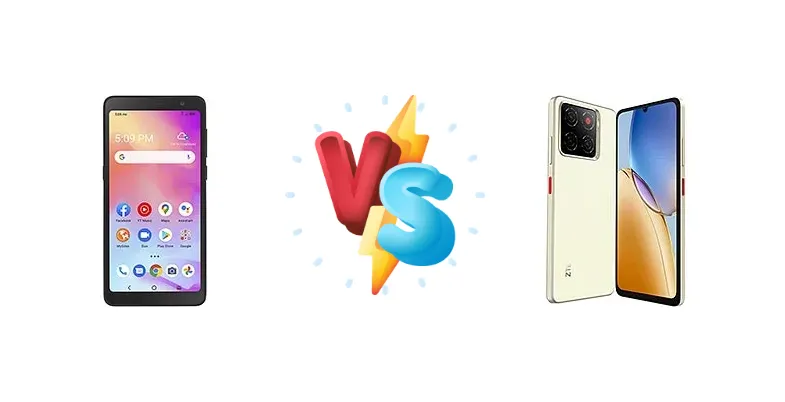
The TCL A3 and ZTE Blade A56 represent the fiercely competitive sub-$150 smartphone market. Both aim to deliver essential functionality without breaking the bank, but they take different approaches. The TCL A3 relies on the established Mediatek Helio P22 platform, while the ZTE Blade A56 opts for the newer Unisoc T7200. This comparison will dissect their strengths and weaknesses to determine which device offers the best value.
🏆 Quick Verdict
For most users, the ZTE Blade A56 emerges as the better choice. Its Unisoc T7200 chipset, featuring Cortex-A75 cores, provides a noticeable performance uplift over the TCL A3’s Helio P22, and the impressive 56-hour endurance rating ensures all-day usability. While the TCL A3 is a capable device, the ZTE offers a more modern and responsive experience.
| Network |
|---|
| 2G bands | GSM 850 / 900 / 1800 / 1900 | GSM 850 / 900 / 1800 / 1900 |
| 3G bands | HSDPA 850 / 1700(AWS) / 1900 | HSDPA 850 / 900 / 1900 / 2100 |
| 4G bands | 2, 4, 5, 13, 66 | 1, 3, 5, 7, 8, 20, 28, 38, 40, 41 |
| Speed | HSPA 42.2/5.76 Mbps, LTE Cat4 150/50 Mbps | HSPA, LTE |
| Technology | GSM / CDMA / HSPA / LTE | GSM / HSPA / LTE |
| Launch |
|---|
| Announced | 2021, October | 2025, June 11 |
| Status | Available. Released 2021, October | Available. Released 2025, July |
| Body |
|---|
| Dimensions | 145.8 x 71.1 x 9.9 mm (5.74 x 2.80 x 0.39 in) | 167.6 x 77.4 x 8.3 mm (6.60 x 3.05 x 0.33 in) |
| SIM | Nano-SIM | Nano-SIM + Nano-SIM |
| Weight | 171 g (6.03 oz) | 193 g (6.81 oz) |
| Display |
|---|
| Protection | - | Mohs level 4 |
| Resolution | 720 x 1440 pixels, 18:9 ratio (~293 ppi density) | 720 x 1600 pixels, 20:9 ratio (~260 ppi density) |
| Size | 5.5 inches, 78.1 cm2 (~75.3% screen-to-body ratio) | 6.75 inches, 110.0 cm2 (~84.8% screen-to-body ratio) |
| Type | TFT LCD | IPS LCD, 90Hz |
| Platform |
|---|
| CPU | Octa-core 2.0 GHz Cortex-A53 | Octa-core (2x1.6 GHz Cortex-A75 & 6x1.6 GHz Cortex-A55) |
| Chipset | Mediatek MT6762 Helio P22 (12 nm) | Unisoc T7200 (12 nm) |
| GPU | PowerVR GE8320 | Mali-G57 MP1 |
| OS | Android 11 | Android 15 |
| Memory |
|---|
| Card slot | microSDXC (dedicated slot) | microSDXC (dedicated slot) |
| Internal | 32GB 3GB RAM | 64GB 4GB RAM, 128GB 4GB RAM |
| Main Camera |
|---|
| Features | LED flash | LED flash |
| Single | 8 MP, 1/4.0", 1.12µm | 13 MP, AF
Auxiliary lenses |
| Video | 1080p@30fps | 1080p@30fps |
| Selfie camera |
|---|
| Single | 5 MP, 1/5.0", 1.12µm | 8 MP |
| Video | 1080p@30fps | Yes |
| Sound |
|---|
| 35mm jack | Yes | Yes |
| Loudspeaker | Yes | Yes |
| Comms |
|---|
| Bluetooth | 5.0, A2DP, LE | 5.2, A2DP, LE |
| NFC | No | No |
| Positioning | GPS | GPS, GALILEO, GLONASS |
| Radio | Unspecified | FM radio |
| USB | microUSB 2.0 | USB Type-C 2.0, OTG |
| WLAN | Wi-Fi 802.11 b/g/n, Wi-Fi Direct | Wi-Fi 802.11 b/g/n |
| Features |
|---|
| Sensors | Accelerometer, proximity | Fingerprint (side-mounted), accelerometer |
| Battery |
|---|
| Charging | - | 10W wired |
| Type | Li-Ion 3000 mAh, removable | Li-Po 5000 mAh |
| Misc |
|---|
| Colors | Black | Black, Yellow |
| Models | A509DL | Z2473 |
| Price | About 40 EUR | € 69.00 / $ 87.12 / £ 66.75 |
| EU LABEL |
|---|
| Battery | - | 56:03h endurance, 800 cycles |
| Energy | - | Class A |
| Free fall | - | Class D (80 falls) |
| Repairability | - | Class B |
TCL A3
- Familiar Mediatek chipset with established software support.
- Likely a lower initial price point.
- Potentially simpler user interface.
- Older, less efficient processor.
- Slower performance compared to the ZTE Blade A56.
- Unspecified battery capacity and charging speed.
ZTE Blade A56
- More powerful Unisoc T7200 chipset with Cortex-A75 cores.
- Exceptional 56-hour battery endurance.
- 800 charge cycles for long-term battery health.
- Unisoc chipset may have limited software optimization.
- 10W charging is relatively slow.
- Less brand recognition compared to TCL.
Display Comparison
Neither TCL nor ZTE provide display specifications beyond the basic existence of a screen. Given the price point, expect 720p+ resolution LCD panels. The absence of details like peak brightness or color gamut suggests both displays are geared towards functional visibility rather than immersive viewing. Bezels are likely to be substantial on both devices, reflecting cost-saving measures. Color accuracy will likely be standard for this segment.
Camera Comparison
Detailed camera specifications are unavailable for either device. However, given the market segment, it’s safe to assume both feature basic camera setups. Expect a primary sensor, likely around 8-13MP, and potentially a secondary depth or macro sensor. Image processing will be software-driven, prioritizing speed over detail. The ZTE Blade A56’s Unisoc T7200 may offer slightly better image signal processing (ISP) capabilities, potentially resulting in marginally improved image quality, but don’t expect flagship-level performance from either.
Performance
The core difference lies in the chipsets. The TCL A3’s Mediatek MT6762 Helio P22 utilizes eight Cortex-A53 cores clocked at 2.0 GHz. This is a proven, but aging, architecture. The ZTE Blade A56’s Unisoc T7200, however, employs a more modern configuration: two Cortex-A75 cores at 1.6 GHz and six Cortex-A55 cores, also at 1.6 GHz. The A75 cores represent a significant architectural improvement over the A53, offering better single-core performance – crucial for app launch speeds and general responsiveness. While both are 12nm chips, the Unisoc T7200’s architecture translates to a smoother user experience, particularly when multitasking. The TCL A3 will likely struggle with demanding applications.
Battery Life
The ZTE Blade A56 boasts a significant advantage in battery endurance, rated at 56:03 hours. This is a remarkable figure for a budget smartphone, and the 800 charge cycles suggest long-term battery health. The TCL A3’s battery capacity is unspecified, but given the Helio P22’s power efficiency, it likely offers a respectable, though not exceptional, battery life. The ZTE Blade A56 also supports 10W wired charging, which, while slow by modern standards, is adequate for topping up the battery overnight. The TCL A3’s charging speed is unknown, but likely similar.
Buying Guide
Buy the TCL A3 if you prioritize a familiar software experience and are comfortable with basic performance for everyday tasks like calling, texting, and light social media. Buy the ZTE Blade A56 if you value smoother multitasking, slightly improved gaming capabilities, and exceptional battery life, even if it means adapting to a less widely known chipset.
Frequently Asked Questions
❓ Is the Unisoc T7200 chipset reliable? Are software updates guaranteed?
Unisoc has been steadily improving its chipset offerings, and the T7200 is a capable processor for the price. However, software update support from ZTE may be less consistent than from more established brands like TCL. Check online forums and ZTE’s official website for information on update schedules.
❓ How does the ZTE Blade A56 perform with popular apps like WhatsApp and Facebook?
The ZTE Blade A56’s Unisoc T7200 chipset should handle apps like WhatsApp and Facebook without issue. The Cortex-A75 cores provide a noticeable performance boost over the TCL A3’s Helio P22, resulting in smoother scrolling and faster app loading times. Multitasking between these apps and others should also be more fluid.
❓ Can the ZTE Blade A56 handle basic mobile gaming?
The ZTE Blade A56 can handle basic mobile gaming, but don’t expect high frame rates or maximum settings in demanding titles. Games like PUBG Mobile or Call of Duty Mobile will likely require reduced graphics settings to maintain playable performance. The TCL A3 will struggle even more with these games.
❓ What type of charging port does the ZTE Blade A56 use?
The ZTE Blade A56 uses a Micro-USB port for charging and data transfer. While not as modern as USB-C, it’s standard for devices in this price range. The 10W charging speed means it will take several hours to fully charge the battery.