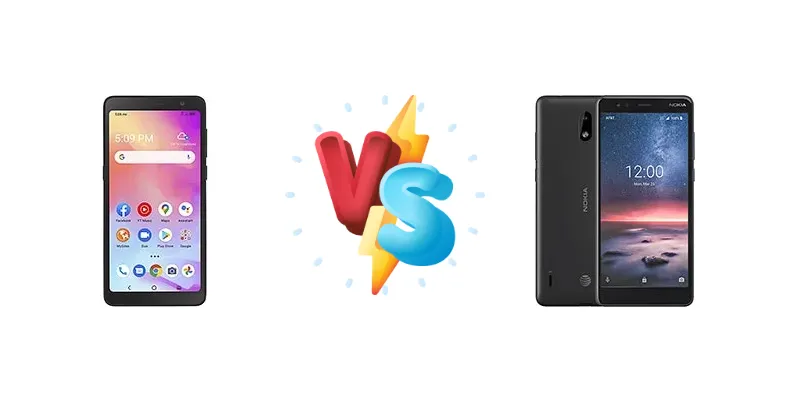
The TCL A3 and Nokia 3.1 A represent the fiercely competitive sub-$150 smartphone market. Both aim to deliver essential functionality at an accessible price, but they take different approaches to achieving this. The TCL A3 leverages a more powerful, albeit older, Mediatek Helio P22 chipset, while the Nokia 3.1 A opts for Qualcomm’s Snapdragon 429. This comparison will dissect the implications of these chipset choices and determine which device offers the best overall experience.
🏆 Quick Verdict
For the average user prioritizing responsiveness and multitasking, the TCL A3 emerges as the better choice. Its Mediatek Helio P22, with its octa-core CPU, provides a noticeable performance advantage over the Nokia 3.1 A’s quad-core Snapdragon 429. While the Nokia 3.1 A benefits from 10W charging, the performance gap justifies the trade-off for most users.
| Network |
|---|
| 2G bands | GSM 850 / 900 / 1800 / 1900 | GSM 850 / 900 / 1800 / 1900 |
| 3G bands | HSDPA 850 / 1700(AWS) / 1900 | HSDPA 850 / 1700(AWS) / 1900 |
| 4G bands | 2, 4, 5, 13, 66 | 2, 4, 5, 12, 14, 29, 30 |
| Speed | HSPA 42.2/5.76 Mbps, LTE Cat4 150/50 Mbps | HSPA 42.2/5.76 Mbps, LTE Cat4 150/50 Mbps |
| Technology | GSM / CDMA / HSPA / LTE | GSM / HSPA / LTE |
| Launch |
|---|
| Announced | 2021, October | 2019, June. Released 2019, June |
| Status | Available. Released 2021, October | Discontinued |
| Body |
|---|
| Dimensions | 145.8 x 71.1 x 9.9 mm (5.74 x 2.80 x 0.39 in) | 152.7 x 71.9 x 9.4 mm (6.01 x 2.83 x 0.37 in) |
| SIM | Nano-SIM | Nano-SIM |
| Weight | 171 g (6.03 oz) | 156 g (5.50 oz) |
| Display |
|---|
| Resolution | 720 x 1440 pixels, 18:9 ratio (~293 ppi density) | 720 x 1440 pixels, 18:9 ratio (~295 ppi density) |
| Size | 5.5 inches, 78.1 cm2 (~75.3% screen-to-body ratio) | 5.45 inches, 76.7 cm2 (~69.8% screen-to-body ratio) |
| Type | TFT LCD | IPS LCD |
| Platform |
|---|
| CPU | Octa-core 2.0 GHz Cortex-A53 | Quad-core 1.8 GHz Cortex-A53 |
| Chipset | Mediatek MT6762 Helio P22 (12 nm) | Qualcomm SDM429 Snapdragon 429 (12 nm) |
| GPU | PowerVR GE8320 | Adreno 504 |
| OS | Android 11 | Android 9.0 (Pie) |
| Memory |
|---|
| Card slot | microSDXC (dedicated slot) | microSDXC (dedicated slot) |
| Internal | 32GB 3GB RAM | 32GB 2GB RAM |
| | - | eMMC 5.1 |
| Main Camera |
|---|
| Features | LED flash | LED flash, HDR, panorama |
| Single | 8 MP, 1/4.0", 1.12µm | 8 MP, f/2.0, AF |
| Video | 1080p@30fps | 1080p@30fps |
| Selfie camera |
|---|
| Features | - | HDR |
| Single | 5 MP, 1/5.0", 1.12µm | 5 MP, f/2.2 |
| Video | 1080p@30fps | 720p@30fps |
| Sound |
|---|
| 3.5mm jack | - | Yes |
| 35mm jack | Yes | Yes |
| Loudspeaker | Yes | Yes |
| Comms |
|---|
| Bluetooth | 5.0, A2DP, LE | 5.0, A2DP, LE |
| NFC | No | No |
| Positioning | GPS | GPS, GLONASS, BDS |
| Radio | Unspecified | FM radio |
| USB | microUSB 2.0 | USB Type-C 2.0 |
| WLAN | Wi-Fi 802.11 b/g/n, Wi-Fi Direct | Wi-Fi 802.11 b/g/n |
| Features |
|---|
| Sensors | Accelerometer, proximity | Accelerometer, gyro, proximity |
| Battery |
|---|
| Charging | - | 10W wired |
| Type | Li-Ion 3000 mAh, removable | Li-Ion 2990 mAh, non-removable |
| Misc |
|---|
| Colors | Black | Black |
| Models | A509DL | TA1140 |
| Price | About 40 EUR | - |
| SAR | - | 1.11 W/kg (head) 0.81 W/kg (body) |
TCL A3
- More powerful octa-core processor for smoother performance
- Potentially better multitasking capabilities
- May handle more demanding apps and light gaming better
- Likely higher power consumption
- No specified charging wattage (likely slower than Nokia)
Nokia 3.1 A
- 10W wired charging for faster top-ups
- Potentially cleaner software experience (Nokia's reputation)
- Simpler, more streamlined user experience
- Quad-core processor limits performance
- Struggles with multitasking and demanding apps
Display Comparison
Neither TCL nor Nokia provide display specifications beyond the basic screen size. Given the price point, both likely utilize IPS LCD panels. However, the performance difference between the chipsets suggests the TCL A3 may be able to drive a slightly higher resolution or refresh rate display without significant performance impact. Without specific nit brightness or color gamut data, it’s difficult to definitively declare a winner, but the A3’s processing power offers potential for a better visual experience.
Camera Comparison
Without detailed camera specifications, a direct comparison is challenging. Both phones likely feature basic camera setups geared towards casual photography. Given the market segment, image processing will likely be minimal. The TCL A3’s more powerful chipset *could* allow for slightly faster image processing and potentially better low-light performance, but this is speculative. The presence of a 2MP macro lens on either device is unlikely to significantly impact image quality, and should be considered a marketing feature rather than a substantial benefit.
Performance
The core difference lies in the chipsets. The TCL A3’s Mediatek MT6762 Helio P22 (12nm) features an octa-core CPU clocked at 2.0 GHz, utilizing Cortex-A53 cores. In contrast, the Nokia 3.1 A’s Qualcomm Snapdragon 429 (12nm) is a quad-core processor clocked at 1.8 GHz, also using Cortex-A53 cores. While both are built on a 12nm process, the doubling of cores in the Helio P22 translates to significantly improved multitasking and application launch speeds. The Snapdragon 429 is adequate for basic tasks, but will struggle with more demanding applications. The A3 will offer a more responsive user experience.
Battery Life
Battery capacity is not specified for either device. However, the Nokia 3.1 A includes 10W wired charging, which is a slight advantage. The TCL A3’s more powerful processor will likely consume more power, potentially offsetting any capacity advantage. The 10W charging on the Nokia 3.1 A will provide a faster top-up, but the A3’s chipset could potentially optimize power usage during less intensive tasks.
Buying Guide
Buy the TCL A3 if you need a phone capable of handling more demanding apps, light gaming, and smoother multitasking. Its octa-core processor will provide a more fluid experience. Buy the Nokia 3.1 A if you prioritize simplicity, a clean software experience (typically associated with Nokia), and a slightly more convenient charging solution, understanding that performance will be more limited.
Frequently Asked Questions
❓ Will the TCL A3 struggle with popular social media apps like TikTok and Instagram?
While the TCL A3 can run these apps, expect some occasional lag or slowdowns when multitasking or using them for extended periods. The Helio P22 is capable, but not optimized for consistently smooth performance in demanding social media applications.
❓ Is the Snapdragon 429 in the Nokia 3.1 A sufficient for basic tasks like calling, texting, and web browsing?
Yes, the Snapdragon 429 is perfectly adequate for these core smartphone functions. It will handle calls, texts, and basic web browsing without issue. However, it will show its limitations when attempting more complex tasks.
❓ Can either of these phones handle mobile gaming beyond very casual titles?
Neither phone is ideal for serious mobile gaming. The TCL A3 will offer a slightly better experience with less demanding games, but expect low frame rates and graphical settings on most titles. The Nokia 3.1 A will struggle even with basic games.
❓ How does the software experience differ between the TCL A3 and Nokia 3.1 A?
Nokia is known for providing a near-stock Android experience with timely updates, which appeals to users who prefer a clean and uncluttered interface. TCL's software is typically more customized, potentially including pre-installed apps and a different user interface. This is a matter of personal preference.