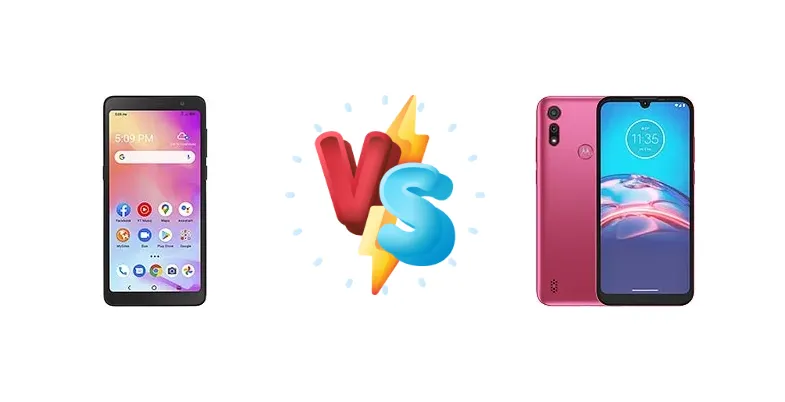
The TCL A3 and Motorola Moto E6i represent the extreme end of the budget smartphone spectrum. Both aim to deliver essential smartphone functionality at the lowest possible price point, but they take different approaches to achieving this. The key differentiator lies in their chipsets, impacting performance, efficiency, and overall user experience. This comparison dissects those differences to help you choose the right device.
🏆 Quick Verdict
For the average user prioritizing responsiveness and slightly better long-term performance, the TCL A3 is the better choice. Its Mediatek Helio P22, built on a 12nm process, offers a more efficient architecture than the Motorola Moto E6i’s Unisoc SC9863A (28nm), translating to smoother multitasking and potentially better battery life under load.
| Network |
|---|
| 2G bands | GSM 850 / 900 / 1800 / 1900 | GSM 850 / 900 / 1800 / 1900 |
| 3G bands | HSDPA 850 / 1700(AWS) / 1900 | HSDPA 850 / 900 / 1700(AWS) / 1900 / 2100 |
| 4G bands | 2, 4, 5, 13, 66 | 1, 2, 3, 4, 5, 7, 8, 19, 28, 66 |
| Speed | HSPA 42.2/5.76 Mbps, LTE Cat4 150/50 Mbps | HSPA, LTE |
| Technology | GSM / CDMA / HSPA / LTE | GSM / HSPA / LTE |
| Launch |
|---|
| Announced | 2021, October | 2021, February 11 |
| Status | Available. Released 2021, October | Available. Released 2021, February 11 |
| Body |
|---|
| Build | - | Glass front, plastic back, plastic frame |
| Dimensions | 145.8 x 71.1 x 9.9 mm (5.74 x 2.80 x 0.39 in) | 155.6 x 73 x 8.5 mm (6.13 x 2.87 x 0.33 in) |
| SIM | Nano-SIM | Nano-SIM + Nano-SIM |
| Weight | 171 g (6.03 oz) | 160 g (5.64 oz) |
| Display |
|---|
| Resolution | 720 x 1440 pixels, 18:9 ratio (~293 ppi density) | 720 x 1560 pixels, 19.5:9 ratio (~282 ppi density) |
| Size | 5.5 inches, 78.1 cm2 (~75.3% screen-to-body ratio) | 6.1 inches, 91.3 cm2 (~80.4% screen-to-body ratio) |
| Type | TFT LCD | IPS LCD |
| Platform |
|---|
| CPU | Octa-core 2.0 GHz Cortex-A53 | Octa-core (4x1.6 GHz Cortex-A55 & 4x1.2 GHz Cortex-A55) |
| Chipset | Mediatek MT6762 Helio P22 (12 nm) | Unisoc SC9863A (28 nm) |
| GPU | PowerVR GE8320 | IMG8322 |
| OS | Android 11 | Android 10 (Go edition) |
| Memory |
|---|
| Card slot | microSDXC (dedicated slot) | microSDXC (uses shared SIM slot) |
| Internal | 32GB 3GB RAM | 32GB 2GB RAM |
| | - | eMMC 5.1 |
| Main Camera |
|---|
| Dual | - | 13 MP, f/2.2, 26mm (wide), 1/3.1", 1.12µm, PDAF
Auxiliary lens |
| Features | LED flash | LED flash, HDR, panorama |
| Single | 8 MP, 1/4.0", 1.12µm | - |
| Video | 1080p@30fps | 1080p@30fps |
| Selfie camera |
|---|
| Single | 5 MP, 1/5.0", 1.12µm | 5 MP, f/2.2, 27mm (wide), 1.12µm |
| Video | 1080p@30fps | 1080p@30fps |
| Sound |
|---|
| 3.5mm jack | - | Yes |
| 35mm jack | Yes | Yes |
| Loudspeaker | Yes | Yes |
| Comms |
|---|
| Bluetooth | 5.0, A2DP, LE | 4.2, A2DP, LE |
| NFC | No | No |
| Positioning | GPS | GPS, GLONASS |
| Radio | Unspecified | Unspecified |
| USB | microUSB 2.0 | microUSB 2.0, OTG |
| WLAN | Wi-Fi 802.11 b/g/n, Wi-Fi Direct | Wi-Fi 802.11 b/g/n |
| Features |
|---|
| Sensors | Accelerometer, proximity | Fingerprint (rear-mounted), accelerometer, proximity |
| Battery |
|---|
| Charging | - | 10W wired |
| Type | Li-Ion 3000 mAh, removable | Li-Ion 3000 mAh |
| Misc |
|---|
| Colors | Black | Titanium Gray, Pink |
| Models | A509DL | XT2053-5 |
| Price | About 40 EUR | About 170 EUR |
TCL A3
- More efficient processor (12nm)
- Potentially smoother multitasking
- Likely better battery life under load
- Charging speed not specified
- Camera performance likely limited by budget sensors
Motorola Moto E6i
- Potentially lower initial cost
- 10W wired charging included
- Simple and easy-to-use interface
- Less efficient processor (28nm)
- Slower performance under load
- Potentially shorter battery life
Display Comparison
Neither TCL nor Motorola provide display specifications beyond resolution. Given the price point, both likely utilize LCD panels with similar color accuracy and viewing angles. The absence of high refresh rates or advanced features like LTPO is expected. The real difference, though unseen, lies in the chipset’s ability to efficiently drive the display; the A3’s Helio P22 has a slight edge here due to its more modern architecture.
Camera Comparison
Both phones are expected to feature basic camera setups. Without detailed sensor information, it’s difficult to make a definitive comparison. However, given the market segment, both will likely rely on budget sensors with limited low-light performance. Image processing will be crucial, and TCL’s software optimizations may provide a slight advantage, but the core hardware limitations will be significant on both devices. Expect acceptable results in good lighting conditions, but avoid relying on these phones for high-quality photography.
Performance
The core of the difference lies in the chipsets. The TCL A3’s Mediatek MT6762 Helio P22 (12nm) features eight Cortex-A53 cores clocked at 2.0 GHz. This 12nm fabrication process is significantly more efficient than the Unisoc SC9863A (28nm) in the Moto E6i. The Moto E6i uses a split core configuration – four Cortex-A55 cores at 1.6 GHz and four at 1.2 GHz. While the A55 cores are individually more efficient than the A53, the larger process node and the split configuration of the E6i’s chipset likely result in lower overall performance and higher power consumption under sustained load. The A3 will handle app switching and moderately demanding tasks more smoothly.
Battery Life
Battery capacity is not specified for either device. However, the Unisoc SC9863A’s 28nm process will inherently consume more power than the Helio P22’s 12nm process. While the Moto E6i includes 10W wired charging, the A3’s charging speed is unknown but likely similar. The A3’s more efficient chipset will likely translate to longer real-world battery life, even if the battery capacities are similar. Users prioritizing all-day battery life should lean towards the TCL A3.
Buying Guide
Buy the TCL A3 if you need a phone that can handle basic multitasking, social media, and light gaming without significant slowdowns. Its more modern processor architecture provides a noticeable advantage in responsiveness. Buy the Motorola Moto E6i if your primary needs are extremely basic – calls, texts, and occasional light browsing – and you prioritize a slightly lower initial cost, accepting a trade-off in performance and efficiency. The E6i is best suited for first-time smartphone users or as a simple backup device.
Frequently Asked Questions
❓ Will the Unisoc SC9863A in the Moto E6i struggle with popular apps like Facebook or WhatsApp?
While the Moto E6i can run these apps, the Unisoc SC9863A’s less efficient architecture and lower processing power may result in noticeable lag or slowdowns when multitasking or using the apps extensively. The TCL A3’s Helio P22 will provide a smoother experience with these common applications.
❓ Is the difference in processor architecture (12nm vs 28nm) significant for everyday use?
Yes, the difference is substantial. A smaller process node (12nm) means more transistors can be packed into the same space, leading to increased performance and significantly improved power efficiency. This translates to longer battery life and cooler operation for the TCL A3, especially when running demanding apps or multitasking.
❓ Does the Moto E6i support software updates beyond the initial Android version?
Motorola’s update policy for the E series is typically limited. Expect at most one major Android version update, and security patches may be infrequent. The TCL A3’s update support is also likely limited, but it’s worth checking TCL’s official website for specific details.
❓ If I play casual games like Candy Crush, will I notice a difference between these two phones?
For very casual games like Candy Crush, the difference will be minimal. However, if you attempt more graphically demanding casual games, the TCL A3’s Helio P22 will provide a smoother and more consistent frame rate, reducing the likelihood of lag or stuttering.