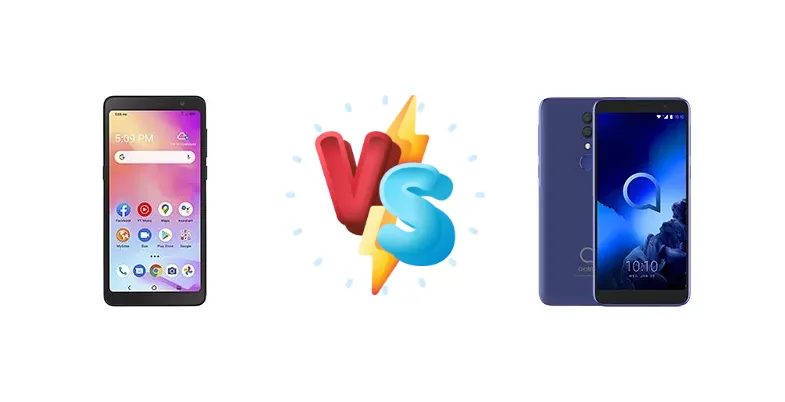
The TCL A3 and Alcatel 1x (2019) represent the extreme end of the smartphone price spectrum. Both aim to deliver basic functionality at an incredibly low cost, but significant differences in their underlying hardware dictate vastly different user experiences. This comparison dissects those differences, focusing on where the A3’s newer chipset justifies a potential price premium.
🏆 Quick Verdict
For the average user prioritizing responsiveness and future-proofing, the TCL A3 is the clear winner. Its Mediatek Helio P22 chipset, built on a 12nm process, offers a substantial performance advantage over the Alcatel 1x’s older, 28nm MT6739. While both phones are limited in features, the A3 provides a smoother, more usable experience.
| Network |
|---|
| 2G bands | GSM 850 / 900 / 1800 / 1900 | GSM 850 / 900 / 1800 / 1900 |
| 3G bands | HSDPA 850 / 1700(AWS) / 1900 | HSDPA 850 / 900 / 1700(AWS) / 1900 / 2100 - 5059A |
| 4G bands | 2, 4, 5, 13, 66 | 1, 3, 5, 7, 8, 28, 38, 40 - 5008T |
| Speed | HSPA 42.2/5.76 Mbps, LTE Cat4 150/50 Mbps | HSPA 42.2/5.76 Mbps, LTE Cat4 150/50 Mbps |
| Technology | GSM / CDMA / HSPA / LTE | GSM / HSPA / LTE |
| | - | 1, 3, 7, 8, 20, 28 - 5008Y |
| Launch |
|---|
| Announced | 2021, October | 2019, January. Released 2019, Q1 |
| Status | Available. Released 2021, October | Discontinued |
| Body |
|---|
| Dimensions | 145.8 x 71.1 x 9.9 mm (5.74 x 2.80 x 0.39 in) | 146.4 x 68.8 x 8.3 mm (5.76 x 2.71 x 0.33 in) |
| SIM | Nano-SIM | · Nano-SIM· Nano-SIM + Nano-SIM |
| Weight | 171 g (6.03 oz) | 130 g (4.59 oz) |
| Display |
|---|
| Resolution | 720 x 1440 pixels, 18:9 ratio (~293 ppi density) | 720 x 1440 pixels, 18:9 ratio (~293 ppi density) |
| Size | 5.5 inches, 78.1 cm2 (~75.3% screen-to-body ratio) | 5.5 inches, 78.1 cm2 (~77.5% screen-to-body ratio) |
| Type | TFT LCD | IPS LCD |
| Platform |
|---|
| CPU | Octa-core 2.0 GHz Cortex-A53 | Quad-core 1.5 GHz Cortex-A53 |
| Chipset | Mediatek MT6762 Helio P22 (12 nm) | Mediatek MT6739 (28 nm) |
| GPU | PowerVR GE8320 | PowerVR GE8100 |
| OS | Android 11 | Android 8.1 (Oreo) |
| Memory |
|---|
| Card slot | microSDXC (dedicated slot) | microSDXC |
| Internal | 32GB 3GB RAM | 16GB 2GB RAM |
| | - | eMMC 5.1 |
| Main Camera |
|---|
| Dual | - | 13 MP
2 MP |
| Features | LED flash | LED flash, HDR |
| Single | 8 MP, 1/4.0", 1.12µm | - |
| Video | 1080p@30fps | 1080p@30fps |
| Selfie camera |
|---|
| Features | - | LED flash |
| Single | 5 MP, 1/5.0", 1.12µm | 5 MP |
| Video | 1080p@30fps | 720p |
| Sound |
|---|
| 3.5mm jack | - | Yes |
| 35mm jack | Yes | Yes |
| Loudspeaker | Yes | Yes |
| Comms |
|---|
| Bluetooth | 5.0, A2DP, LE | 4.2, A2DP, LE |
| NFC | No | No |
| Positioning | GPS | GPS |
| Radio | Unspecified | FM radio |
| USB | microUSB 2.0 | microUSB 2.0 |
| WLAN | Wi-Fi 802.11 b/g/n, Wi-Fi Direct | Wi-Fi 802.11 b/g/n, Wi-Fi Direct |
| Features |
|---|
| Sensors | Accelerometer, proximity | Fingerprint (rear-mounted, 5008T only), accelerometer, proximity |
| Battery |
|---|
| Type | Li-Ion 3000 mAh, removable | Li-Ion 3000 mAh, removable |
| Misc |
|---|
| Colors | Black | Pebble Blue, Pebble Black |
| Models | A509DL | 5008T, 5008Y, 5008U, 5008R, 5008D_EEA, 5008Y_EEA, 5008D |
| Price | About 40 EUR | About 120 EUR |
TCL A3
- Significantly faster processor for smoother performance
- More power-efficient chipset for longer battery life
- Improved image processing capabilities
- Better potential for software updates
- Likely higher price point than the Alcatel 1x
- Still a budget device with limited features
alcatel 1x (2019)
- Extremely affordable price
- Basic functionality for calls and texts
- Simple and easy-to-use interface
- Lightweight and portable
- Slow and laggy performance
- Poor battery life due to inefficient chipset
- Limited camera quality
- Likely limited software support
Display Comparison
Neither TCL nor Alcatel provide detailed display specifications for these models. However, given their price points, both likely utilize IPS LCD panels with 720p+ resolutions. The key difference lies in the processing power driving them. The A3’s Helio P22 has a more capable GPU, potentially resulting in smoother scrolling and transitions. Bezels are expected to be substantial on both devices, reflecting their budget nature. Color accuracy is unlikely to be a strong point on either.
Camera Comparison
Both phones likely feature basic camera setups. Detailed sensor information is unavailable, but it’s safe to assume both rely on low-resolution primary sensors. Focusing on megapixel counts would be misleading; the image signal processor (ISP) within the chipset plays a far more significant role. The Helio P22 in the A3 has a more advanced ISP, enabling better image processing, noise reduction, and dynamic range. While neither phone will produce flagship-level photos, the A3 will likely deliver noticeably better results, particularly in challenging lighting conditions. Any secondary cameras (depth or macro) on either device are likely to be of minimal quality.
Performance
The TCL A3’s Mediatek MT6762 Helio P22 is the defining advantage in this comparison. Its octa-core Cortex-A53 CPU clocked at 2.0 GHz significantly outperforms the Alcatel 1x’s quad-core 1.5 GHz Cortex-A53 processor. Crucially, the Helio P22 is fabricated on a 12nm process, compared to the MT6739’s 28nm node. This smaller process node translates to improved power efficiency and reduced heat generation, meaning the A3 is less likely to throttle under sustained load. Users will experience faster app launch times, smoother multitasking, and a more responsive overall experience with the A3. The Alcatel 1x will struggle with even moderately demanding applications.
Battery Life
Battery capacity details are missing for both devices. However, the A3’s more efficient 12nm chipset will undoubtedly contribute to longer battery life, even if the Alcatel 1x has a slightly larger battery. The MT6739’s 28nm process is inherently less power-efficient. Charging speeds are also likely to be slow on both devices, given their budget positioning. The A3’s improved power management will likely result in a more consistent user experience throughout the day.
Buying Guide
Buy the TCL A3 if you need a smartphone capable of handling everyday tasks like social media, messaging, and light web browsing without significant lag. It’s a better choice for users who anticipate keeping their phone for more than a year. Buy the Alcatel 1x (2019) if you absolutely need the cheapest possible smartphone for basic calling and texting, and are willing to accept noticeable performance limitations and a shorter lifespan.
Frequently Asked Questions
❓ Will the TCL A3 be able to run popular social media apps like Facebook and Instagram smoothly?
Yes, the TCL A3’s Helio P22 chipset is sufficiently powerful to run most popular social media apps without significant lag. While it won’t offer a flagship-level experience, it will provide a usable and responsive experience for everyday social media browsing.
❓ Is the Alcatel 1x (2019) suitable for playing mobile games?
The Alcatel 1x (2019) is not well-suited for gaming. Its MT6739 chipset is underpowered and will struggle with even basic 3D games. Expect low frame rates, stuttering, and long loading times. It’s best reserved for very simple, 2D games.
❓ How long will software updates be supported on the TCL A3 compared to the Alcatel 1x?
TCL generally provides longer software support for its devices than Alcatel. While neither phone is likely to receive major Android version updates, the A3 is more likely to receive security patches and minor updates for a longer period, enhancing its long-term security and usability.
❓ Does the TCL A3 support 4G LTE connectivity for faster data speeds?
Yes, the Mediatek Helio P22 chipset in the TCL A3 includes a 4G LTE modem, enabling faster data speeds compared to older 3G networks. The Alcatel 1x (2019) also supports 4G LTE, but the A3’s more efficient chipset will likely result in better battery life while using data.