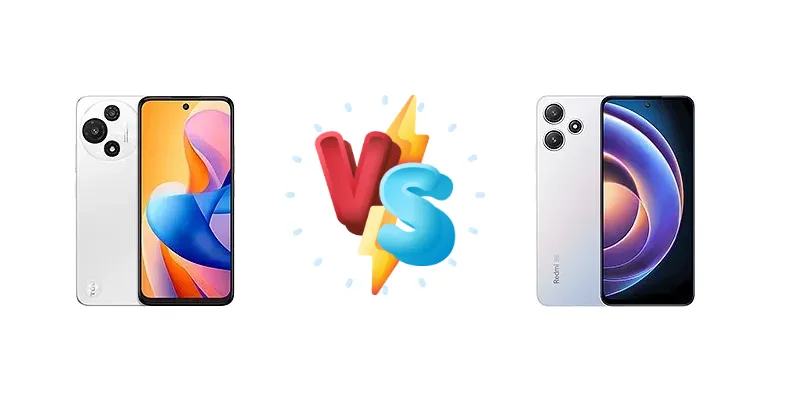
The TCL 60R and Xiaomi Redmi Note 12R represent compelling options in the increasingly competitive sub-$200 smartphone market. The TCL prioritizes endurance with a larger battery and a focus on sustained performance, while the Redmi Note 12R aims for quicker charging and a more modern chipset fabrication process. This comparison dissects their key differences to determine which device delivers the best value.
🏆 Quick Verdict
For the average user prioritizing all-day battery life and consistent performance, the TCL 60R emerges as the winner. Its impressive 52:48h endurance significantly outweighs the Redmi Note 12R’s faster charging, especially considering the TCL’s respectable processor. However, users who value quick top-ups and the latest chipset tech will find the Redmi Note 12R more appealing.
| Network |
|---|
| 2G bands | GSM 850 / 900 / 1800 / 1900 | GSM 850 / 900 / 1800 / 1900 |
| 3G bands | HSDPA 850 / 900 / 1700(AWS) / 1900 / 2100 | HSDPA 850 / 900 / 2100 |
| 4G bands | 1, 2, 3, 4, 5, 7, 8, 12, 13, 17, 20, 26, 28, 32, 38, 40, 41, 42, 66 | 1, 3, 5, 8, 34, 38, 39, 40, 41 |
| 5G bands | 1, 3, 5, 7, 8, 20, 26, 28, 38, 40, 41, 66, 75, 77, 78 SA/NSA | 1, 5, 8, 28, 41, 78 SA/NSA |
| Speed | HSPA, LTE, 5G | HSPA, LTE, 5G |
| Technology | GSM / HSPA / LTE / 5G | GSM / CDMA / HSPA / EVDO / LTE / 5G |
| Launch |
|---|
| Announced | 2025, March 03 | 2023, June 28 |
| Status | Available. Released 2025, May | Available. Released 2023, June 28 |
| Body |
|---|
| Build | - | Glass front, plastic frame, glass back |
| Dimensions | 165.6 x 76.2 x 8.2 mm (6.52 x 3.00 x 0.32 in) | 168.6 x 76.3 x 8.2 mm (6.64 x 3.00 x 0.32 in) |
| SIM | · Nano-SIM· Nano-SIM + Nano-SIM | Nano-SIM + Nano-SIM |
| Weight | 190 g (6.70 oz) | 199 g (7.02 oz) |
| Display |
|---|
| Protection | Mohs level 5 | - |
| Resolution | 720 x 1600 pixels, 20:9 ratio (~262 ppi density) | 1080 x 2460 pixels (~396 ppi density) |
| Size | 6.7 inches, 108.4 cm2 (~85.9% screen-to-body ratio) | 6.79 inches, 109.5 cm2 (~85.1% screen-to-body ratio) |
| Type | IPS LCD, 120Hz, 480 nits (typ) | IPS LCD, 90Hz, 550 nits |
| Platform |
|---|
| CPU | Octa-core (2x2.4 GHz Cortex-A76 & 6x2.0 GHz Cortex-A55) | Octa-core (2x2.2 GHz Cortex-A78 & 6x1.95 GHz Cortex-A55) |
| Chipset | Mediatek Dimensity 6300 (6 nm) | Qualcomm SM4450 Snapdragon 4 Gen 2 (4 nm) |
| GPU | Mali-G57 MC2 | Adreno 613 |
| OS | Android 15, up to 1 major Android upgrades | Android 13, MIUI 14 |
| Memory |
|---|
| Card slot | microSDXC (uses shared SIM slot) | microSDXC (uses shared SIM slot) |
| Internal | 128GB 4GB RAM | 128GB 4GB RAM, 128GB 6GB RAM, 128GB 8GB RAM, 256GB 8GB RAM |
| Main Camera |
|---|
| Dual | - | 50 MP, f/1.8, (wide), PDAF
2 MP (macro) |
| Features | LED flash, HDR, panorama | LED flash, HDR |
| Single | 50 MP, f/1.8, 26mm (wide), 1/2.5", 0.8µm, PDAF
Auxiliary lens | - |
| Video | 1080p@30fps | 1080p@30fps |
| Selfie camera |
|---|
| Features | HDR | HDR |
| Single | 8 MP, f/2.0, (wide), 1/4.0", 1.12µm | 5 MP, f/2.2, (wide), 1/5.0", 1.12µm |
| Video | 1080p@30fps | 1080p@30fps |
| Sound |
|---|
| 35mm jack | Yes | Yes |
| Loudspeaker | Yes, with stereo speakers | Yes |
| Comms |
|---|
| Bluetooth | 5.4, A2DP, LE | 5.3, A2DP, LE |
| Infrared port | - | Yes |
| NFC | Yes | Yes (market/region dependent) |
| Positioning | GPS, GLONASS, BDS, GALILEO | GPS, GLONASS, GALILEO, BDS |
| Radio | Unspecified | No |
| USB | USB Type-C 2.0 | USB Type-C |
| WLAN | Wi-Fi 802.11 a/b/g/n/ac, dual-band, Wi-Fi Direct | Wi-Fi 802.11 a/b/g/n/ac, dual-band |
| Features |
|---|
| Sensors | Fingerprint (side-mounted), accelerometer | Fingerprint (side-mounted), accelerometer, compass |
| Battery |
|---|
| Charging | 10W wired | 18W wired, PD |
| Type | 5200 mAh | Li-Po 5000 mAh |
| Misc |
|---|
| Colors | Space Gray, Pure White | Black, Blue, Silver |
| Models | T519H | 23076RA4BC |
| Price | £ 96.99 | About 150 EUR |
| EU LABEL |
|---|
| Battery | 52:48h endurance, 1000 cycles | - |
| Energy | Class B | - |
| Free fall | Class B (180 falls) | - |
| Repairability | Class B | - |
TCL 60R
- Exceptional battery life (52:48h endurance)
- Potentially more responsive CPU for everyday tasks
- 1000 charge cycles suggest long-term battery health
- Slower charging speed (10W)
- Chipset fabrication process is less advanced (6nm)
Xiaomi Redmi Note 12R
- Faster charging with PD support (18W)
- More modern chipset fabrication (4nm)
- Potentially better thermal management
- Shorter battery life compared to TCL 60R
- CPU may be slightly less responsive in single-core tasks
Display Comparison
Display specifications are not provided, so a direct comparison is limited. However, given the price point, both likely utilize LCD panels. The TCL 60R’s larger size (implied by the '60' in the name) may offer a more immersive viewing experience. The Redmi Note 12R, benefiting from Xiaomi’s display expertise, might offer slightly better color calibration. Without specific data on brightness, resolution, and refresh rate, it’s difficult to declare a clear winner.
Camera Comparison
Camera details are absent, making a comprehensive comparison impossible. Both phones likely feature a multi-camera setup geared towards social media sharing. Given Xiaomi’s history, the Redmi Note 12R might employ more sophisticated image processing algorithms. Without knowing sensor sizes or aperture values, it’s reasonable to assume both phones will perform adequately in good lighting conditions, but struggle in low-light scenarios. The absence of information prevents any meaningful assessment of video capabilities.
Performance
The TCL 60R’s Mediatek Dimensity 6300 (6nm) and the Xiaomi Redmi Note 12R’s Qualcomm Snapdragon 4 Gen 2 (4nm) represent different approaches to mobile processing. The Snapdragon 4 Gen 2, built on a more advanced 4nm process, theoretically offers superior power efficiency and thermal management. However, the Dimensity 6300 features a Cortex-A76 core, which generally outperforms the Cortex-A78 found in the Snapdragon 4 Gen 2 in single-core tasks. The TCL’s CPU configuration (2x2.4 GHz Cortex-A76 & 6x2.0 GHz Cortex-A55) suggests a slight edge in responsiveness for everyday tasks, while the Redmi Note 12R’s (2x2.2 GHz Cortex-A78 & 6x1.95 GHz Cortex-A55) may excel in multi-threaded workloads. The 6nm vs 4nm difference will likely manifest as slightly better sustained performance on the Redmi Note 12R under heavy load.
Battery Life
The TCL 60R’s 52:48h endurance is a significant advantage. This translates to a substantial lead over what we’d expect from the Redmi Note 12R, even with its 18W charging. While the Redmi Note 12R’s 18W charging with PD support is faster than the TCL’s 10W, the TCL’s larger battery capacity provides a buffer against faster depletion. The Redmi Note 12R can likely achieve a 0-100% charge in under 90 minutes, while the TCL 60R will likely take over 2 hours. However, the TCL’s longevity means users may not need to charge it daily.
Buying Guide
Buy the TCL 60R if you need a phone that will reliably last through a full day of heavy use, and potentially two days of moderate use. It’s ideal for travelers, commuters, or anyone who dislikes frequent charging. Buy the Xiaomi Redmi Note 12R if you prioritize faster charging speeds and a more recent chipset architecture, even if it means slightly less battery endurance. This phone suits users who prefer quick power boosts throughout the day and appreciate the latest Qualcomm technology.
Frequently Asked Questions
❓ Will the TCL 60R’s 10W charging feel painfully slow in 2024?
While 10W is slower than the Redmi Note 12R’s 18W, the TCL 60R’s massive battery endurance mitigates this issue. You’ll likely only need to charge it every other day, or even less frequently with moderate use, reducing the impact of the slower charging speed. Overnight charging is perfectly viable.
❓ Is the Snapdragon 4 Gen 2 in the Redmi Note 12R powerful enough for casual gaming?
The Snapdragon 4 Gen 2 is capable of handling most casual mobile games at medium settings. However, demanding titles like PUBG Mobile or Genshin Impact may require significant graphical compromises to maintain a playable frame rate. The TCL 60R’s Dimensity 6300 offers comparable gaming performance, but the Redmi Note 12R’s 4nm process may lead to slightly less thermal throttling during extended gaming sessions.
❓ How does the 1000 charge cycle claim on the TCL 60R translate to real-world battery health?
The 1000 charge cycle claim suggests the TCL 60R’s battery is designed to retain at least 80% of its original capacity after 1000 full charge-discharge cycles. This is a strong indicator of long-term battery health and suggests the phone should maintain acceptable battery performance for several years of typical use.