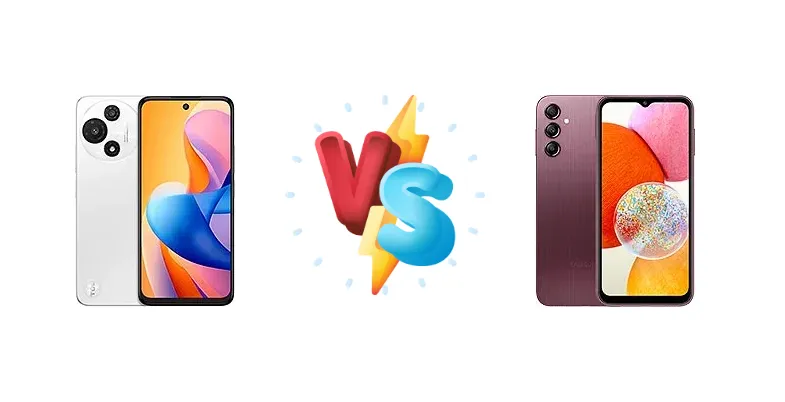
The sub-$200 smartphone market is fiercely competitive. The TCL 60R, with its newer Mediatek Dimensity 6300 chipset, enters the arena challenging Samsung’s established Galaxy A14, which offers a choice between the Helio G80 and Exynos 850. This comparison dissects the key differences to determine which device delivers the best value for budget-conscious consumers.
🏆 Quick Verdict
For most users, the TCL 60R emerges as the stronger contender. Its more modern and efficient Dimensity 6300 chipset, coupled with impressive 52:48h battery endurance, provides a smoother overall experience and longer usability than either version of the Galaxy A14. While the A14 offers Samsung’s brand recognition, the 60R’s performance edge is significant.
| Network |
|---|
| 2G bands | GSM 850 / 900 / 1800 / 1900 | GSM 850 / 900 / 1800 / 1900 |
| 3G bands | HSDPA 850 / 900 / 1700(AWS) / 1900 / 2100 | HSDPA 850 / 900 / 2100 |
| 4G bands | 1, 2, 3, 4, 5, 7, 8, 12, 13, 17, 20, 26, 28, 32, 38, 40, 41, 42, 66 | 1, 3, 5, 7, 8, 20, 28, 38, 40, 41 |
| 5G bands | 1, 3, 5, 7, 8, 20, 26, 28, 38, 40, 41, 66, 75, 77, 78 SA/NSA | - |
| Speed | HSPA, LTE, 5G | HSPA, LTE |
| Technology | GSM / HSPA / LTE / 5G | GSM / HSPA / LTE |
| Launch |
|---|
| Announced | 2025, March 03 | 2023, February 28 |
| Status | Available. Released 2025, May | Available. Released 2023, March 27 |
| Body |
|---|
| Build | - | Glass front, plastic back, plastic frame |
| Dimensions | 165.6 x 76.2 x 8.2 mm (6.52 x 3.00 x 0.32 in) | 167.7 x 78 x 9.1 mm (6.60 x 3.07 x 0.36 in) |
| SIM | · Nano-SIM· Nano-SIM + Nano-SIM | · Nano-SIM· Nano-SIM + Nano-SIM |
| Weight | 190 g (6.70 oz) | 201 g (7.09 oz) |
| Display |
|---|
| Protection | Mohs level 5 | - |
| Resolution | 720 x 1600 pixels, 20:9 ratio (~262 ppi density) | 1080 x 2408 pixels, 20:9 ratio (~400 ppi density) |
| Size | 6.7 inches, 108.4 cm2 (~85.9% screen-to-body ratio) | 6.6 inches, 104.9 cm2 (~80.2% screen-to-body ratio) |
| Type | IPS LCD, 120Hz, 480 nits (typ) | PLS LCD |
| Platform |
|---|
| CPU | Octa-core (2x2.4 GHz Cortex-A76 & 6x2.0 GHz Cortex-A55) | Octa-core (2x2.0 GHz Cortex-A75 & 6x1.8 GHz Cortex-A55) - Version AOcta-core (4x2.0 GHz Cortex-A55 & 4x2.0 GHz Cortex-A55) - Version B |
| Chipset | Mediatek Dimensity 6300 (6 nm) | Mediatek MT6769 Helio G80 (12 nm) - Version AExynos 850 (8 nm) - Version B |
| GPU | Mali-G57 MC2 | Mali-G52 MC2 |
| OS | Android 15, up to 1 major Android upgrades | Android 13, upgradable to Android 15, One UI 7 |
| Memory |
|---|
| Card slot | microSDXC (uses shared SIM slot) | microSDXC (dedicated slot) |
| Internal | 128GB 4GB RAM | 64GB 4GB RAM, 128GB 4GB RAM, 128GB 6GB RAM |
| Main Camera |
|---|
| Features | LED flash, HDR, panorama | LED flash, panorama, HDR |
| Single | 50 MP, f/1.8, 26mm (wide), 1/2.5", 0.8µm, PDAF
Auxiliary lens | 13 MP, f/2.0, (wide) |
| Triple | - | 50 MP, f/1.8, 26mm (wide), 1/2.75", 0.64µm, PDAF
5 MP, f/2.2, 17mm (ultrawide), 1/5.0", 1.12µm
2 MP (macro) |
| Video | 1080p@30fps | 1080p@30fps |
| Selfie camera |
|---|
| Features | HDR | - |
| Single | 8 MP, f/2.0, (wide), 1/4.0", 1.12µm | 13 MP, f/2.0, 26mm (wide), 1/3.1", 1.12µm |
| Video | 1080p@30fps | 1080p@30fps |
| Sound |
|---|
| 3.5mm jack | - | Yes |
| 35mm jack | Yes | Yes |
| Loudspeaker | Yes, with stereo speakers | Yes |
| Comms |
|---|
| Bluetooth | 5.4, A2DP, LE | 5.1 or 5.3, A2DP, LE |
| NFC | Yes | Yes (market/region dependent) |
| Positioning | GPS, GLONASS, BDS, GALILEO | GPS, GALILEO, GLONASS, BDS, QZSS |
| Radio | Unspecified | Unspecified |
| USB | USB Type-C 2.0 | USB Type-C 2.0 |
| WLAN | Wi-Fi 802.11 a/b/g/n/ac, dual-band, Wi-Fi Direct | Wi-Fi 802.11 a/b/g/n/ac, dual-band, Wi-Fi Direct |
| Features |
|---|
| Sensors | Fingerprint (side-mounted), accelerometer | Fingerprint (side-mounted), accelerometer, proximity, compass |
| Battery |
|---|
| Charging | 10W wired | 15W wired |
| Type | 5200 mAh | Li-Po 5000 mAh |
| Misc |
|---|
| Colors | Space Gray, Pure White | Black, Dark Red, Silver, Green |
| Models | T519H | SM-A145F, SM-A145F/DSN, SM-A145M, SM-A145M/DS, SM-A145P, SM-A145R |
| Price | £ 96.99 | € 85.76 / $ 147.60 / £ 79.95 |
| SAR EU | - | 0.46 W/kg (head) 1.37 W/kg (body) |
| EU LABEL |
|---|
| Battery | 52:48h endurance, 1000 cycles | - |
| Energy | Class B | - |
| Free fall | Class B (180 falls) | - |
| Repairability | Class B | - |
TCL 60R
- Superior chipset performance (Dimensity 6300)
- Exceptional battery endurance (52:48h)
- More efficient 6nm process
- Slower charging speed (10W)
- Less established brand recognition
Samsung Galaxy A14
- Samsung’s One UI software experience
- Potential for 5G connectivity (depending on variant)
- Wider brand availability
- Less powerful chipset (Helio G80/Exynos 850)
- Lower battery endurance
- Variable CPU configuration depending on version
Display Comparison
Neither device boasts a premium display. Both are likely to utilize LCD panels, though specific details like peak brightness are unavailable. The TCL 60R’s larger 6.58-inch screen versus the A14’s 6.6-inch offers a marginally more immersive experience. However, the real difference lies under the hood. The Dimensity 6300’s integrated display engine may offer slightly better image processing, but without detailed panel specs, this remains speculative. Bezels are expected to be comparable, typical of this price bracket.
Camera Comparison
Camera performance is difficult to assess without sample images. Both phones likely feature a primary camera alongside depth and macro sensors. The TCL 60R’s sensor size is unknown, but the focus should be on the primary lens quality. The Galaxy A14’s camera setup is similarly shrouded in detail. The 2MP macro cameras on both devices are largely marketing filler and offer limited practical value. Image processing will be a key differentiator; Samsung’s software typically prioritizes vibrant colors, while TCL’s approach is less defined. Without detailed sensor specs, the TCL 60R’s advantage, if any, is likely tied to the Dimensity 6300’s image signal processor (ISP).
Performance
The TCL 60R’s Mediatek Dimensity 6300 (6nm) is the clear winner in this category. Built on a more advanced 6nm process compared to the Galaxy A14’s Helio G80 (12nm) or Exynos 850 (8nm), the Dimensity 6300 offers superior power efficiency and processing capabilities. The Cortex-A76 cores in the 6300 are a generation ahead of the A75 cores in the Helio G80, translating to faster app loading and smoother multitasking. Even against the Exynos 850, the 6nm process and newer architecture give the 6300 an edge. The A14’s CPU configuration varies; the A75/A55 pairing in the Helio G80 version is more capable than the all-A55 configuration in some Exynos 850 variants. However, neither A14 configuration matches the 6300’s overall performance.
Battery Life
The TCL 60R’s 52:48h endurance rating is a standout feature. This suggests excellent power efficiency, directly attributable to the Dimensity 6300’s 6nm process. The Galaxy A14, while likely possessing a comparable battery capacity (specific mAh not provided), suffers from the less efficient Helio G80 or Exynos 850 chipsets. The A14’s 15W charging is slightly faster than the 60R’s 10W, but the difference is unlikely to offset the 60R’s significantly longer runtime. Users prioritizing all-day (and beyond) battery life will strongly favor the TCL 60R.
Buying Guide
Buy the TCL 60R if you prioritize sustained performance for everyday tasks and longer battery life. It’s ideal for users who stream videos, browse the web, and occasionally game. Buy the Samsung Galaxy A14 if you are deeply embedded in the Samsung ecosystem, value the One UI software experience, or find a significantly lower price point that outweighs the performance difference. The A14’s availability of both 4G and 5G variants also offers flexibility.
Frequently Asked Questions
❓ Does the Exynos 850 version of the Galaxy A14 significantly outperform the Helio G80 version?
The Exynos 850 is generally more efficient and offers slightly better CPU performance than the Helio G80. However, the difference isn't massive, and both are still outclassed by the TCL 60R’s Dimensity 6300. The Exynos 850’s 8nm process provides a modest improvement over the Helio G80’s 12nm, but the architectural advantages of the Dimensity 6300 are more impactful.
❓ Is the 10W charging on the TCL 60R a significant drawback?
While 10W charging is slower than the Galaxy A14’s 15W, the TCL 60R’s exceptional battery life mitigates this concern. The phone’s long endurance means you’ll need to charge it less frequently, reducing the impact of the slower charging speed. Overnight charging is perfectly viable, and the efficiency of the Dimensity 6300 minimizes heat generation during charging.
❓ Will the TCL 60R handle demanding games like PUBG Mobile?
The TCL 60R’s Dimensity 6300 can run PUBG Mobile, but expect to play at medium settings for a smooth experience. The chipset isn’t designed for ultra-high frame rates or graphics. The Galaxy A14, even with the Exynos 850, will likely offer a similar gaming experience, though potentially with more noticeable frame drops under sustained load.