
TCL 60R vs Google Pixel 7a: A Deep Dive into Budget and Mid-Range Contenders
| Phones Images | |||||
|---|---|---|---|---|---|
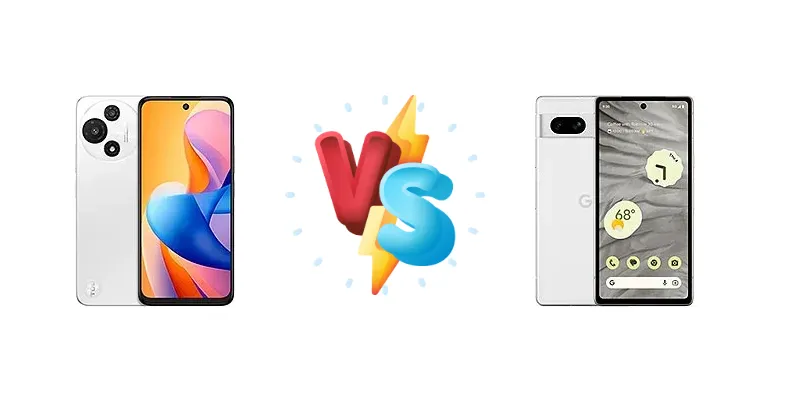
|
🏆 Quick Verdict
For the average user prioritizing battery life and value, the TCL 60R emerges as the winner. Its exceptional 52:48h endurance rating and lower price point outweigh the Pixel 7a’s superior processing power and camera features. However, the Pixel 7a is the better choice for those deeply invested in the Google ecosystem and demanding a more refined software experience.
| PHONES | ||
|---|---|---|
| Phone Names | TCL 60R | Google Pixel 7a |
| Network | ||
|---|---|---|
| 2G bands | GSM 850 / 900 / 1800 / 1900 | GSM 850 / 900 / 1800 / 1900 |
| 3G bands | HSDPA 850 / 900 / 1700(AWS) / 1900 / 2100 | HSDPA 800 / 850 / 900 / 1700(AWS) / 1900 / 2100 |
| 4G bands | 1, 2, 3, 4, 5, 7, 8, 12, 13, 17, 20, 26, 28, 32, 38, 40, 41, 42, 66 | 1, 2, 3, 4, 5, 7, 8, 12, 13, 14, 17, 20, 25, 26, 28, 29, 30, 38, 40, 41, 48, 66, 71 - GWKK3, G0DZQ |
| 5G bands | 1, 3, 5, 7, 8, 20, 26, 28, 38, 40, 41, 66, 75, 77, 78 SA/NSA | 1, 2, 3, 5, 7, 8, 12, 14, 20, 25, 28, 30, 38, 41, 48, 66, 71, 77, 78 SA/NSA/Sub6 - GWKK3 |
| Speed | HSPA, LTE, 5G | HSPA, LTE, 5G |
| Technology | GSM / HSPA / LTE / 5G | GSM / HSPA / LTE / 5G |
| - | 1, 2, 3, 5, 7, 8, 12, 20, 25, 28, 38, 40, 41, 66, 75, 76, 77, 78, 79 SA/NSA/Sub6 - GHL1X, G82U8 | |
| Launch | ||
|---|---|---|
| Announced | 2025, March 03 | 2023, May 10 |
| Status | Available. Released 2025, May | Available. Released 2023, May 10 |
| Body | ||
|---|---|---|
| Build | - | Glass front (Gorilla Glass 3), aluminum frame, plastic back |
| Dimensions | 165.6 x 76.2 x 8.2 mm (6.52 x 3.00 x 0.32 in) | 152 x 72.9 x 9 mm (5.98 x 2.87 x 0.35 in) |
| SIM | · Nano-SIM· Nano-SIM + Nano-SIM | Nano-SIM + eSIM |
| Weight | 190 g (6.70 oz) | 193.5 g (6.84 oz) |
| - | IP67 dust/water resistant (up to 1m for 30 min) | |
| Display | ||
|---|---|---|
| Protection | Mohs level 5 | Corning Gorilla Glass 3 |
| Resolution | 720 x 1600 pixels, 20:9 ratio (~262 ppi density) | 1080 x 2400 pixels, 20:9 ratio (~429 ppi density) |
| Size | 6.7 inches, 108.4 cm2 (~85.9% screen-to-body ratio) | 6.1 inches, 90.7 cm2 (~81.8% screen-to-body ratio) |
| Type | IPS LCD, 120Hz, 480 nits (typ) | OLED, HDR, 90Hz |
| - | Always-on display | |
| Platform | ||
|---|---|---|
| CPU | Octa-core (2x2.4 GHz Cortex-A76 & 6x2.0 GHz Cortex-A55) | Octa-core (2x2.85 GHz Cortex-X1 & 2x2.35 GHz Cortex-A78 & 4x1.80 GHz Cortex-A55) |
| Chipset | Mediatek Dimensity 6300 (6 nm) | Google Tensor G2 (5 nm) |
| GPU | Mali-G57 MC2 | Mali-G710 MP7 |
| OS | Android 15, up to 1 major Android upgrades | Android 13, upgradable to Android 15, up to 5 major Android upgrades |
| Memory | ||
|---|---|---|
| Card slot | microSDXC (uses shared SIM slot) | No |
| Internal | 128GB 4GB RAM | 128GB 8GB RAM |
| - | UFS 3.1 | |
| Main Camera | ||
|---|---|---|
| Dual | - | 64 MP, f/1.9, 26mm (wide), 1/1.73", 0.8µm, dual pixel PDAF, OIS 13 MP, f/2.2, 120˚ (ultrawide), 1.12µm |
| Features | LED flash, HDR, panorama | Dual-LED flash, Pixel Shift, Auto-HDR, panorama |
| Single | 50 MP, f/1.8, 26mm (wide), 1/2.5", 0.8µm, PDAF Auxiliary lens | - |
| Video | 1080p@30fps | 4K@30/60fps, 1080p@30/60/120/240fps, OIS |
| Selfie camera | ||
|---|---|---|
| Features | HDR | HDR, panorama |
| Single | 8 MP, f/2.0, (wide), 1/4.0", 1.12µm | 13 MP, f/2.2, 20mm (ultrawide), 1.12µm |
| Video | 1080p@30fps | 4K@30fps, 1080p@30fps |
| Sound | ||
|---|---|---|
| 3.5mm jack | - | No |
| 35mm jack | Yes | No |
| Loudspeaker | Yes, with stereo speakers | Yes, with stereo speakers |
| Comms | ||
|---|---|---|
| Bluetooth | 5.4, A2DP, LE | 5.3, A2DP, LE |
| NFC | Yes | Yes |
| Positioning | GPS, GLONASS, BDS, GALILEO | GPS, GLONASS, GALILEO, BDS, QZSS, NavIC |
| Radio | Unspecified | No |
| USB | USB Type-C 2.0 | USB Type-C 3.2 |
| WLAN | Wi-Fi 802.11 a/b/g/n/ac, dual-band, Wi-Fi Direct | Wi-Fi 802.11 a/b/g/n/ac/6e, tri-band |
| Features | ||
|---|---|---|
| Sensors | Fingerprint (side-mounted), accelerometer | Fingerprint (under display, optical), accelerometer, gyro, proximity, compass, barometer |
| Battery | ||
|---|---|---|
| Charging | 10W wired | 18W wired, PD3.0 7.5W wireless |
| Type | 5200 mAh | Li-Po 4385 mAh |
| Misc | ||
|---|---|---|
| Colors | Space Gray, Pure White | Charcoal, Snow, Sea, Coral |
| Models | T519H | GWKK3, GHL1X, G0DZQ, G82U8 |
| Price | £ 96.99 | € 179.90 / $ 150.00 / £ 170.00 / ₹ 25,980 |
| EU LABEL | ||
|---|---|---|
| Battery | 52:48h endurance, 1000 cycles | - |
| Energy | Class B | - |
| Free fall | Class B (180 falls) | - |
| Repairability | Class B | - |
TCL 60R
- Exceptional battery life (52:48h endurance)
- More affordable price point
- Decent performance for everyday tasks
- Slower charging speed (10W)
- Less powerful chipset compared to Pixel 7a
- Camera likely inferior to Pixel 7a
Google Pixel 7a
- Powerful Google Tensor G2 chipset
- Excellent camera quality and features
- Bright and vibrant OLED display
- Shorter battery life compared to TCL 60R
- Higher price point
- Wireless charging is slow (7.5W)
Display Comparison
The Pixel 7a boasts a significantly brighter display, reaching a measured 1070 nits, compared to the TCL 60R’s unspecified brightness. This translates to superior visibility in direct sunlight. While the TCL 60R’s panel technology isn’t detailed, the Pixel 7a’s OLED panel offers richer colors and deeper blacks. The Pixel 7a’s smaller size (6.1” vs 6.56”) also contributes to a higher pixel density, potentially resulting in a sharper image, though this is less impactful than the brightness difference. Bezels are likely comparable given the price points, and color accuracy data is unavailable for both.
Camera Comparison
The Pixel 7a’s camera system is a key differentiator. While specific sensor sizes aren’t provided, Google’s computational photography prowess, powered by the Tensor G2, elevates image quality significantly. The Pixel 7a excels in low-light photography and offers advanced features like Magic Eraser and Photo Unblur. The TCL 60R’s camera capabilities are less defined, and likely focus on providing acceptable results in good lighting conditions. The absence of details regarding OIS on the TCL 60R suggests it may struggle with image stabilization in challenging scenarios. The Pixel 7a’s video recording capabilities are also expected to be superior, benefiting from the Tensor G2’s image signal processor.
Performance
The Google Pixel 7a’s Tensor G2 chipset, fabricated on a 5nm process, offers a clear performance advantage over the TCL 60R’s Mediatek Dimensity 6300 (6nm). The Tensor G2’s CPU configuration – 2x2.85 GHz Cortex-X1, 2x2.35 GHz Cortex-A78, and 4x1.80 GHz Cortex-A55 – is more powerful than the Dimensity 6300’s 2x2.4 GHz Cortex-A76 & 6x2.0 GHz Cortex-A55. This difference is particularly noticeable in demanding tasks like video editing and gaming. The 5nm process also contributes to better thermal efficiency, potentially reducing throttling during sustained workloads. While both phones likely feature adequate RAM, the Pixel 7a’s optimized software and tighter hardware-software integration provide a smoother overall experience.
Battery Life
The TCL 60R’s standout feature is its exceptional battery endurance, rated at 52:48h. This is significantly longer than the Pixel 7a’s older 76h rating. While the Pixel 7a supports faster wired charging at 18W with PD3.0 and 7.5W wireless charging, the TCL 60R is limited to 10W wired charging. However, the TCL 60R’s larger battery capacity and efficient chipset likely offset the slower charging speed for most users. The Pixel 7a’s wireless charging is a convenience feature, but the TCL 60R’s longevity is a more substantial benefit for power users.
Buying Guide
Buy the TCL 60R if you need a phone that lasts all day (and then some) on a single charge, and if maximizing value for your money is paramount. It’s ideal for users who primarily browse, stream media, and engage in light social media use. Buy the Google Pixel 7a if you prioritize camera quality, a smooth and responsive user interface powered by Google’s Tensor G2, and access to timely software updates and exclusive Pixel features. It’s best suited for photography enthusiasts and those who rely heavily on Google services.